Nikon engineers have found a smarter way to improve focus precision, not by stopping lens vibrations, but by outsmarting them. When you’re shooting handheld, tracking a moving subject, or walking with a gimbal, autofocus is under pressure. And even the best lenses struggle to stay perfectly locked when the camera, and everything inside the lens, starts to move. Nikon’s latest patent, titled LENS BARREL AND IMAGING APPARATUS, offers a mechanical yet elegant solution. Instead of trying to cancel out the vibration entirely, Nikon proposes a smarter trick: place the focus sensor where the vibration naturally cancels itself out. That one small shift could make autofocus much more accurate during kinetic shots.
Autofocus Can Struggle in Real-World Motion
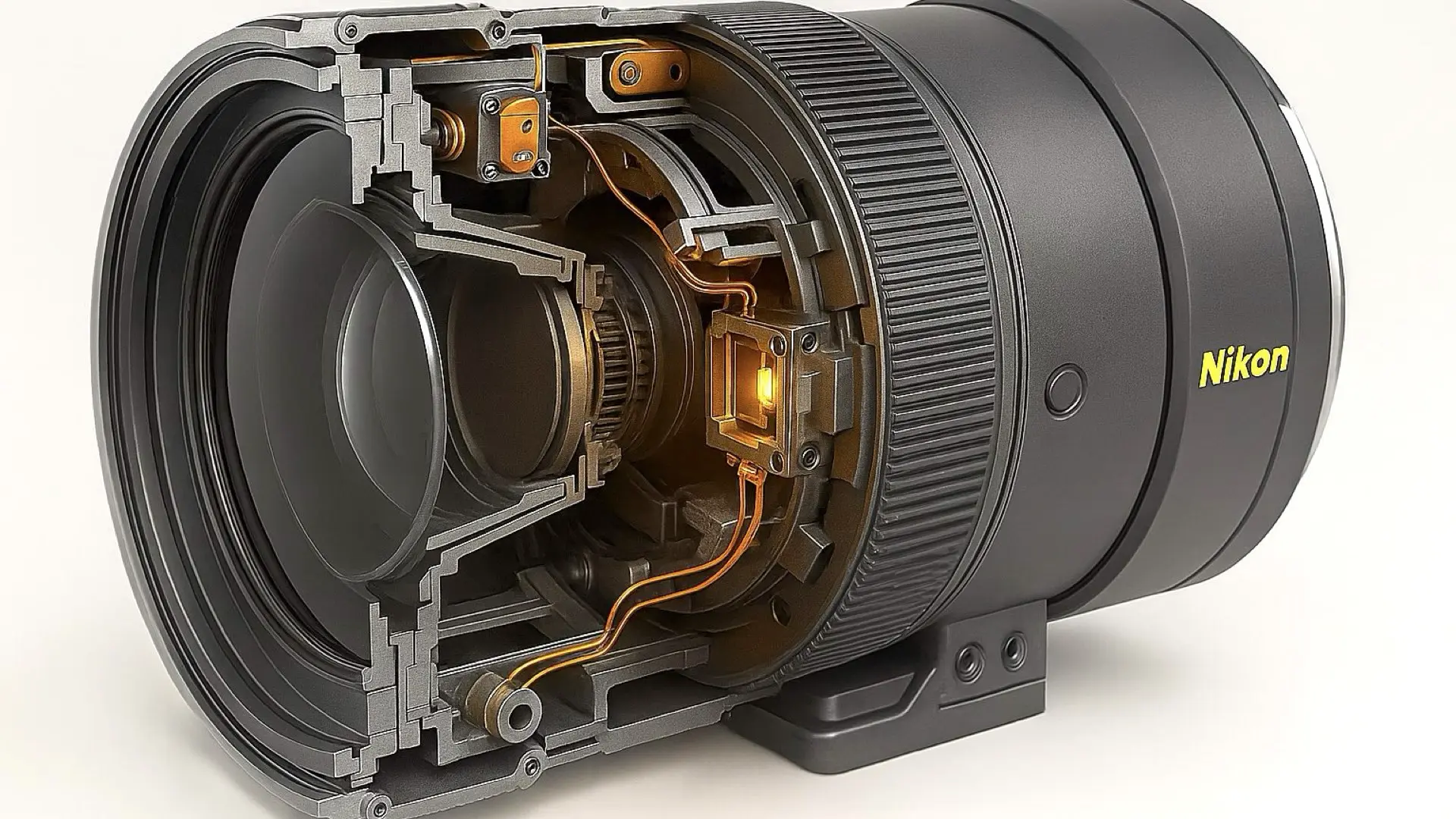
Inside every modern lens, especially those designed for mirrorless systems and video shooting, there’s a lot going on. Lenses use small motors, in Nikon’s case, quiet and fast Voice Coil Motors (VCMs), to move internal glass elements and achieve focus. These elements are held in place by a sliding frame and driven forward or backward depending on the subject distance. But here’s the problem: every time the focus motor moves, it creates tiny vibrations inside the lens barrel. And when the whole camera is also moving, say, during handheld filming or dolly tracking, those internal vibrations become harder to control. That’s where autofocus starts to drift. The camera relies on precise readings from a position detection system, a sensor that constantly tracks where the internal focus group is located. But if the lens starts vibrating, the sensor can misread the position. Even a tiny shift causes autofocus to slow down, hunt, or fall short of tack-sharp accuracy.
Nikon’s Solution: Use the Physics of Vibration to Their Advantage
Nikon’s engineers ran simulations on how their lens holding frame and focus group behave during motion. They discovered that the most disruptive internal vibration, known as mode 2, happening at around 264 Hz, causes the lens group to sway slightly. But they also noticed something important: there’s a specific line inside the lens structure that stays almost completely still during that vibration. It’s called a node. Rather than fight the vibration directly, Nikon decided to mount the position sensor’s scale exactly at that node. That way, even if the rest of the lens is vibrating, the point where the sensor reads movement stays calm and stable. By reading from a physically “quiet” part of the lens, Nikon’s design ensures autofocus remains accurate even when the system is under motion. It’s a smart solution to a mechanical problem, and it avoids the need for more complex compensation systems or software tricks.
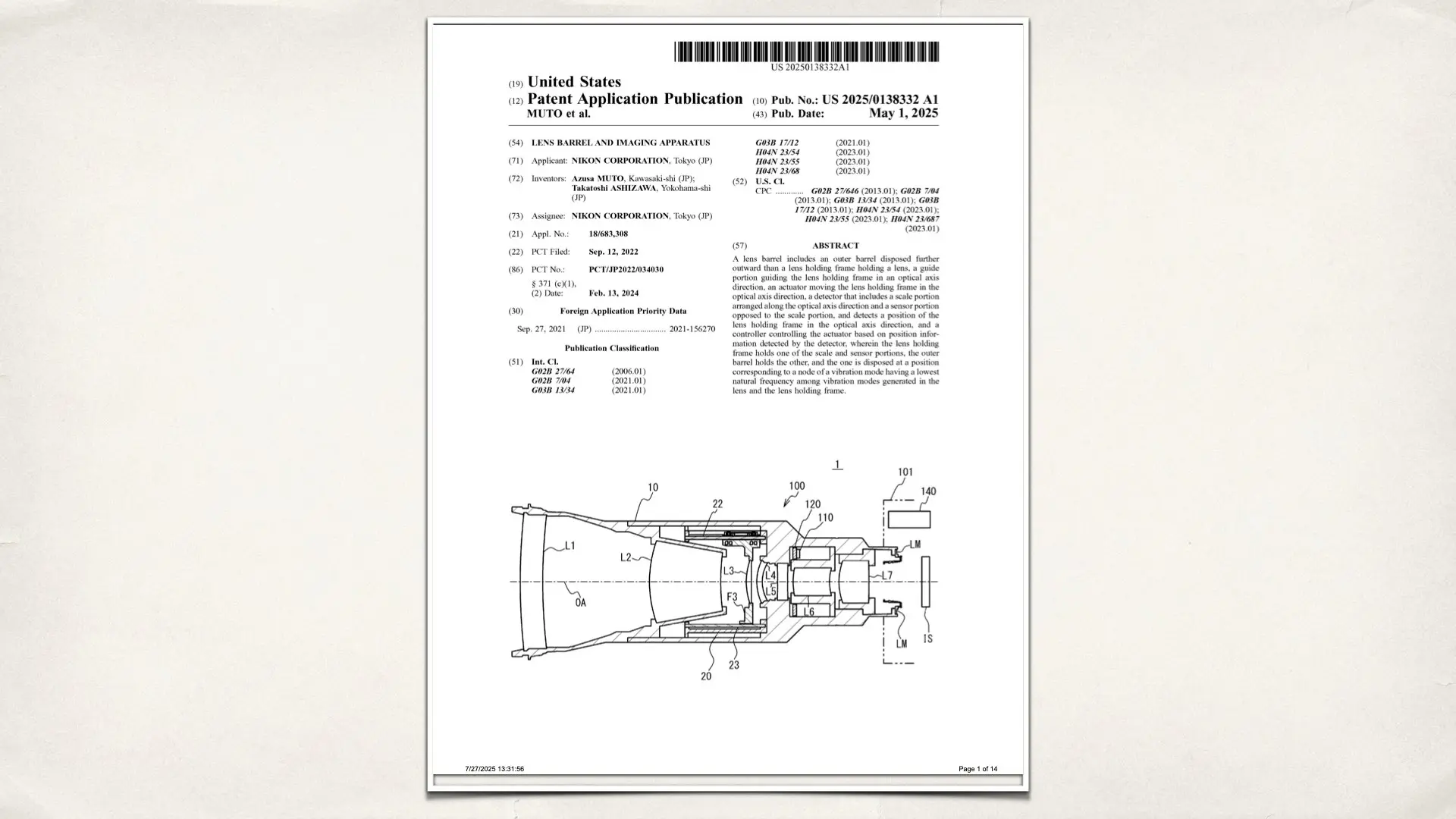
A lens barrel includes an outer barrel disposed further outward than a lens holding frame holding a lens, a guide portion guiding the lens holding frame in an optical axis direction, an actuator moving the lens holding frame in the optical axis direction, a detector that includes a scale portion arranged along the optical axis direction and a sensor portion opposed to the scale portion, and detects a position of the lens holding frame in the optical axis direction, and a controller controlling the actuator based on position information detected by the detector, wherein the lens holding frame holds one of the scale and sensor portions, the outer barrel holds the other, and the one is disposed at a position corresponding to a node of a vibration mode having a lowest natural frequency among vibration modes generated in the lens and the lens holding frame.
-From Nikon’s patent “LENS BARREL AND IMAGING APPARATUS”
So What Does This Mean for Filmmakers?
If you’re shooting static landscapes with a tripod, this might not change much. But for filmmakers, documentarians, hybrid shooters, vloggers, and event cinematographers, this is a real upgrade. The patent improves how focus behaves when the camera is moving fast, whether you’re walking with a gimbal, running after a subject, or riding in a car. Since the system can avoid the unstable vibration mode, Nikon can now let the autofocus control loop run at a higher frequency, up to around 96 Hz. That means: smoother continuous tracking, faster subject reacquisition, and less focus drift in shaky environments. It’s all about making the lens more intelligent in how it handles its own physical behavior.
A Closer Look: What the Patent Describes in Simple Terms
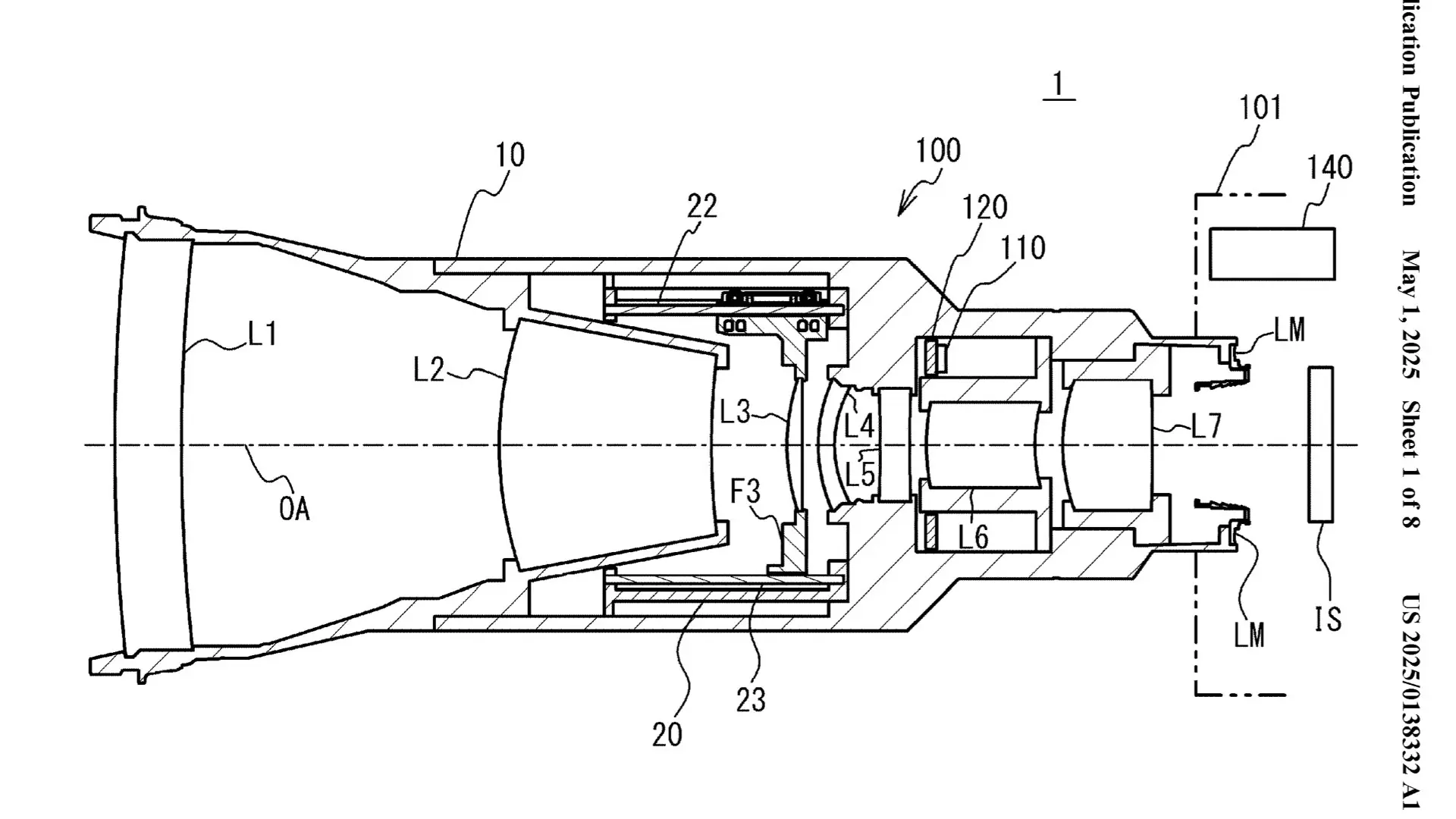
Here’s what Nikon’s patent is actually about, broken down: The lens contains a moving lens group that handles focus. It’s guided by rails and powered by tiny voice coil motors. A position sensor tells the system where this lens group is, using a sensor and a scale, one mounted to the moving part, one to the stationary part. Now, when the camera moves or the lens motor kicks in, the internal lens group shakes. If the sensor is mounted in a spot that moves during that shake, it reports inaccurate data. So Nikon simulated those movements, pinpointed the spot inside the lens that doesn’t move — the node — and placed the sensor’s scale there. This doesn’t eliminate vibration, but it neutralizes its effect on autofocus. The result: precise lens group positioning, even when the rest of the system is bouncing around.
The patent also allows for:
-
A dual-sensor configuration to further enhance stability
-
Optimized placement of internal wiring using flexible boards
-
A design that’s compatible with both single-focus and zoom lenses
It’s a physical, engineering-level improvement, not a software patch, and it shows how much Nikon is thinking ahead for hybrid and video-focused creators.

A Small Detail with Big Impact
This patent might not sound flashy. There’s no new lens name or headline feature. But innovations like this are what make a lens feel solid, responsive, and reliable in the field. Whether Nikon introduces this in a new prime, a high-end cine zoom, or a next-gen Nikkor Z lens, it’s clear they’re thinking about how to make autofocus smarter, and not just faster. They didn’t add more parts. They just put the right part in the right place. That’s clever engineering.

Nikon Is Clearly Pushing Forward
This patent is part of a much larger picture. Since acquiring RED, Nikon has been quietly but steadily expanding its influence in cinema technology, not just in lenses, but across image pipelines and sensor design. If you’re tracking Nikon’s recent moves, it’s clear they’re aiming to become a serious player in pro video. For example, they’ve been exploring a potential RAW imaging workflow inspired by RED’s tech. You can read more about that in our coverage here: Is Nikon Building a New RAW Workflow with RED’s Tech?. They’re also developing infrared-sensitive sensors that could enable bold new possibilities for specialty cinematography: Nikon’s New Patent Hints at Cinema-Ready IR Sensor Innovation. And if you’re in the market for their current lenses, don’t miss our regularly updated roundup of the best Nikon lens deals available right now: Top Nikon Lens Deals on Amazon — The Best Glass at the Best Price. All signs point to Nikon taking cinema seriously. Watch this space. And let’s be honest, with Canon working on compact cinema zoom tech of its own, it’s starting to feel like we’re witnessing a full-on lens patent war between Nikon and Canon… and honestly, we’re here for it.