
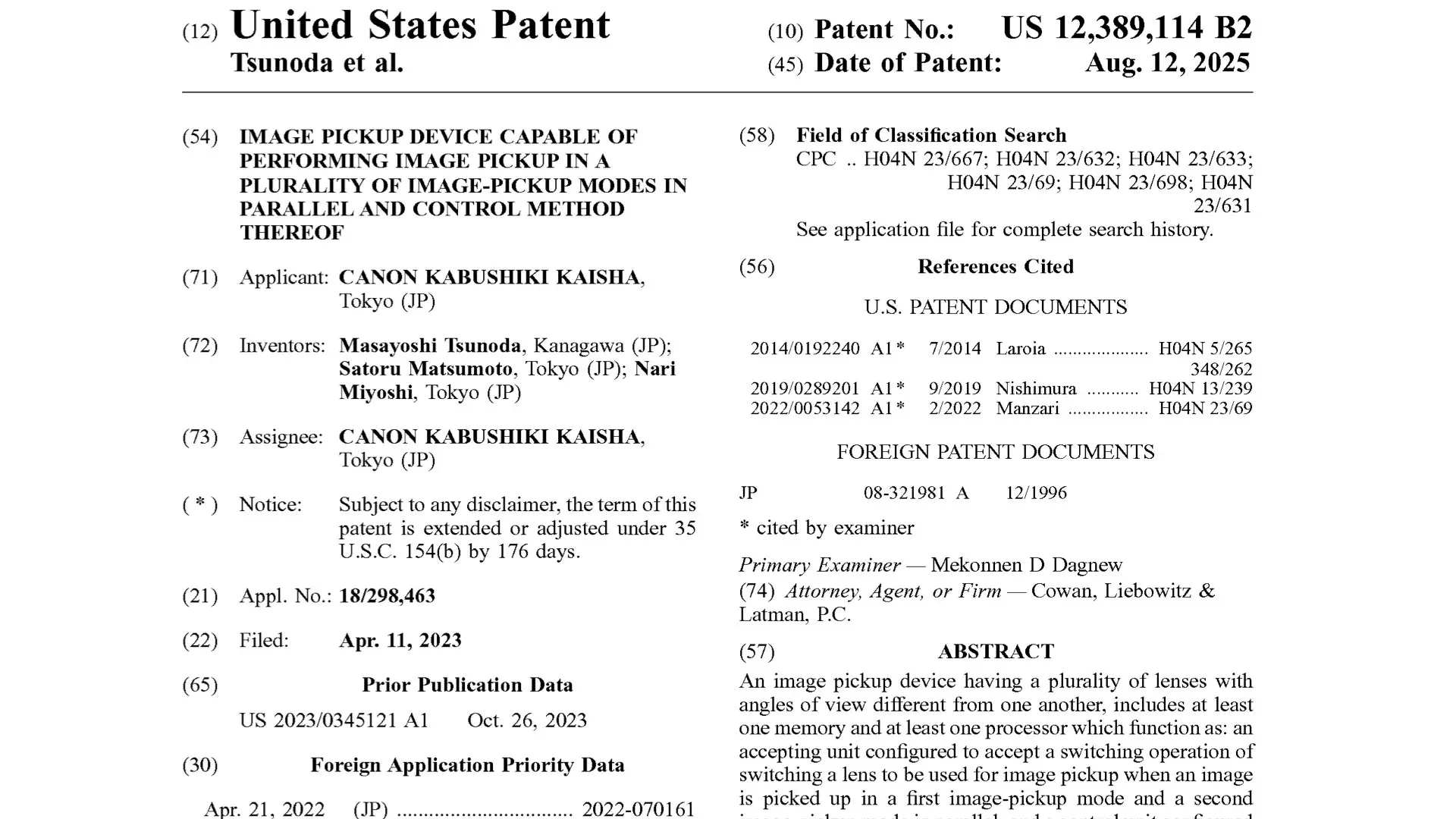
Canon’s latest patent application, titled “Image Pickup Device Capable Of Performing Image Pickup In A Plurality Of Image-pickup Modes In Parallel And Control Method Thereof”, shows something more than a modest incremental camera tweak. Hidden inside its dense technical jargon and flowcharts lies something far more intriguing, perhaps even revolutionary: a solid hint that Canon is preparing to enter the high-end cinematic smartphone market. Let’s dive in!

A Patent That Reads Like a Smartphone Blueprint
Canon’s new filing is titled “Image Pickup Device Capable of Performing Image Pickup in a Plurality of Image-Pickup Modes in Parallel and Control Method Thereof”.
If that sounds like legal-technical soup, here’s the plain English version:
It’s a camera system that can record video and still photos at the same time, using different lenses for each, and lets you switch between them without stopping the recording.
Think about shooting a live concert, you’re filming in wide angle, but you also want high-resolution stills from a telephoto perspective. On today’s smartphones, switching lenses usually causes a momentary blackout or forces one mode to stop. This patent solves that problem completely.
Why the Smartphone Clues Are Impossible to Ignore
The first thing that jumps out: every single diagram in this patent is a smartphone.
Not a generic camera body. Not a camcorder. Not a mirrorless shape. A phone — complete with:
-
Front and rear cameras
-
Volume buttons
-
A touchscreen interface
-
On-screen controls for switching lenses and modes
In patents, illustrations aren’t chosen at random. If Canon wanted this to look universal, they’d show a plain rectangle with a lens. Instead, they’ve drawn a full smartphone form factor, down to UI elements that mimic mobile camera apps. That’s like a chef leaving breadcrumbs to the kitchen.
The Core Technology
Imagine you’re in a photography class. Your teacher puts two cameras on the table, one with a telephoto lens, one with a wide lens.
“Now,” the teacher says, “I want you to take a portrait and a wide shot at the same time… without moving your feet, without stopping, and without missing a moment.”
With normal gear, that’s impossible unless you have two shooters. Canon’s patent describes a virtual “dual camera” setup inside a single device. Each “camera” has its own lens module and sensor, running in parallel:
-
One handles still photography.
-
The other handles video recording.
When you switch lenses in one mode, the system automatically reassigns a different lens to the other mode so they never clash, no interruptions, no “stopping the video to take a photo.” It’s not just a clever trick. It’s a fundamental change in how multi-lens cameras can work together.

Why This Screams “High-End Cinema Smartphone”
If you strip this idea to its core, the biggest beneficiary isn’t a Canon EOS R5C or C70. Those already have full manual lens control and continuous capture.
The real battlefield is smartphones — where:
-
Multiple fixed lenses (wide, ultra-wide, tele) are the norm
-
Computational photography drives market competition
-
Mobile creators demand seamless still/video workflows
This patent would allow a smartphone to function like a mini multi-cam rig, ideal for cinematic mobile filmmaking:
-
Shoot a 4K or even 8K video with one lens while pulling RAW stills from another
-
Switch focal lengths mid-shot without the jarring “lens jump” seen on most phones
-
Create synchronized multi-perspective footage in one take
For mobile filmmaking, that’s gold. For Canon, it’s a way to merge its legendary color science, lens expertise, and pro video know-how into a form factor that’s already in everyone’s pocket.

Canon’s Possible Market Play
This wouldn’t be the first time a camera brand flirted with phones: Sony’s Xperia Pro and Zeiss’s ZX1 are examples. But Canon’s approach here feels different.
-
Patent scope: It explicitly applies to “any electronic device,” but the examples are all smartphones.
-
Technical fit: Canon’s computational video experience from their cinema lineup could leapfrog the smartphone competition.
-
Brand impact: A Canon phone could instantly appeal to mobile filmmakers, journalists, and content creators who want pro-level quality without hauling a full rig.
There are two possible strategies:
-
Canon makes its own smartphone which is risky, but disruptive.
-
Canon partners with a smartphone OEM: think Canon camera tech inside a premium Android flagship.
Either route would shake up both the smartphone and cinema worlds.
Why Filmmakers Should Care
A Canon cinema-capable smartphone could mean:
-
True Canon color science in a pocket device
-
High-bitrate recording with pro codecs
-
Seamless switching between focal lengths during filming
-
Dual-stream capture for instant A/B camera angles
-
Canon lens branding, even potential for modular lens accessories

Final Take: A Smoking Gun or a Clever Mock-Up?
Could the smartphone drawings be a placeholder? Yes. But the sheer detail in the mobile form factor, the explicit multi-lens control flow, and the direct targeting of mobile shooting problems make this feel like more than a coincidence. If Canon is indeed preparing its first cinema-capable smartphone, this patent is our first clear window into it. And if that’s true, the next wave of mobile filmmaking could come with a red Canon logo on the back. Your move, Canon.







Not sure why you’re hyping up the whole “Dual-stream capture for instant A/B camera angles” of all things, where that’s been possible on iPhones for FIVE PLUS YEARS. 🙄
iPhones have had multi-cam recording for years, however, Canon’s approach in this patent is different, aiming for pro-level control, lens switching without interruption.
Cheers!
Surely you’re not suggesting that it would be anything other than a virtual ‘flip of a switch’ for Apple – or any other phone maker, for that matter – to implement everything on your list?
After all, iPhones *already* have advanced (HDR) color science and high-bitrate (LOG) recording with a professional codec, not to mention the huge market for modular lens accessories that already exists. The idea of implementing switching between focal lengths during filming and even more advanced dual-stream capture seems utterly paltry in comparison.
Not to mention that there is already FOUR-camera multicam recording for iPhones. Albeit requiring as many phones, but that only shows that all the puzzle pieces are in place should they even consider it a feature worth implementing.
But hey, competition is always good, so let’s see Canon go for it!