

Overheating has been the silent enemy of hybrid cameras. Long 8K or high-fps takes often force recording limits, with hot media cards becoming the weakest link. While Fujifilm’s large GFX cameras already manage heat through their sheer body volume and magnesium frames, the company’s smaller X-series models don’t have that luxury. A new Fujifilm patent reveals a clever solution: an integrated airflow and heat dissipation system designed specifically for compact mirrorless cameras.

The problem with small hybrid bodies
In high-resolution video modes, heat builds quickly inside smaller housings. The image processor, the sensor, and especially the recording medium (CFexpress or XQD cards) generate continuous thermal load. Today’s X-series cameras rely on bolt-on accessories like the FAN-001 to keep running during long takes. That approach is practical but not elegant, and it limits reliability for filmmakers who need uninterrupted capture.
What the patent describes
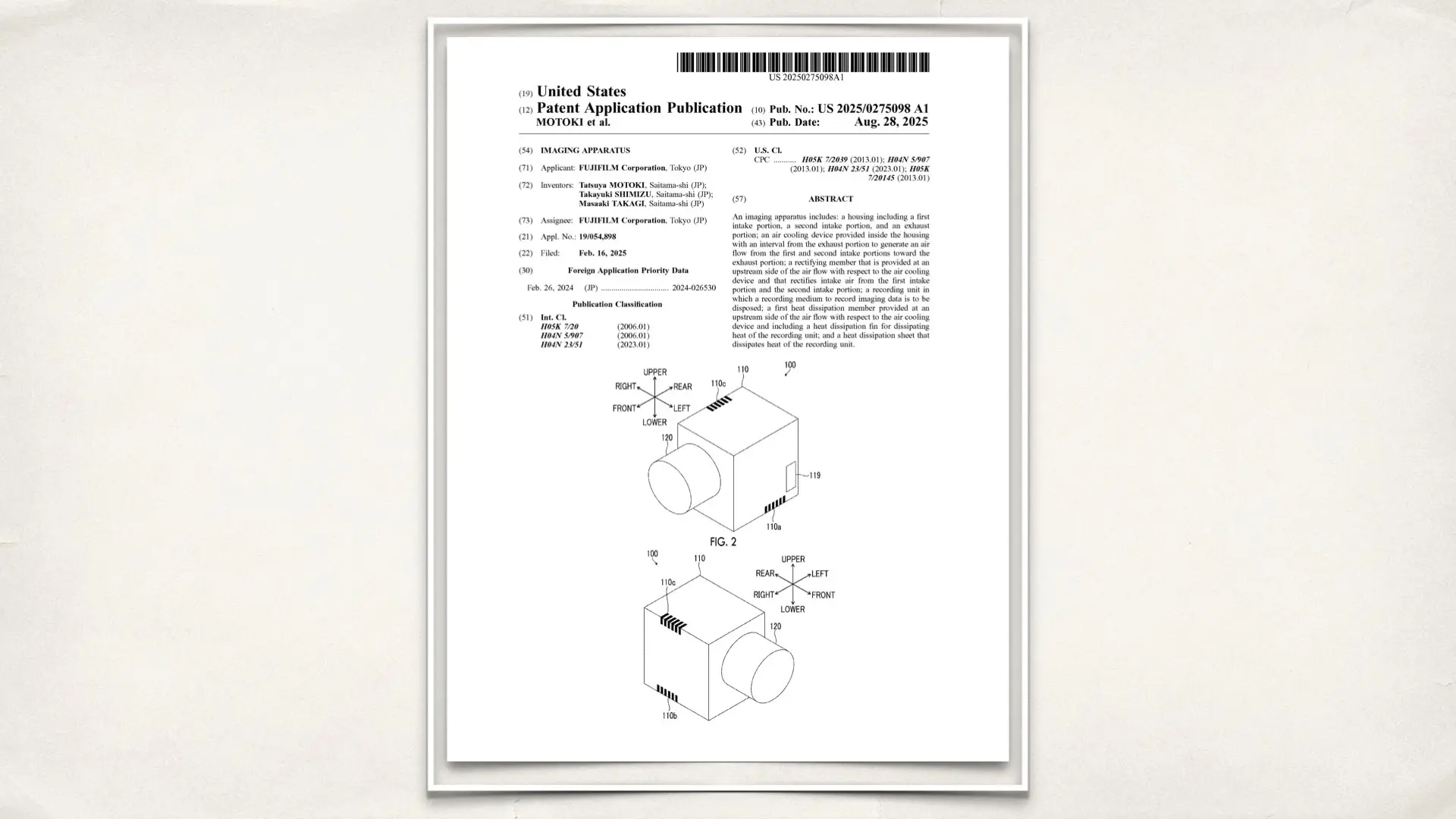
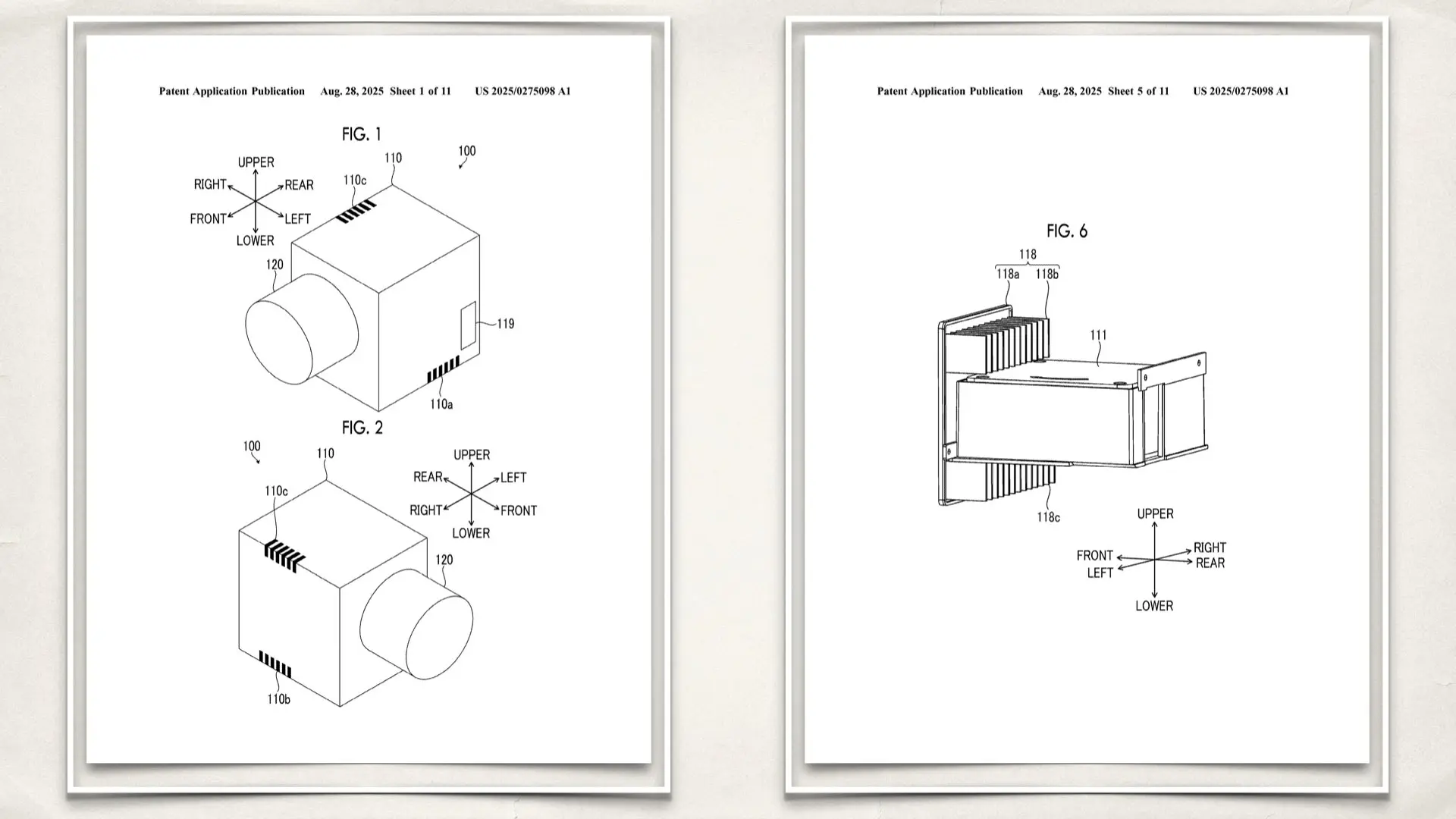
The filing shows a housing with two intakes at the bottom and a single exhaust at the top right, creating a vertical airflow. A central cooling fan sits away from the exhaust, so that components in between are actively bathed in moving air. A small rectifying ridge inside the body pushes intake air upward into the fan, ensuring even circulation.
The real innovation is focused on the recording unit:
-
A finned heat sink cools the controller board that writes data.
-
A thin graphite or metal sheet wicks heat away from the card slot and even its lid, dispersing thermal load across the chassis.
-
Different fin orientations and spacings are used for separate components to avoid turbulence and interference between heat flows.
-
The image sensor’s companion electronics are cooled by dual fin stacks with the fan partially between them, saving space while keeping temperatures stable.
Why this matters
CFexpress cards are notorious for heating up under sustained 8K or ProRes recording. Once the card bay reaches critical temperature, the whole system throttles or stops. Fujifilm’s patent directly targets this failure point. By splitting the card bay cooling into a heat sink for the electronics and a graphite sheet for the media cage, the design ensures the camera can maintain data rates without forcing a stop. This approach is different from GFX cameras, which solve heat dissipation through sheer size. Here, Fujifilm is miniaturizing pro-level cooling into a smaller body, likely signaling the next generation of X-H cameras or even a new flagship X-mount hybrid.
The bigger picture
If implemented, this design would put Fujifilm alongside Canon and Sony, who have also filed patents for internal cooling architectures. But the emphasis on recording media stability is unusual and directly relevant to filmmakers working with high-bitrate codecs. It shows Fujifilm understands that reliability is no longer about just the sensor or processor but the entire data path.

Final thought
Patents are never guarantees of shipping products. Still, the detail in this filing, down to fin orientation, graphite sheet placement, and door conduction, suggests Fujifilm is preparing its smaller cameras for true long-form, high-data-rate video without external fans. For filmmakers, that could mean the next X-H body runs cooler, longer, and more quietly, finally closing the gap between compact hybrids and dedicated cinema cameras.











I laugh when I read “ patent” and Fuji in the same sentence. You copied emulsion codes with such stunning accuracy you added the tracers we used for global tracking. We knew, we always knew, in a better world you would have been punished for patent infringement.