

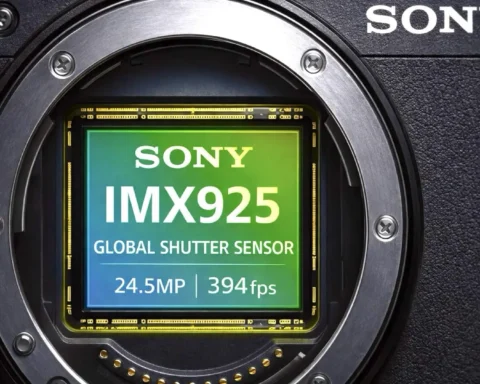
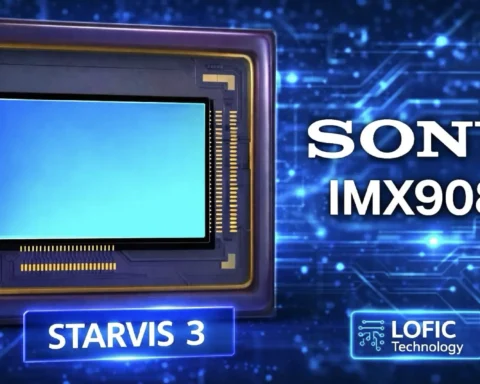
Sony has quietly revealed a new large-format global shutter image sensor, the IMX928, and the implications reach far beyond industrial imaging. The publication of an official Sony technical flyer confirms a sensor that pushes size, speed, and architecture into territory that cinema cameras have long aimed for. The IMX928 is positioned as an industrial and machine vision sensor, yet many of its design choices intersect directly with challenges that cinema cameras still struggle to solve today. Global shutter performance at large formats, high resolution without rolling shutter artifacts, and extreme readout speed are all areas where cinema has historically made compromises. All details are below:

The IMX928: A large format global shutter sensor
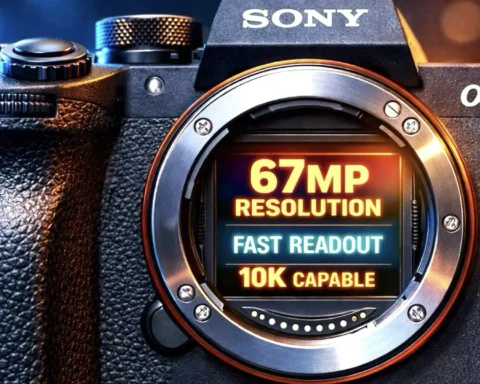
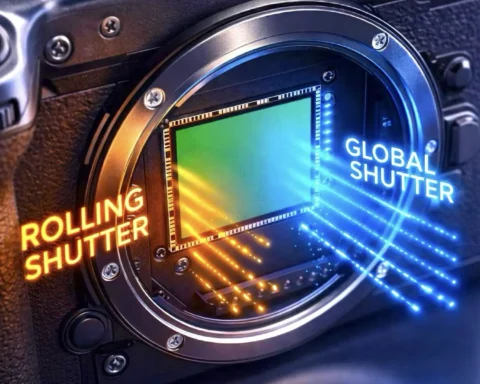
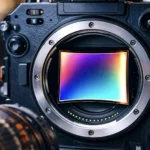
The IMX928 uses a Type 2.0 optical format with a diagonal of 31.9 mm. This places it well beyond Super 35 and very close to full frame territory, but with a geometry that is far more flexible. The sensor is square, measuring roughly 8280 by 8280 effective pixels, resulting in approximately 68.5 megapixels of usable resolution. This square layout is not a novelty. It enables significant overscan, reframing, and multi-aspect delivery without sacrificing image area. For cinema, this is particularly relevant in a world where the same footage is increasingly repurposed for theatrical, streaming, vertical, and immersive formats. More importantly, this large surface area is paired with a true global shutter. Every pixel is exposed simultaneously, eliminating rolling shutter distortion entirely. Large-format global shutter sensors remain extremely rare, especially at this resolution and speed.

Built on Pregius S global shutter technology
IMX928 is based on Sony’s Pregius S architecture, a stacked global shutter design where signal processing circuitry is placed beneath the photodiode layer. This approach allows Sony to maintain high sensitivity and low noise while preserving the advantages of global shutter operation. Historically, global shutter sensors have suffered from reduced dynamic range and increased noise compared to rolling shutter designs. Pregius S represents Sony’s attempt to close that gap, and IMX928 is one of the largest and fastest examples of that technology to date.

Speed is the defining characteristic
What immediately stands out in the IMX928 specifications is the readout speed. At full resolution, the sensor can reach approximately 138.9 frames per second at 8-bit, 126.8 frames per second at 10-bit, and 90.6 frames per second at 12-bit output. Even more striking is the half-resolution subsampling mode, where frame rates exceed 270 frames per second. These numbers are achieved while maintaining global shutter operation across the entire sensor area. For cinema applications, this level of performance suggests future possibilities for high-speed capture without the visual penalties of rolling shutter skew, partial readout, or aggressive cropping.
Pixel size and optical considerations
Each pixel measures 2.74 micrometers, a size that balances resolution with sensitivity. Combined with the stacked architecture and low dark current characteristics described by Sony, the IMX928 is clearly optimized for precision imaging under demanding conditions. Sony also specifies a chief ray angle target of 6 degrees at full image height. This relatively conservative CRA suggests compatibility with high-quality optics and reduced shading or color shift toward the edges, another consideration that aligns with cinema lens requirements.
Data throughput and system design
IMX928 uses the SLVS EC interface with up to dual 8 lane configurations and per lane speeds reaching 12.474 Gbps. This level of bandwidth is necessary to sustain the extreme data rates generated by such a large and fast sensor. While this interface is common in industrial systems, it also mirrors the kind of high-throughput pipelines required by modern cinema cameras. As processing and storage technology continue to evolve, sensors like IMX928 provide a glimpse into what future cinema platforms may be designed around.

Implications for cinema
Sony does not describe the IMX928 as a cinema sensor, and it is unlikely to appear directly in a consumer or professional cinema camera in its current form. However, Sony has a long history of introducing breakthrough sensor technologies in industrial or scientific markets before adapting them for cinema. The relevance of IMX928 lies in what it proves is now possible. A large format sensor with true global shutter, high resolution, and extremely fast readout is no longer theoretical. The engineering tradeoffs that once limited such designs are being steadily reduced. This context is especially important when viewed alongside Sony’s previously announced large-format global shutter sensor, the IMX927. That sensor, covered in depth in YMCinema’s article “Sony’s 10K Global Shutter Large Format Sensor,” established Sony’s intent to push global shutter technology into resolutions and formats once reserved for rolling shutter designs. IMX928 strengthens that narrative. Together, these sensors suggest a clear direction for Sony’s imaging roadmap, one where global shutter is no longer confined to small formats or niche applications.

Possible solutions
Sony’s decision to publish a detailed technical flyer rather than stage a formal announcement reflects the sensor’s industrial positioning. Yet the information disclosed is substantial, concrete, and forward-looking. For filmmakers, cinematographers, and camera designers, IMX928 is about understanding where sensor technology is headed. Large format, high-speed, global shutter imaging is moving from experimental to practical. IMX928 may not be a cinema sensor today, but it clearly outlines the technological foundation on which future cinema cameras could be built. Sony has repeatedly used industrial and scientific sensors as proving grounds for technologies that later migrate into cinema cameras. The lessons learned from sensors like IMX928 can directly inform future cinema designs, particularly in areas where filmmakers continue to demand improvement. A large-format global shutter sensor with this level of speed opens the door to cinema cameras that no longer need to trade motion integrity for sensor size. Fast readout enables higher frame rates, cleaner motion rendering, and more reliable VFX plates, while square or near-square sensor geometries allow unprecedented flexibility in framing and delivery. If global shutter dynamic range and noise performance continue to improve at this scale, future Sony cinema cameras could finally combine large format aesthetics, high speed capture, and distortion-free motion in a single platform.







Amazon reviewed?
Do you mean all these troll, and paid reviewers making revies on amazon?
Or
Do you mean amazonnthrmselvesnacrually tested an old camera and made a review about it?
Either way i Am not buyng it, because i already have a1 II and a9 III, a7 II is too old and probably needs a good maintenance and refurbushment anyway, because of its age and wear and tear accumulated over time and use.