Fujifilm has taken a rare step toward transparency. In a recent official presentation, engineers from the company openly discussed a collection of 14 experimental lens concepts they would love to build for the X Mount system. None of these lenses are currently in development. Some may take years before they become technically possible. Yet the ideas offer a fascinating glimpse into how Fujifilm imagines the future of APS-C photography and filmmaking. The discussion took place during Fujifilm’s “Focus on Glass” program, where engineers explained the philosophy behind the company’s lenses and then revealed several “dream lenses” they hope to create one day. The concepts range from extremely fast optics to unusual creative lenses designed to produce distinctive visual signatures.

A look into Fujifilm’s lens philosophy
Before presenting the future concepts, Fujifilm explained the philosophy that guides its lens design. The company emphasized that image quality is not defined only by resolution. Instead, Fujifilm prioritizes overall rendering. This includes bokeh character, subject separation, aberration control, tonal transitions, and how the image behaves at different apertures. The classic XF35mm F1.4 R was presented as the best example of this philosophy. Despite being introduced in 2012, the lens remains one of the most popular in the X Mount lineup. According to Fujifilm, its appeal comes from a balance of qualities. Wide open it produces soft and atmospheric rendering. Stopped down, it becomes crisp and detailed. This balance between character and precision is something Fujifilm tries to maintain across the entire lineup.
Fujifilm emphasized that none of these lenses are currently under development. Many of the ideas remain technically difficult or commercially uncertain. However, the presentation provides an unusually open window into how the company thinks about the future of its APS-C ecosystem.
The lenses
Ultra-fast prime lenses
Among the most exciting concepts revealed was an extremely fast standard prime. Fujifilm engineers discussed the possibility of revisiting the XF33mm F1.0 idea. This lens had originally been considered during the development of the XF50mm F1.0, but the design became too large to be practical. Now the team hopes that future advances in optical design could make such a lens possible. Even more interesting is that engineers suggested going beyond F1.0. They mentioned the possibility of F0.95, which would deliver extraordinary subject separation on an APS-C sensor and create an image signature rarely seen outside specialized lenses.
The dream of an F1.4 zoom
Another ambitious concept discussed during the presentation was a zoom lens with a constant F1.4 aperture. The idea is an XF18 to 50mm F1.4, offering a focal range equivalent to roughly 27 to 75mm in full-frame terms. Fujifilm engineers described it as a “dream lens” because of the extreme technical difficulty involved. Designing such a lens while keeping it reasonably compact would require major advances in optical engineering. According to the team, the goal would be to maintain a size similar to the XF16 to 55mm F2.8, which is already a professional standard zoom for the X Mount system. If realized, this lens could effectively replace several prime lenses while maintaining the shallow depth of field typically associated with fast primes.
A more versatile professional zoom
Fujifilm also explored the idea of expanding the range of its professional zoom lenses. One concept involves a 16 to 80mm F2.8 constant aperture zoom. This would significantly extend the telephoto reach compared to the existing 16 to 55mm F2.8 while maintaining the same brightness across the entire zoom range. In full frame terms, this lens would offer a field of view similar to 24 to 120mm F2.8, making it a powerful all-purpose optic for travel, documentary work, and event coverage.
A lightweight high-magnification travel lens
While many concepts focused on speed and optical performance, Fujifilm also addressed practical use cases. One proposal involves a 14 to 140mm zoom lens designed to deliver very high image quality while remaining lightweight. The engineers suggested a target weight between 300 and 400 grams, allowing photographers to carry the lens comfortably throughout the day. The goal would be a single lens capable of covering wide angle landscapes, portraits, and telephoto subjects without sacrificing image quality. Such a lens would appeal strongly to travel photographers and documentary shooters who prefer a minimal setup.
Lenses designed for creative rendering
One of the most unusual concepts discussed during the presentation was a lens designed to intentionally produce flare and ghosting. The idea behind this ghost control lens is simple but clever. With the lens hood attached, the lens behaves normally and produces clean images. When the hood is removed, the lens would deliberately generate dramatic flare and ghost patterns reminiscent of vintage optics. This approach would allow photographers and filmmakers to switch between two visual styles without changing lenses. Another creative concept involves the use of an apodization filter. Fujifilm already employs this technology in the XF56mm F1.2 APD, but engineers suggested expanding it to a 90mm F2 APD lens. Apodization filters soften the edges of out-of-focus highlights, producing exceptionally smooth bokeh. The result is a subtle, almost “melting” background blur that is especially attractive for portrait photography.
A Cine Prime series for X Mount
Filmmakers may find one concept particularly exciting. Fujifilm engineers revealed a desire to create a set of T1.2 cine prime lenses designed specifically for the X Mount system. The initial lineup would include focal lengths such as 16mm, 23mm, 33mm, and 56mm, with the possibility of expanding the range over time. Currently Fujifilm offers cinema zoom lenses in the MK series, but the company recognizes that many filmmakers prefer prime lenses for narrative work. A dedicated cine prime lineup could strengthen the X Mount ecosystem for video production.
Vintage-inspired and experimental ideas
Some of the concepts revealed during the presentation were more experimental in nature. One proposal involves producing lenses with brass exteriors. Over time, the metal would develop a natural patina, giving each lens a unique appearance similar to vintage photographic equipment. Another idea explores the development of a manual focus lens series optimized for rangefinder-style cameras such as the X Pro line. Without autofocus mechanisms, these lenses could be extremely compact while offering a highly tactile shooting experience. Fujifilm also discussed reviving unusual historical designs. One example is a lens with a porous aperture, which replaces the traditional circular opening with many small holes. This creates a soft, dreamlike rendering unlike conventional lenses. Finally, engineers presented a particularly interesting concept inspired by a vintage Fujifilm camera. Instead of zooming continuously, the lens would switch between two focal lengths. The proposed design would offer 18mm and 30mm positions, allowing photographers to change perspective instantly while maintaining a very compact form factor.
The challenge of evolving a legend
Among the most delicate topics discussed was the future of the XF35mm F1.4, widely regarded as one of the most beloved lenses in the X Mount system. Fujifilm is considering several possible directions for a future version. One option is to keep the original optical design and simply add weather resistance. Another approach would improve autofocus performance while preserving the lens character. The most ambitious option would involve a complete optical redesign. The challenge, according to Fujifilm engineers, is maintaining the distinctive rendering that made the original lens famous while delivering modern performance improvements.
A glimpse of the future
Fujifilm emphasized that none of these lenses are currently under development. Many of the ideas remain technically difficult or commercially uncertain. However, the presentation provides an unusually open window into how the company thinks about the future of its APS-C ecosystem. From ultra-fast primes and ambitious zoom lenses to creative optical experiments, the concepts reveal a company still deeply interested in pushing the boundaries of lens design. Whether any of these dream lenses eventually reach production remains unknown. Yet the discussion itself highlights a clear message. Fujifilm continues to view the X Mount system as a platform where innovation in optics remains very much alive.
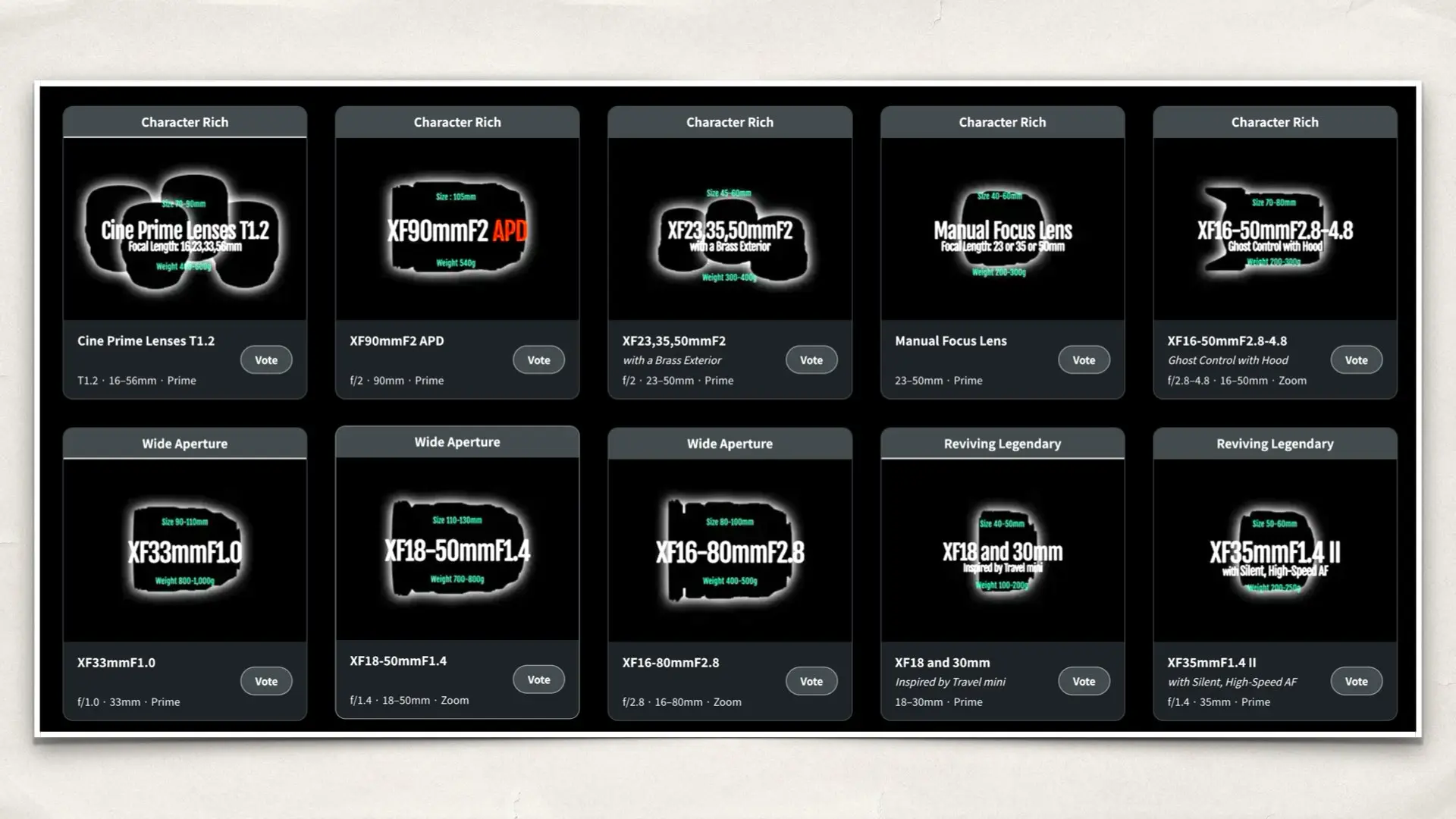
Fujifilm is asking creators to vote for their favorite concepts
Fujifilm is also inviting the community to help shape the future of the X Mount ecosystem. During the presentation, the company launched a public vote where users can select the lens concepts they would most like to see become real products. Participants can choose up to 3 lenses from the list of 14 concepts presented by the engineers. The results could help Fujifilm understand which ideas resonate most with photographers and filmmakers. If you want to participate, you can cast your vote here.
As an Amazon Associate, Y.M.Cinema earns from qualifying purchases. If you purchase through the Amazon links above, Y.M.Cinema may earn a small commission at no additional cost to you. This helps support our work.
Here are the products mentioned in this article and the buttons to buy them on Amazon.