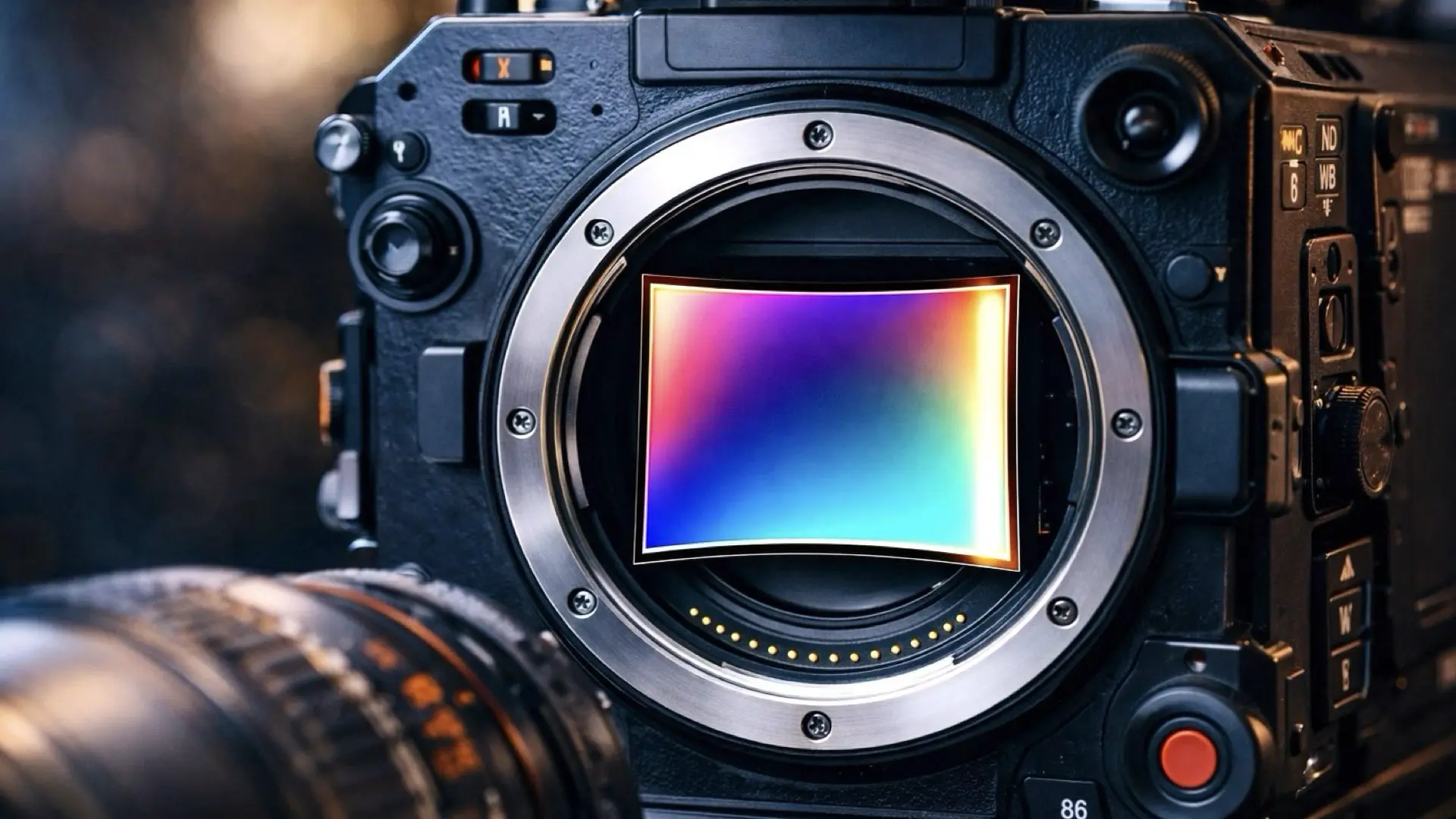
For decades, every digital cinema camera has shared the same fundamental constraint. The image sensor is flat. That sounds trivial, but it has shaped the entire design of modern optics. Light does not naturally focus onto a flat surface. It prefers a curved one, much like the human retina. Because of this mismatch, lens designers are forced to compensate. They add more glass elements, introduce complex corrections, and accept tradeoffs in size, weight, and performance. The result is the cinema lenses we know today. Powerful, but often large, heavy, and optically complex. A new research paper published in Optics Express introduces a different direction. Instead of correcting the lens to match the sensor, it reshapes the sensor to match the light.
Why curvature changes everything
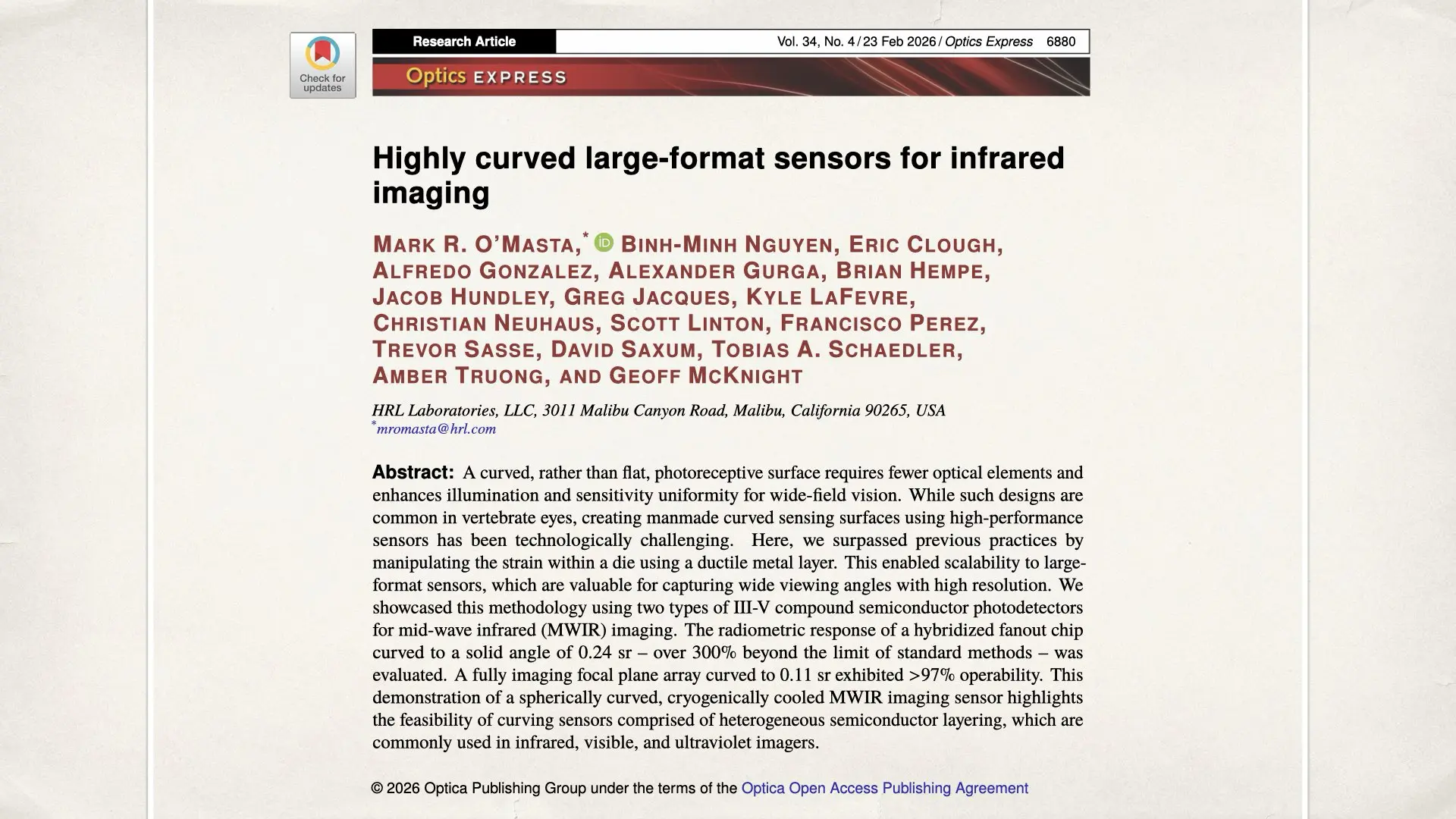
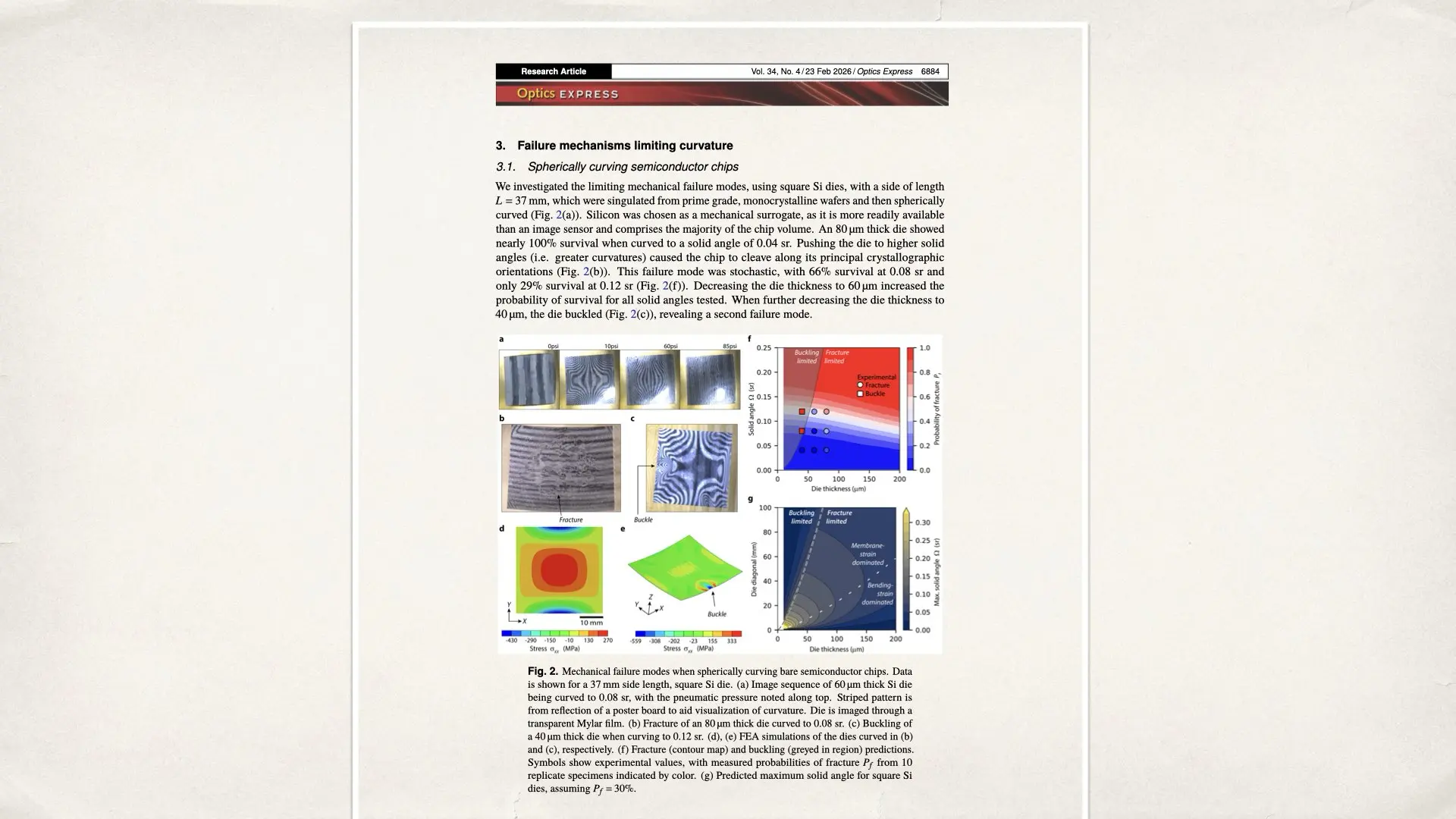
The concept is simple but profound. A curved sensor aligns with the natural focal surface of a lens. When this happens, several things improve at once. Light hits the sensor more evenly across the frame. Brightness becomes more uniform. Optical aberrations such as field curvature are reduced at the source rather than corrected later through additional lens elements. In practical terms, this means lenses can be simpler. Fewer elements are needed. Designs can become smaller and lighter. For filmmakers, this opens the door to more compact camera systems without sacrificing image quality. It also creates opportunities for new types of lenses that were previously impractical due to optical constraints. Curved sensors have been explored before, but scaling them to large formats has always been a major challenge. Semiconductor sensors are brittle. When you try to bend them, they tend to crack or buckle. This has limited previous attempts to small sensors or very mild curvature. The new research overcomes this limitation with a clever mechanical approach. The sensor is thinned to increase flexibility and then bonded to a ductile metal layer. This layer absorbs stress during bending and prevents catastrophic failure. The result is a sensor that can curve much more aggressively without breaking. The team demonstrated curvature levels more than three times higher than previous limits for similar sensor sizes. Importantly, this was achieved on a large format sensor with 16 megapixels, not a small experimental chip.
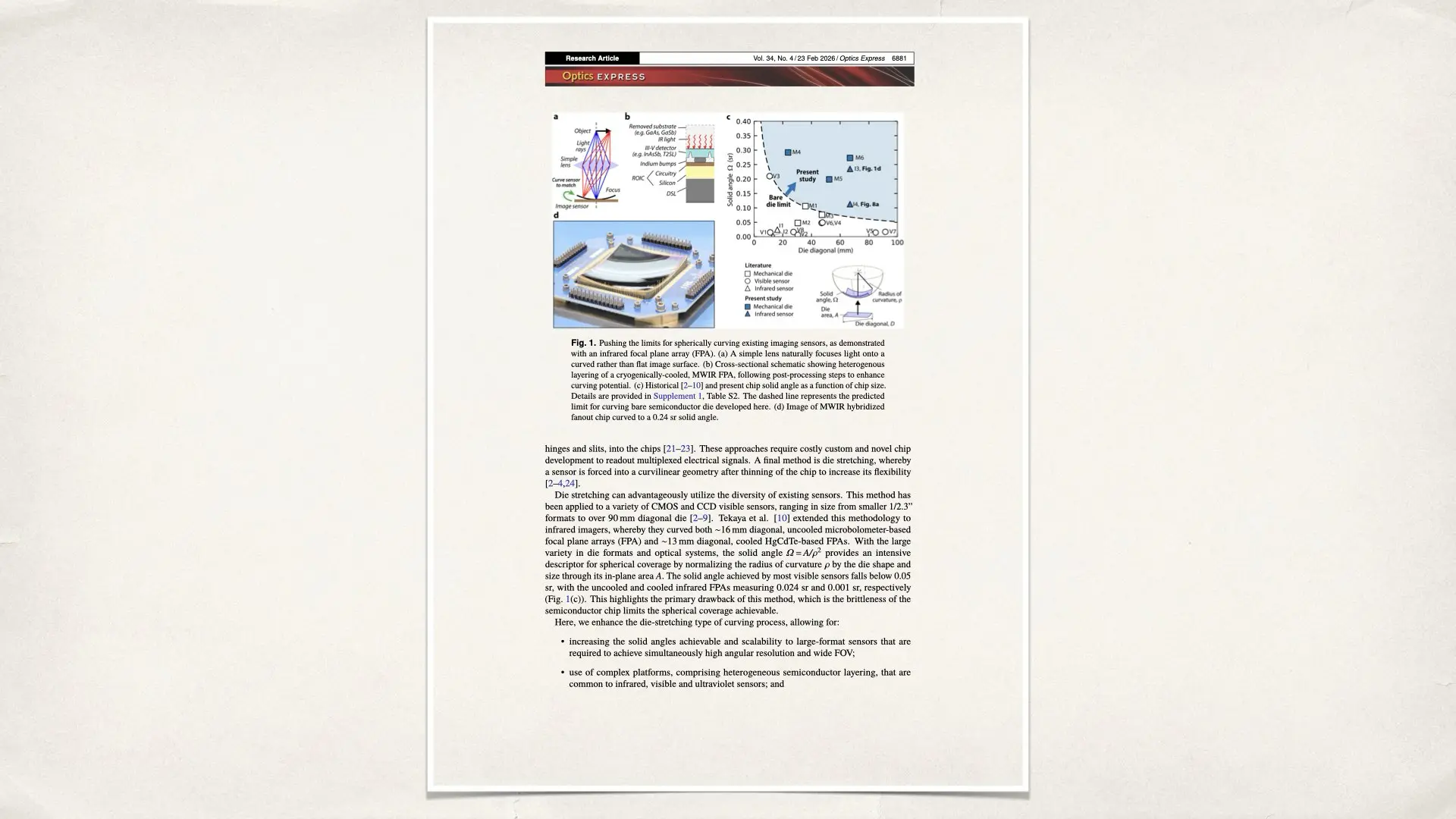
Curved sensors have been explored before, but scaling them to large formats has always been a major challenge. Semiconductor sensors are brittle. When you try to bend them, they tend to crack or buckle. This has limited previous attempts to small sensors or very mild curvature. The new research overcomes this limitation with a clever mechanical approach. The sensor is thinned to increase flexibility and then bonded to a ductile metal layer. This layer absorbs stress during bending and prevents catastrophic failure. The result is a sensor that can curve much more aggressively without breaking.
From theory to a working imaging system
The researchers built a fully functional curved focal plane array. The sensor was tested at cryogenic temperatures and delivered stable imaging performance across almost the entire surface. More than 97 percent of the pixels operated within a normal response range, which is a strong result for a first generation system. They also measured how curvature affects the sensor’s spectral response. Mechanical stress slightly shifts the sensor’s sensitivity across the frame, but the variation remained small enough to be manageable in real imaging systems. In many cases, it can be corrected with filters or calibration.
Why this might be interesting for filmmaking
At first glance, this research targets infrared imaging. However, the underlying method applies to visible light sensors as well. The structure of modern image sensors shares common layers across infrared, visible, and ultraviolet technologies. The authors explicitly note that the approach can extend beyond infrared into standard imaging systems. This is where the story becomes relevant to cinema. Large format sensors are increasingly common in filmmaking. They offer shallow depth of field, wide field of view, and a distinctive cinematic look. But they also demand complex lenses to maintain image quality across the frame. A curved large format sensor changes that equation. It allows wide angle and fast lenses to perform more efficiently with fewer corrections. That can reduce lens size, improve edge performance, and potentially lower costs. There is also a creative implication. When lens design constraints are relaxed, new optical signatures become possible. Filmmakers could see lenses that combine wide field coverage with high brightness and minimal distortion in ways that are difficult to achieve today.
A shift in camera design philosophy
What makes this development interesting is not just the technology itself, but the shift in thinking it represents. For years, the industry has focused on improving lenses to compensate for sensor limitations. This research suggests the opposite approach. Adapt the sensor to the physics of light, and simplify everything upstream. This mirrors the design of biological vision systems. The human eye uses a curved retina and a relatively simple optical structure. Modern cameras, by contrast, rely on complex lens stacks to correct for a flat sensor. Moving toward curved sensors brings camera design closer to that biological model. There are still hurdles before this technology reaches cinema cameras. The current prototypes operate under controlled laboratory conditions and require cooling systems that are not practical for filmmaking. Manufacturing processes will need to mature, and integration with existing camera electronics must be refined. However, the path is clear. The research demonstrates that large format curved sensors are no longer a theoretical concept. They are physically achievable, scalable, and capable of real imaging performance.

A new set of possibilities
If curved sensors become viable in visible light cameras, they could reshape how cameras and lenses are designed. Smaller systems, simpler optics, and new visual characteristics could emerge from this shift. The flat sensor has defined digital imaging for decades. This research suggests that its dominance may not be permanent.