

Imagine a drone that completely disappears from your 360° footage, no rotors, no arms, no landing gear. Just pure, uninterrupted sky. That’s the promise of Insta360’s unreleased Antigravity drone, and thanks to three newly uncovered patents, we finally understand how it works.

A Flying Camera That Hides Itself
In a market dominated by DJI, most drones follow the same design formula: foldable arms, bulky bodies, and protruding camera gimbals. They’re great for standard aerial shots, but if you want to shoot 360° immersive content, you’re stuck with a big problem: the drone always photobombs the shot. Even when filmmakers get creative by mounting 360 cameras on DJI Mavics or FPVs, they still have to edit out the drone body in post. It’s tedious. It’s messy. And it never really works perfectly. That’s where Insta360’s Antigravity changes everything.

The Patents Reveal a Drone That Literally Vanishes
Three patent applications: one filed in China, one internationally (PCT), and one in Europe, give us the most detailed look yet at Insta360’s secret weapon. And what they describe isn’t only smart engineering, but an entirely new design philosophy. Here’s the core idea: The drone is designed so that its body, arms, landing gear, and props all fall outside the field of view of the dual-lens 360° camera system, both top and bottom lenses. Instead of flying a drone that carries a 360 camera, this is a 360 camera that just happens to fly.
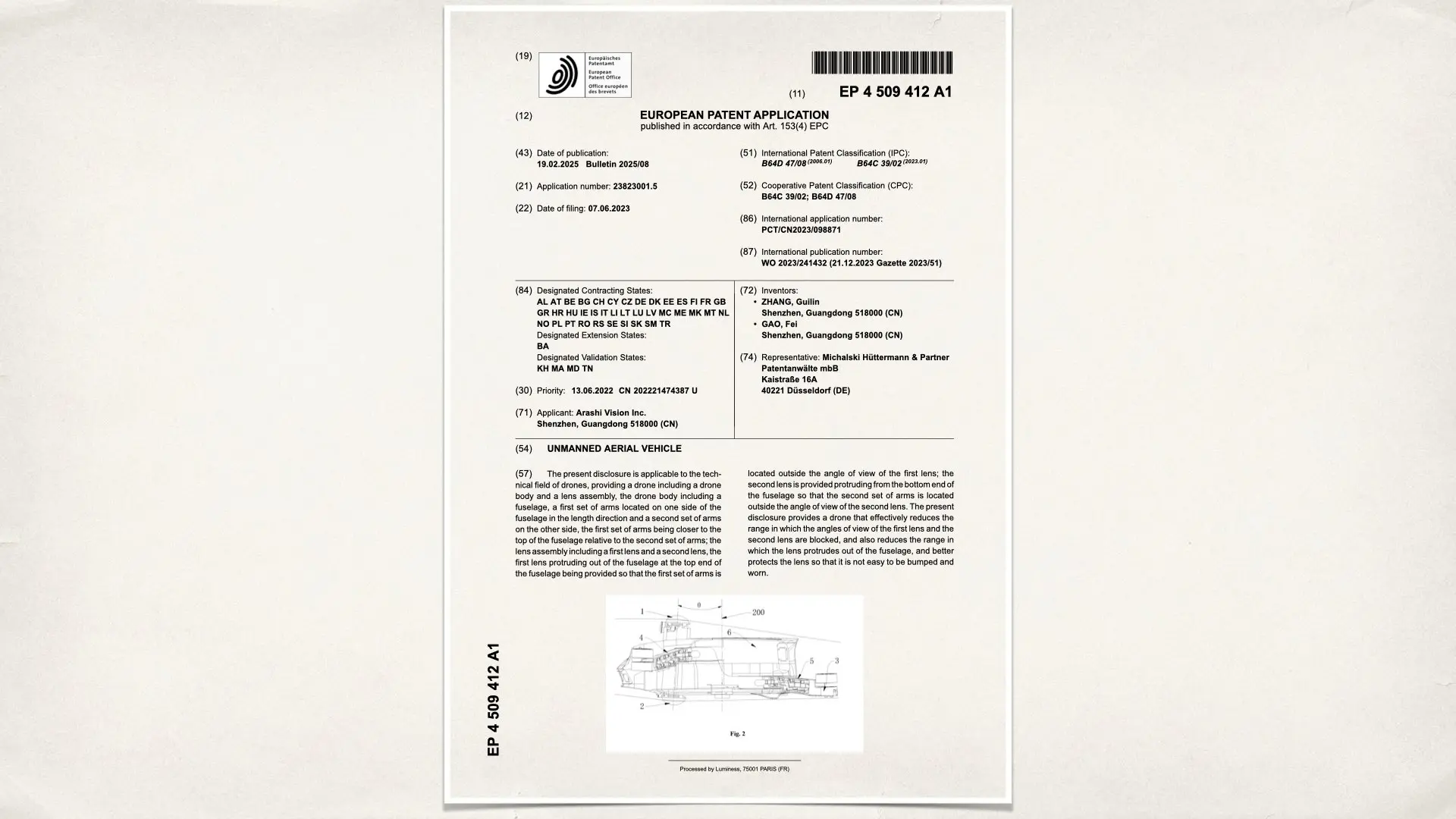
How Does It Work? Smart Design, Clever Mechanics
According to the patents, the drone uses:
-
Dual panoramic lens modules: one on top, one on bottom, aligned along the same optical axis
-
A unique shared motorized system that synchronizes the top lens rising and the landing gear retracting
-
A cleverly tilted fuselage (2–10°) to ensure no part of the drone obstructs the image stitching zone
-
Compact arms and props placed precisely to avoid entering the camera’s view
Even the mounting bracket and motor housing are placed and shaped to vanish from the shot. And the wildest part? All this movement, the lens lift and gear retraction, is powered by just one internal motor. That keeps the drone light, power-efficient, and incredibly elegant in its operation.

The Real Game-Changer: A Sky Without Distractions
In real-world use, this means:
-
No rotor shadows
-
No prop blur
-
No weird objects jutting into your 360° video
-
No post-production cleanup or masking
Just clean, immersive VR content straight out of the sky. It’s like mounting your 360 camera on an invisible tripod that floats in mid-air.

How It Compares to DJI and Others
DJI’s latest FPV drones, like the Avata 2 ($1,019 on Amazon) , can capture dynamic shots, but they were never built for 360°. The DJI Mavic 3 ($2,199 on Amazon) with a mounted Insta360 Sphere can approximate the effect, but it’s clunky and never truly invisible. GoPro tried a similar path with Karma, but it lacked a dedicated 360° design. Even custom rigs or CineWhoops can’t match what Insta360 is trying to achieve here: a drone built from the ground up to be invisible. Everything about Antigravity screams intention. The shared motor saves weight. The telescoping lens improves stitching. The body design eliminates obstruction. And the tech is housed in a compact, possibly consumer-friendly frame, unlike massive professional cinema drones.

Final Thought: Insta360 Is Building the Future of Drone Filmmaking?
Insta360’s upcoming drone is aiming at one very specific thing, and nailing it: The purest, cleanest, most immersive aerial 360° shots possible. If even half of what these patents describe makes it to production, Antigravity could become the go-to drone for immersive storytelling, VR production, travel creators, and forward-thinking filmmakers. And best of all? You’ll never even see it 😉
Gear mentioned in this article
Available on Amazon
| Product | New | Renewed | Used |
|---|---|---|---|
| DJI Avata 2 | $1,019 | — | From $926.10 |
| DJI Mavic 4 Pro | $2,199 | — | From $1,999 |
Prices checked: Sep 11, 2026, 5:30 PM GMT+0000
As an Amazon Associate, Y.M.Cinema earns from qualifying purchases. If you buy through our links, we may earn a small commission at no extra cost to you.
Product prices and availability are accurate as of the date/time indicated and are subject to change. Any price and availability information displayed on Amazon.com at the time of purchase will apply to the purchase of this product.
CERTAIN CONTENT THAT APPEARS ON THIS SITE COMES FROM AMAZON. THIS CONTENT IS PROVIDED “AS IS” AND IS SUBJECT TO CHANGE OR REMOVAL AT ANY TIME.







This solution existed long long before, it is not even their original idea. Strange how anyone with resources can patent such things. I hope not.