

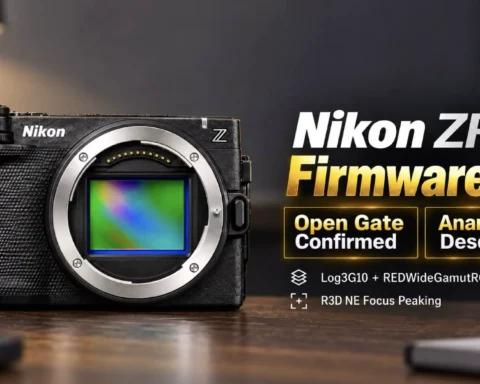
It’s official! Nikon aims to be a leading cinema camera company. Nikon has officially unveiled the ZR, a groundbreaking addition to its Z CINEMA lineup. This is no ordinary release. The ZR marks Nikon’s first true synergy with RED, delivering internal R3D recording in a compact full-frame body that filmmakers will find both practical and powerful. And the price? $2,200! Can anyone compete with that? Read on!

The Nikon RED connection
For years, the idea of Nikon working side by side with RED sounded like speculation. Now it is real. The ZR is the first Nikon camera capable of recording in R3D, thanks to a dedicated codec called R3D NE. This format not only keeps the RAW flexibility RED shooters are familiar with, but also ensures seamless color matching across Nikon and RED systems. In fact, the ZR inherits RED’s exposure standards and color science, making it a true crossover tool for productions where RED cinema cameras dominate. This collaboration has been hinted at before in Nikon in the Cinema World and earlier rumors around the ZR itself. Our recent breakdown of Nikon’s new sensor with faster readout and high resolution already signaled something big was coming. Now we see those technologies fully realized in this camera.

Compact size, cinematic power
The ZR weighs just 540 g (630 g with battery and media), making it the lightest model in the Z CINEMA series. Yet it delivers internal 12-bit RAW 6K at 59.94p and 4K at 119.88p. Its full-frame sensor offers dual base ISOs of 800 and 6400, combined with 15+ stops of dynamic range. This ensures filmmakers can capture both shadow detail and highlight roll-off with cinematic finesse. The Nikon ZR ($2,196.95 on Amazon) Cinema Camera Rumors article speculated about such a form factor, and Nikon has exceeded expectations by building the ZR as a small yet uncompromising cinema body.

World’s first 32-bit float audio in-camera
One of the biggest surprises is sound. The ZR is the first camera in the world to feature internal 32-bit float audio recording, whether from the built-in mic or through external microphones. That means distortion-free sound, from whispers to concerts, without manual gain adjustments. The integrated microphones use Nokia’s OZO Audio system, offering five pickup patterns from super directional to immersive stereo. For documentary shooters, solo creators, or production crews that want reference audio good enough for final mix, this is a serious innovation.

Designed for filmmakers
Nikon did not stop at codecs and audio. The ZR is built with cinema workflow in mind. A bright 4.0-inch LCD with full DCI-P3 coverage makes external monitors optional. It supports LUT preview and direct cloud upload via Frame.io integration. The digital accessory shoe enables two-way communication with future third-party tools, while the 16 mm flange focal distance opens the door to nearly any lens on the market. Autofocus gets a major boost from Nikon’s EXPEED 7 processor and AI subject recognition, inherited from the flagship Z9 ($5,296.95 on Amazon) . Add 5-axis sensor stabilization, efficient heat dissipation for long takes, and shutter angle adjustment from 5.6° to 360°, and you have a camera built to satisfy both indie filmmakers and major productions.

A strategic leap for Nikon
Nikon has positioned the ZR as more than just another cinema camera. It is a statement about where the company sees its future. As we analyzed in Nikon Z CINEMA: A New Era or a Risky Bet Against Sony and Canon, Nikon is now fully challenging the established players. With RED’s DNA in its codec and color science, the ZR represents a fusion that could disrupt the cinema ecosystem. The company has already invested heavily in sensor and large-format research, as highlighted in Nikon Large Sensor Cinema Camera Technology. With the ZR, those efforts are in the hands of filmmakers.


Discussion
The release of the ZR is proof of how quickly Nikon has moved since acquiring RED. Many observers assumed years would pass before we saw a tangible result of the deal. Instead, Nikon has executed with surprising speed, merging RED’s core strengths into a Nikon-designed camera in less than two years. This efficiency is worth pausing on. Acquisitions in the imaging world often drag on, with promises of integration that never quite materialize. Nikon, however, has shown what a successful buyout and implementation can look like. The ZR is not a rebranded RED or a Nikon camera with vague “RED DNA.” It is a hybrid where both companies’ technologies genuinely complement each other. From one angle, this is about Nikon proving that it can pivot fast in a market dominated by Sony and Canon. In Nikon Z CINEMA: A New Era or a Risky Bet Against Sony and Canon, we asked whether Nikon could take bold steps to secure a place in cinema. The ZR feels like a decisive answer. From another perspective, this release sets a new standard for how camera companies might handle acquisitions. Instead of protecting silos, Nikon fused RED’s codec and color science with its own hardware design, making the outcome greater than the sum of its parts. Finally, this is a moment for filmmakers to reflect on the industry itself. If a legacy company like Nikon can adapt this quickly, it raises the question: what happens when other giants, from tech or optics, decide to acquire niche players? Could this be the model for future innovation—faster, sharper, and more disruptive than we expected? The ZR invites these conversations because it is more than a camera, but a reference for a case study in execution. Meanwhile, enjoy some YT videos about this very special camera:
Final take
The Nikon ZR is the first true Nikon RED hybrid, merging two heritages into a small, versatile tool for high-end cinema and creator-driven productions. Its R3D workflow, 32-bit float audio, AI autofocus, and compact build make it a one-of-a-kind release in 2025. For those who doubted Nikon’s cinema ambitions, the ZR is a clear answer. The future of Nikon in filmmaking is no longer a question—it is here.
Gear mentioned in this article
Available on Amazon
| Product | New | Renewed | Used |
|---|---|---|---|
| Nikon ZR | $2,196.95 | — | — |
| Nikon Z9 | $5,296.95 | — | From $4,275 |
Prices checked: Oct 2, 2026, 1:30 PM GMT+0000
As an Amazon Associate, Y.M.Cinema earns from qualifying purchases. If you buy through our links, we may earn a small commission at no extra cost to you.
Product prices and availability are accurate as of the date/time indicated and are subject to change. Any price and availability information displayed on Amazon.com at the time of purchase will apply to the purchase of this product.
CERTAIN CONTENT THAT APPEARS ON THIS SITE COMES FROM AMAZON. THIS CONTENT IS PROVIDED “AS IS” AND IS SUBJECT TO CHANGE OR REMOVAL AT ANY TIME.

![Nikon Is Developing Nine NIKKOR Z CINEMA T1.9 VV Lenses for RED V RAPTOR [X]](https://ymcinema.com/wp-content/uploads/2026/09/Nikon-Is-Developing-Nine-NIKKOR-Z-CINEMA-T1.9-VV-Lenses-for-RED-V-RAPTOR-X.001-480x384.webp)







Nice coverage, though I don’t believe this is the first camera with internal 32-bit float. Wasn’t that the Panasonic GH7 or S1R II?
Panasonic’s GH7 introduced 32-bit float recording earlier this year, but only with an external XLR module attached. What makes the Nikon ZR unique is that it’s the first interchangeable-lens camera to support 32-bit float internally through both its built-in mics and 3.5mm input, without any extra hardware. THX!
Concernant l’obturateur pas trop d’informations
Obturateur global ou pas
The Nikon ZR does not feature a global shutter. It uses a full-frame sensor with a very fast readout speed (something Nikon has been developing, as we covered : https://ymcinema.com/2025/09/08/nikon-new-sensor-faster-readout-high-resolution/
). This helps minimize rolling shutter artifacts significantly, but it isn’t a true global shutter system.