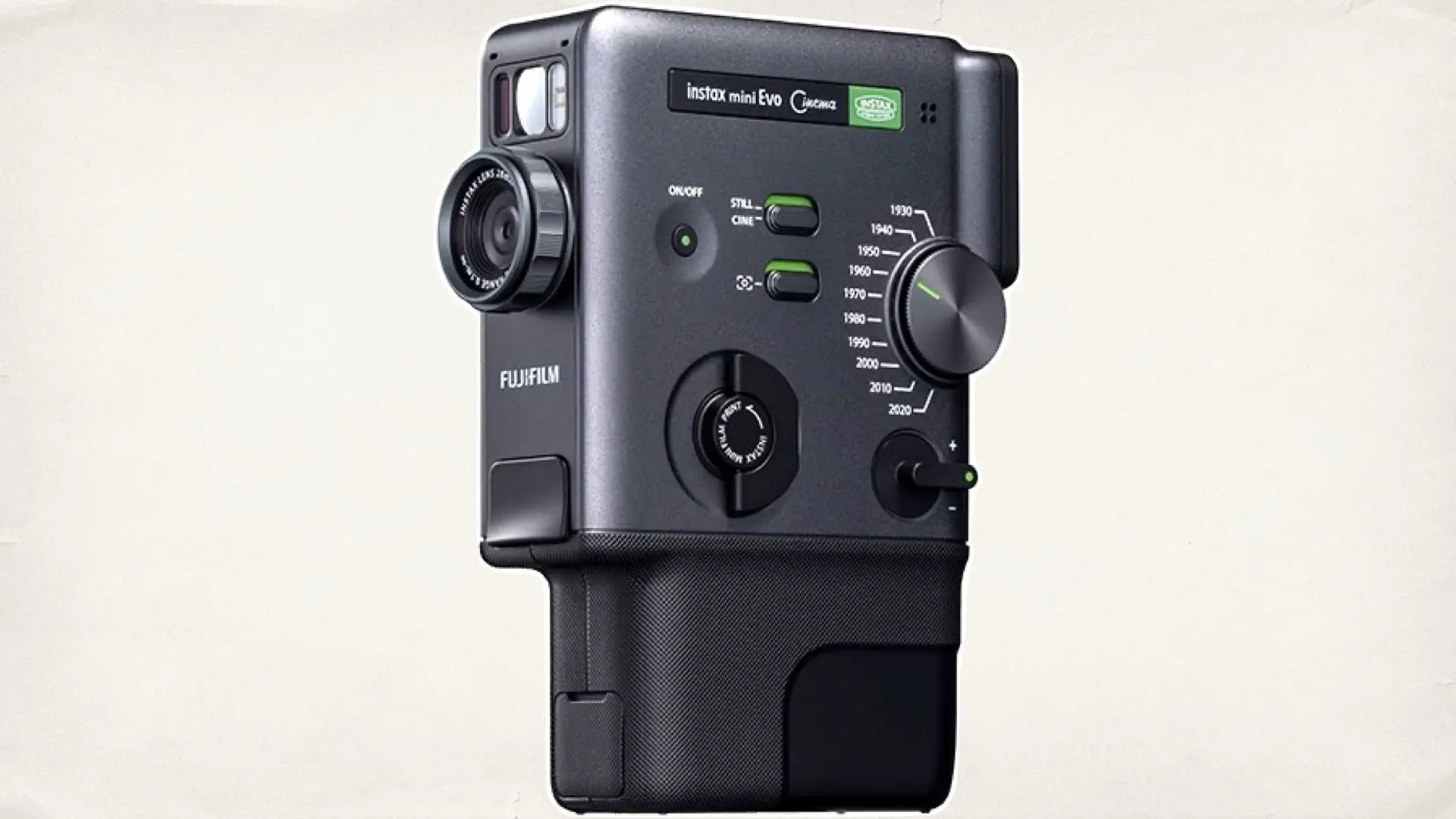
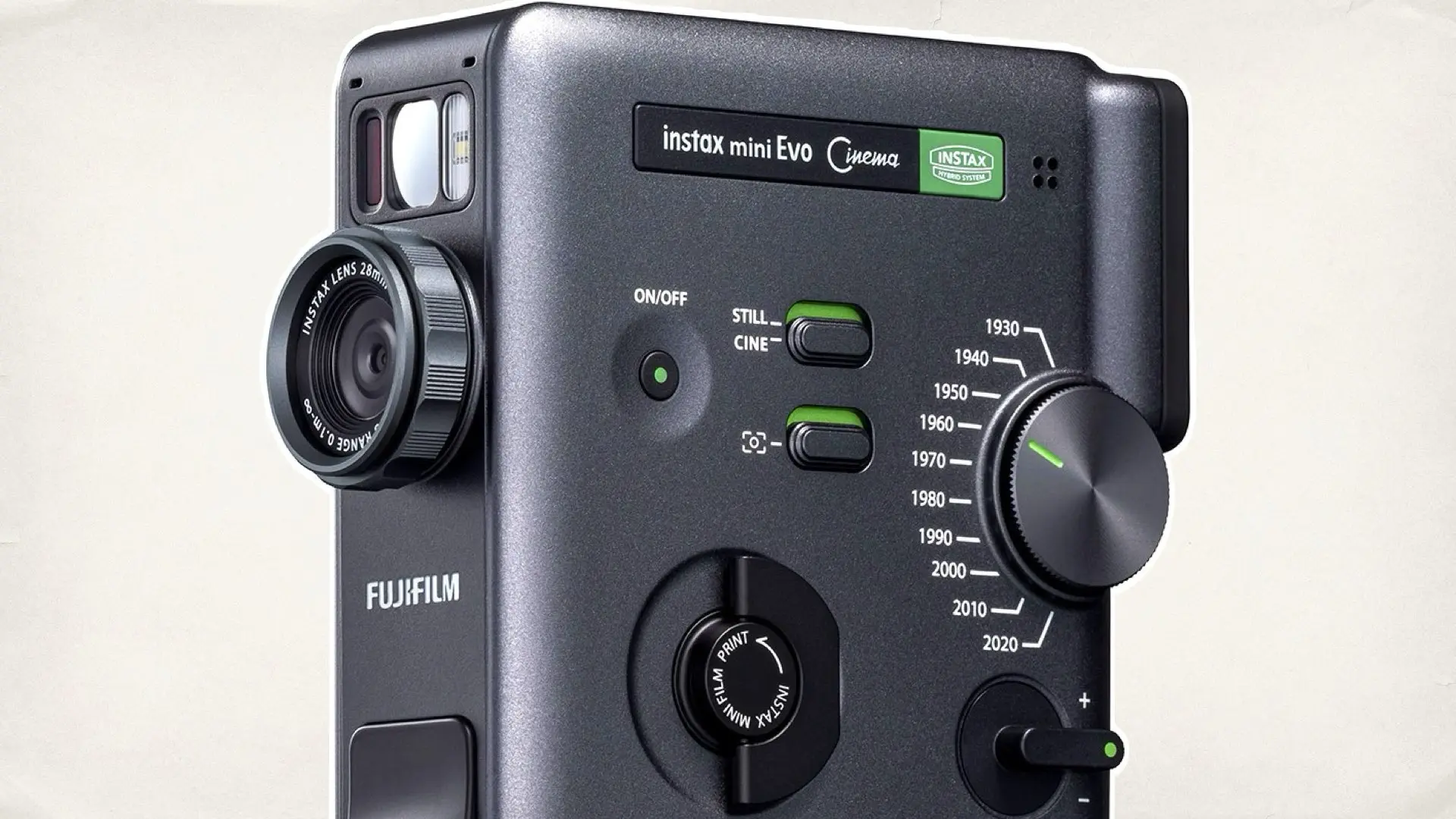
Fujifilm just announced the Instax Mini Evo Cinema ($399.99 on Amazon) , a hybrid instant camera that deliberately blurs the line between still photography, short video, and physical prints. The idea is intentionally theatrical rather than technical. Users can shoot photos or record video clips up to 15 seconds long, choose a frame, and print it on instax film with a QR code that plays the video on a smartphone. Alongside this is the new Eras Dial, offering 10 era-inspired visual styles with 10 levels of intensity each. From the press release alone, it is clear this camera is designed around experience, not performance charts or professional benchmarks.

Yes, it looks like a gimmick, and that is intentional
At first glance, this looks like a gimmick. And that reaction is exactly what Fujifilm is counting on. The company has always excelled at thinking outside the box, building cameras that provoke curiosity instead of quietly chasing specifications. That same creative impulse was behind the X Half ($629 on Amazon), a product that made little sense on paper yet resonated strongly with photographers when it surfaced as an Amazon holiday strong seller, as explored in Fujifilm X Half Amazon Holiday Deal. Fujifilm understands something many brands forget. Emotional connection often matters more than logical justification.
“Cinema” but not Cinema
It is important to be clear about what the instax mini Evo Cinema is not. This is not a lightweight branch of Fujifilm’s professional cinema strategy. It has nothing to do with color pipelines, codecs, or production workflows. Those ambitions live elsewhere, in cameras designed to earn trust on real sets, such as the ETERNA line. We already examined that professional direction in Fujifilm GFX ETERNA 55 Pros and Cons, where the focus is on long term filmmaking credibility. The instax mini Evo Cinema sits at the opposite end of the spectrum, and that separation is deliberate. The connection to “Cinema” is just in the name of this product (and it also has a cool CiNE button on it as you can see in the picture below.
A Japan-first release that explains a lot
The context of this launch matters. The instax mini Evo Cinema has been introduced first and foremost for the Japanese market. That is not a coincidence. Fujifilm understands its domestic audience exceptionally well, especially when it comes to novelty-driven hardware that blends nostalgia, physical interaction, and digital culture. Japan has long embraced hybrid experiences where physical objects coexist naturally with digital layers. A printed photo that unlocks motion through a QR code fits comfortably into that cultural space. This is not yet a global mass market play. It is a locally tuned experiment released where Fujifilm can observe real user behavior closely.
Pricing uncertainty is part of the strategy
Pricing further reinforces the experimental nature of the product. Fujifilm has not announced an official retail price, listing the camera under the familiar Japanese open price model. That means no fixed MSRP and full flexibility for retailers. Early estimates from industry observers suggest a price positioned in the upper range of the instax ecosystem, but those numbers remain unofficial and subject to change. The absence of a confirmed price signals that Fujifilm is testing appetite rather than locking the product into a rigid commercial category from day one.
Playfulness on one side, serious momentum on the other
What makes this announcement more interesting is that it does not exist in isolation. While Fujifilm experiments with playful, experience driven products on the consumer side, it continues to gain real traction with more serious cameras. That momentum is visible right now, with Fujifilm’s new Super 35 camera dominating attention among Amazon hot releases, as shown in Best Selling Cameras on Amazon Right Now. This dual strategy is not accidental. Fujifilm is one of the few companies comfortable operating in multiple creative lanes at the same time.
Cinema as emotion, not production
Critics will argue that QR-coded video prints have limited practical value, and they are not wrong. This camera is not meant to replace phones, mirrorless systems, or cinema rigs. But that criticism misses the point. Fujifilm is not positioning this product as a filmmaking tool. The word cinema here is emotional rather than technical. It refers to storytelling, memory, and movement, not resolution charts or bitrates. By framing it this way, Fujifilm avoids forced comparisons and allows the camera to exist on its own terms.
Closing thoughts
Viewed through a wider lens, the instax mini Evo Cinema feels less like a product launch and more like a cultural probe. It asks whether physical photography can regain relevance by becoming interactive again. Fujifilm is uniquely positioned to explore that question because it controls both the digital camera experience and the instant film ecosystem. Few other companies could attempt this idea without it feeling incoherent. Cinema culture has always been driven by emotion, memory, and experimentation, not just by technology. Fujifilm’s new cinema announcement embraces that spirit unapologetically. Yes, it is a gimmick. But it is a Fujifilm gimmick. And that is precisely why it might work.
Gear mentioned in this article
Available on Amazon
| Product | New | Renewed | Used |
|---|---|---|---|
| Fujifilm Instax Mini Evo Cinema | $399.99 | — | From $287.74 |
| Fujifilm X-Half | $629 | — | From $435.60 |
Prices checked: Oct 2, 2026, 1:30 PM GMT+0000
As an Amazon Associate, Y.M.Cinema earns from qualifying purchases. If you buy through our links, we may earn a small commission at no extra cost to you.
Product prices and availability are accurate as of the date/time indicated and are subject to change. Any price and availability information displayed on Amazon.com at the time of purchase will apply to the purchase of this product.
CERTAIN CONTENT THAT APPEARS ON THIS SITE COMES FROM AMAZON. THIS CONTENT IS PROVIDED “AS IS” AND IS SUBJECT TO CHANGE OR REMOVAL AT ANY TIME.