

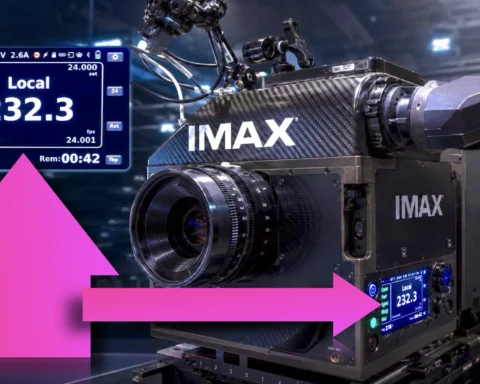
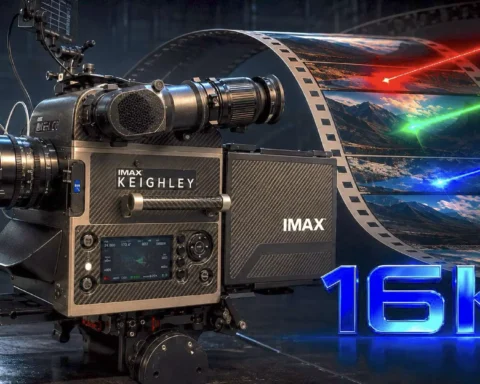
Without a formal announcement, a next-generation IMAX camera appeared on the set of Christopher Nolan’s The Odyssey, marking a pivotal moment for the company. Dats after, images of the camera were shared publicly by the Keighley family on X, revealing not only a new piece of technology but a name deeply embedded in the history of large format cinema. The camera is called Keighley, and that choice tells a story that goes far beyond hardware.
The Keighley name and the foundations of IMAX quality
The Keighley camera is named after David Keighley, IMAX’s first Chief Quality Officer, who passed away earlier this year in September at the age of 77, and his wife, Patricia Keighley, who continues to serve as IMAX’s Chief Quality Guru. David Keighley was one of the most influential figures in IMAX’s global rise. He helped define the technical and presentation standards that separated IMAX from every other cinematic format, ensuring that image quality, projection consistency, and audience experience remained non-negotiable as the company expanded worldwide. Patricia Keighley’s role has been equally essential. From the earliest days of IMAX, she has been deeply involved in quality control, exhibition integrity, and filmmaker relationships. Decades later, she remains actively engaged at IMAX, reinforcing that the values associated with the Keighley name are not historical footnotes but living principles. Their son, Geoff Keighley, host and creator of The Game Awards and Summer Game Fest, publicly acknowledged the naming, emphasizing that his mother’s contributions were just as vital as his father’s. As he noted, his father often said she was responsible for 50 percent of everything he ever accomplished.

First appearance on the set of The Odyssey
The Keighley IMAX camera made its first known production appearance on The Odyssey, directed by Christopher Nolan. The film adapts Homer’s ancient Greek epic and stars Matt Damon as Odysseus, alongside Tom Holland, Anne Hathaway, Robert Pattinson, Lupita Nyong’o, Zendaya, and Charlize Theron. YMCinema was the first outlet to identify this camera in active production conditions, documenting its presence on set in our early report on IMAX’s next-gen camera first appearance on The Odyssey set. At the time, IMAX had not publicly acknowledged the system, nor revealed its name or intent, making the discovery particularly significant. That this camera debuted on a Nolan production is not incidental. Nolan has long been IMAX’s most demanding collaborator, pushing the format beyond spectacle into sustained narrative filmmaking. Introducing a new IMAX camera under his scrutiny reflects confidence in both the technology and the philosophy behind it.

A bridge between generations of IMAX
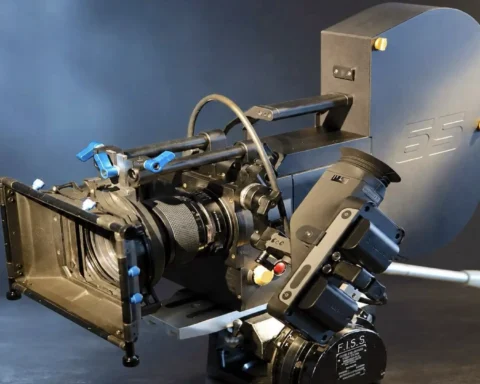
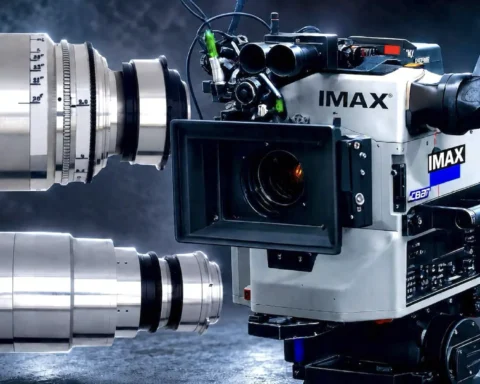
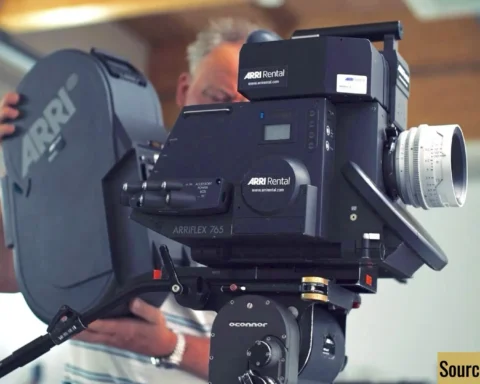
What makes The Odyssey especially important is that it captures IMAX in a rare transitional phase. Alongside the Keighley camera, Nolan’s production also employed legacy IMAX film technology. YMCinema documented the use of a first-generation MSM9802 IMAX film camera during handheld shooting in our coverage of Hoyte van Hoytema’s handheld IMAX film work on The Odyssey. These two moments, captured in separate reports, tell a single story. IMAX is not replacing its past. It is carrying it forward, allowing film and digital to coexist as complementary tools rather than opposing ideologies.

What the Keighley camera represents visually
The images published by the Keighley family on X reveal a camera unlike any previous IMAX system. The body is dramatically more compact than legacy IMAX film cameras, with a centralized, balanced design that reflects a fully digital architecture rather than a film-based one (although 65mm film runs through it!). In their place is a system designed for mobility, capable of integrating into modern production workflows while retaining IMAX’s emphasis on image integrity. Electronic monitoring and contemporary interfaces replace the purely optical operation of earlier IMAX film cameras, signaling a shift from film physics to image science as the defining engineering challenge. And of course the carbon… 🙂

From mechanical force to craftsmanship by design
Legacy IMAX cameras such as the MSM9802 were feats of mechanical engineering, built to move 15 perf 65 mm film with absolute precision. Their size and complexity were inseparable from their purpose. The Keighley camera reflects a different kind of craftsmanship. Its design suggests a focus on sensor performance, data throughput, thermal stability, and reliability over long shooting days. These are the concerns of modern large-format cinematography, and IMAX is clearly addressing them on its own terms.

Why the Keighley name matters now
Naming this camera Keighley is not symbolic branding but a statement of intent. David and Patricia Keighley dedicated their careers to ensuring that IMAX never compromised on quality, even as technology and exhibition landscapes changed. Attaching their name to IMAX’s next-generation camera signals that the same standards are expected to guide its digital future. The coexistence of film cameras and the Keighley system on The Odyssey shows where IMAX stands today. The company is not choosing between past and future. It is building a bridge between them. In that context, the Keighley camera feels less like a product launch and more like a milestone. A tool shaped by decades of experience, introduced quietly, and trusted immediately on one of the most demanding film sets in the world. Go IMAX!









So simple YES or NO, can this Keighley IMAX camera shoot “15 perf” 65 mm film?
the lack of actual information in this article is baffling, keeps saying its different than legacy cameras but not at all “how”… not really “meeting the camera” just the name lol