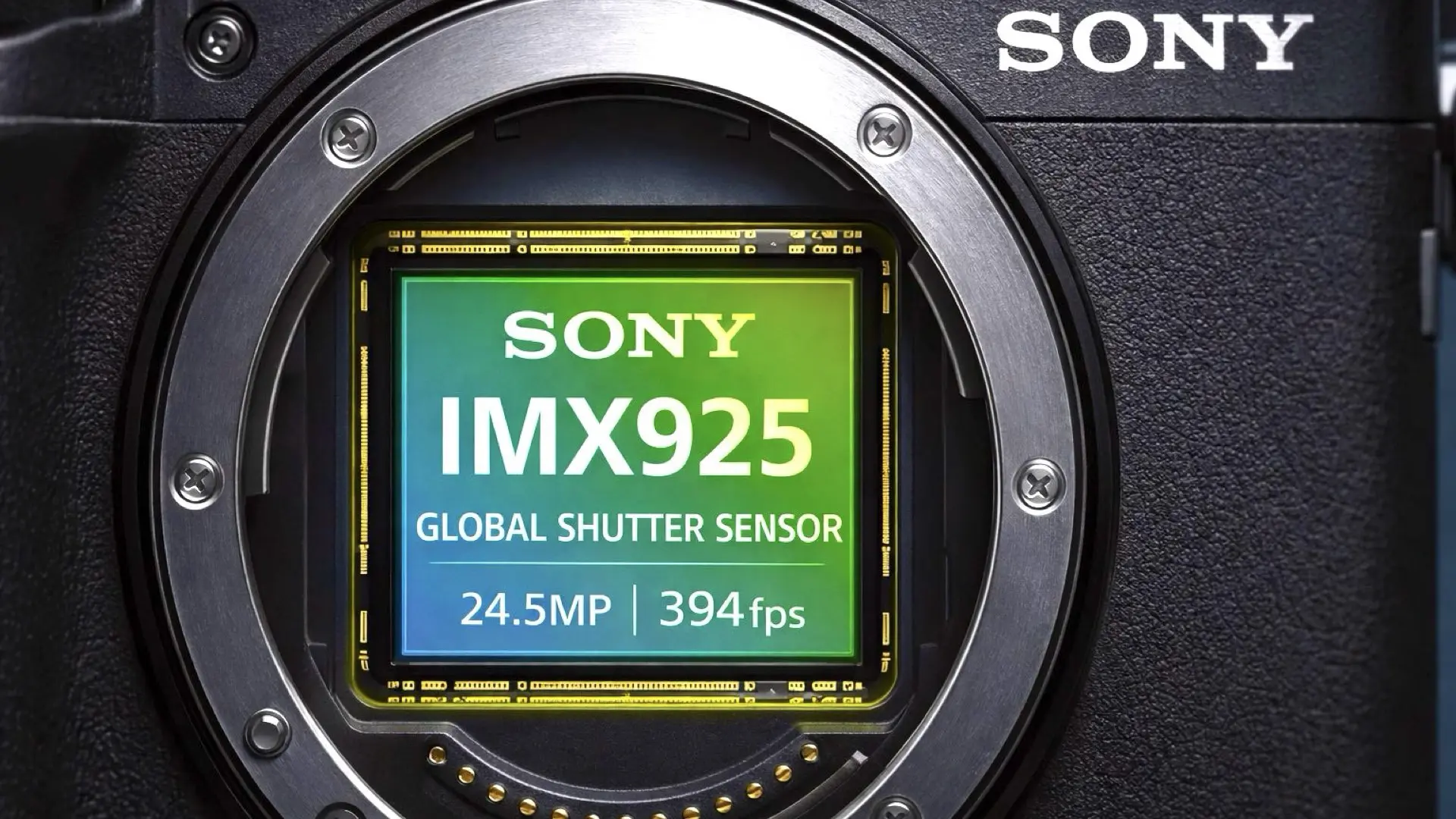
Sony’s IMX925 global shutter sensor, first introduced in November 2024, has now entered the production phase, moving from announcement to real-world availability. This transition marks the point where manufacturers can begin integrating the sensor into actual systems, mainly in industrial and machine vision environments. We covered the initial reveal in Sony Introduces a New High Speed Global Shutter Sensor, and this update confirms that the technology is now ready for deployment.
While the IMX925’s size could theoretically fit advanced compact cameras, its design priorities make it unsuitable for consumer point and shoot systems, which rely on dynamic range and low light performance rather than extreme speed.
A closer look at the core specifications
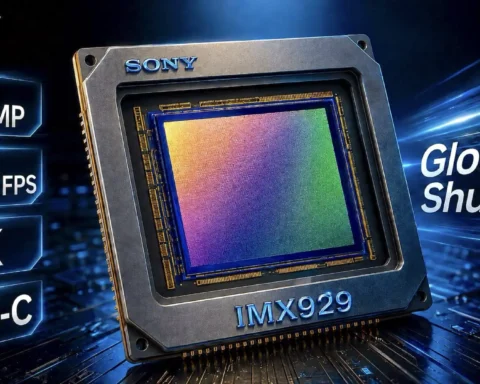
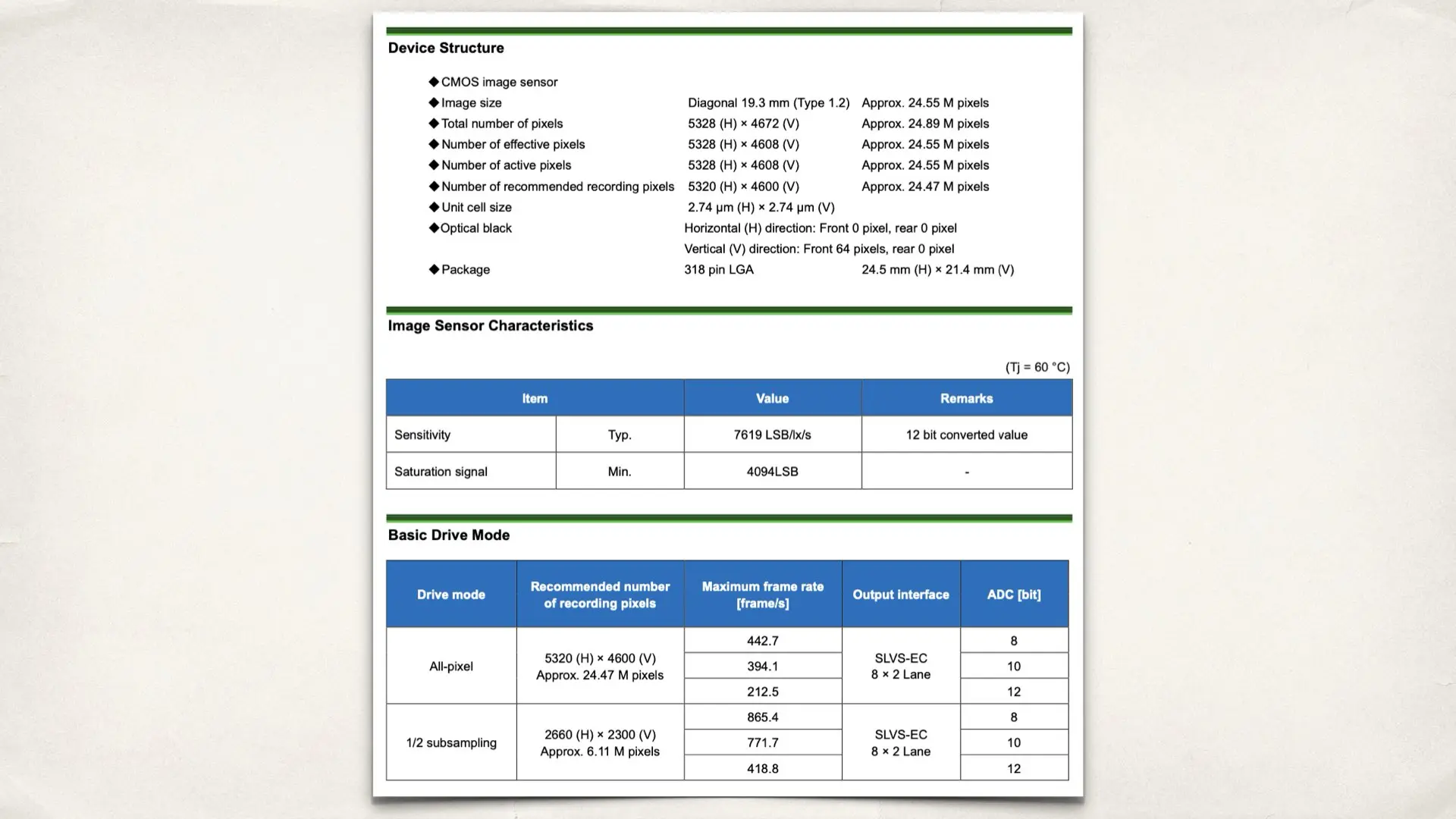
The IMX925 is built around a Type 1.2 optical format sensor with approximately 24.55 million effective pixels. It uses a 4:3 aspect ratio and a unit pixel size of 2.74 μm, delivering a balance between resolution and readout speed. The sensor can reach up to 394 fps in 10-bit mode, with even higher frame rates available in lower bit depths and subsampling modes. This level of performance is enabled by a redesigned circuit structure that optimizes sensor drive and data throughput. Sony states that the IMX925 achieves roughly 4 times the speed of previous comparable sensors, alongside a significant improvement in power efficiency. For high-throughput environments, this combination of speed and efficiency is critical, especially when operating continuously.

Pregius S and the role of global shutter
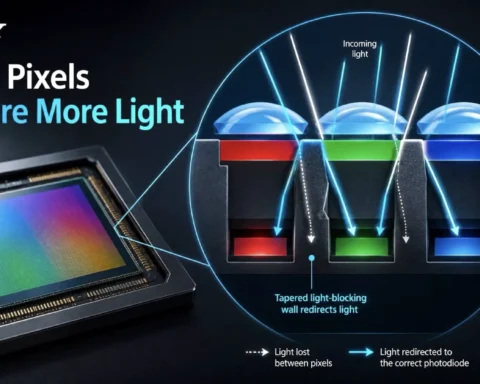
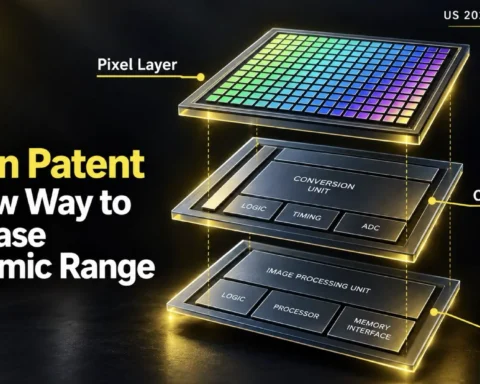
The IMX925 is part of Sony’s Pregius S family, which is based on stacked CMOS architecture with a global shutter design. Unlike rolling shutter sensors, which read the image line by line, a global shutter captures the entire frame at once. This eliminates motion distortion, skew, and wobble, which are common artifacts in fast-moving scenes. In practical terms, this means the sensor can capture high-speed motion with precision. This is essential for applications like automated optical inspection, 3D scanning, robotics, and motion analysis, where even small distortions can compromise accuracy. The stacked structure also allows Sony to separate the pixel layer from the processing circuitry. This improves readout speed and contributes to the sensor’s high frame rate capability without increasing the footprint dramatically.
Let’s talk about the sensor size
The IMX925 uses a Type 1.2 format, with a diagonal of around 19.3 mm. This places it above traditional 1-inch sensors but below APS-C and Super 35 formats. The choice of this size is not accidental. It allows for a relatively large imaging area while maintaining manageable data rates and thermal behavior at very high frame rates. For industrial systems, this size also aligns well with C-mount lens ecosystems, making integration more straightforward. One of the more interesting aspects of the IMX925 is that it does not trade resolution for speed. Achieving nearly 400 fps at over 24 MP is a strong indicator of how far global shutter technology has progressed. Traditionally, high-speed sensors required significant compromises in resolution or image quality. Here, Sony is pushing both simultaneously. The sensor also supports higher frame rates through subsampling modes, reaching well above 700 fps depending on configuration. This flexibility allows system designers to prioritize either full resolution or extreme speed depending on the use case.
Beyond industrial applications (filmmaking?)
The IMX925 is clearly not designed for cinema cameras or hybrid systems. Its priorities are precision, speed, and reliability rather than dynamic range or low-light performance. However, the technology direction is relevant. Advances in global shutter efficiency, readout speed, and stacked architectures tend to propagate over time. While this specific sensor is aimed at machine vision, the underlying innovations could influence future imaging systems in smaller form factors. In particular, areas like action cameras and high-speed mobile imaging could benefit from improved global shutter implementations, especially for distortion-free video capture. To sum it up, the IMX925 does not introduce a new category of camera, but it does represent a meaningful step in sensor development. Sony continues to refine global shutter technology in ways that expand its performance envelope, especially in high-speed scenarios. With production now underway, the IMX925 moves from a promising specification sheet to a component that will power real-world imaging systems. That transition is where the real impact begins.