Canon’s latest patent, titled “LENS BARREL AND IMAGING APPARATUS”, hints at a compact revolution in RF zoom lenses, thanks to a clever mechanical solution filmmakers will appreciate. When designing cinema lenses, size always fights performance. Filmmakers want lighter setups that don’t sacrifice sharpness, autofocus, or zoom precision. Canon might have just found a way to bring those wishes together in one barrel. In a newly published patent, Canon introduces a surprisingly elegant mechanism that allows internal lens groups to overlap safely during zooming, a move that could make future RF cinema zooms significantly shorter without compromising on power or precision.
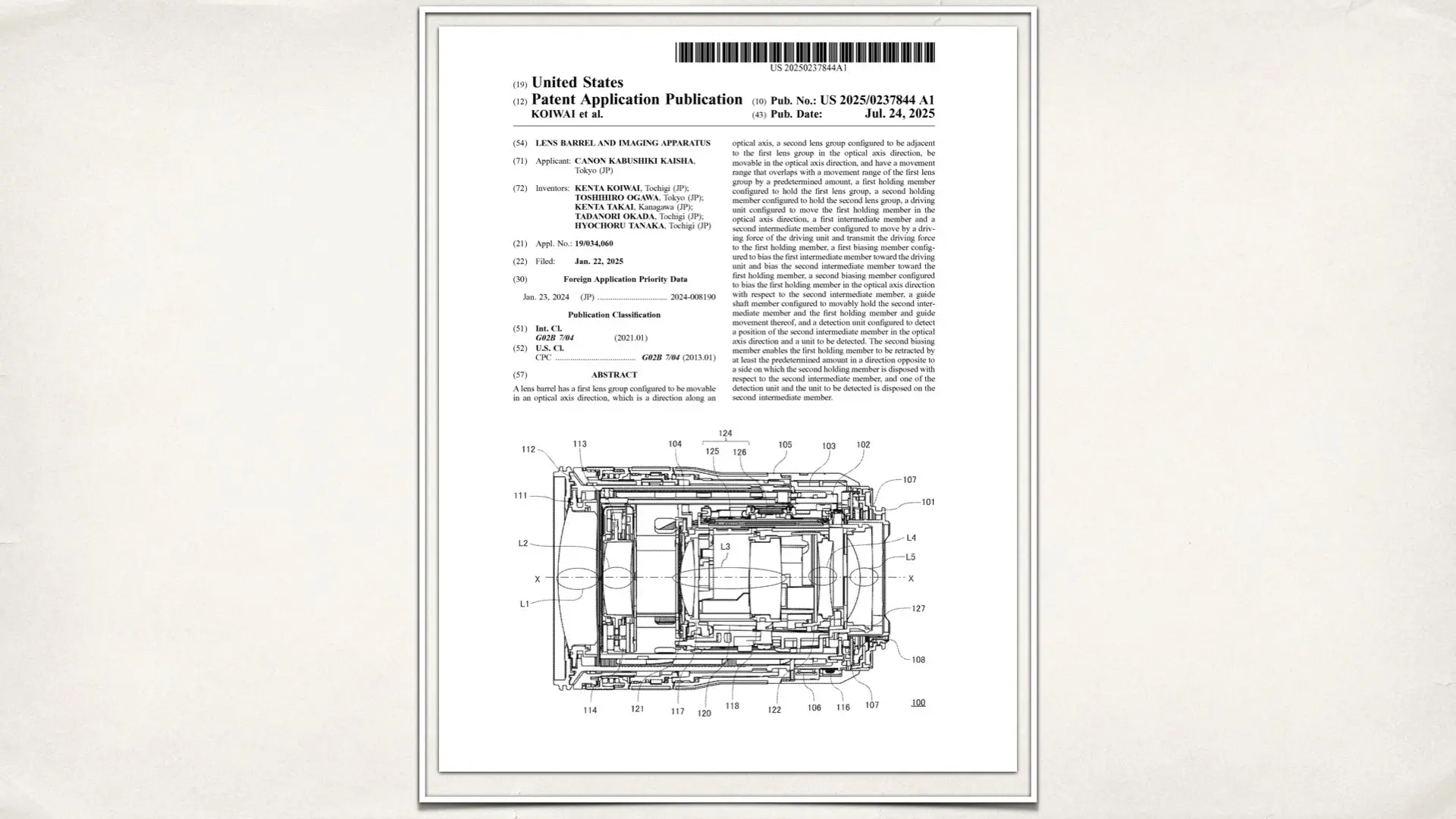
The Challenge: Zooming and Focusing in Tight Spaces
Inside every modern zoom lens is a complex choreography of glass elements. Some move to zoom. Others adjust for focus. But traditionally, each group needs its own space to travel, no overlap allowed, or they’ll crash into each other. That “no-fly zone” is why many lenses are physically longer than they need to be. Canon’s patent flips this design on its head. Rather than keeping the lens groups apart, Canon now allows overlap, but with a safeguard. If one lens group moves too fast or unexpectedly during zooming, it won’t break anything. Instead, it’s gently retracted by an internal spring system, like a car’s shock absorber.
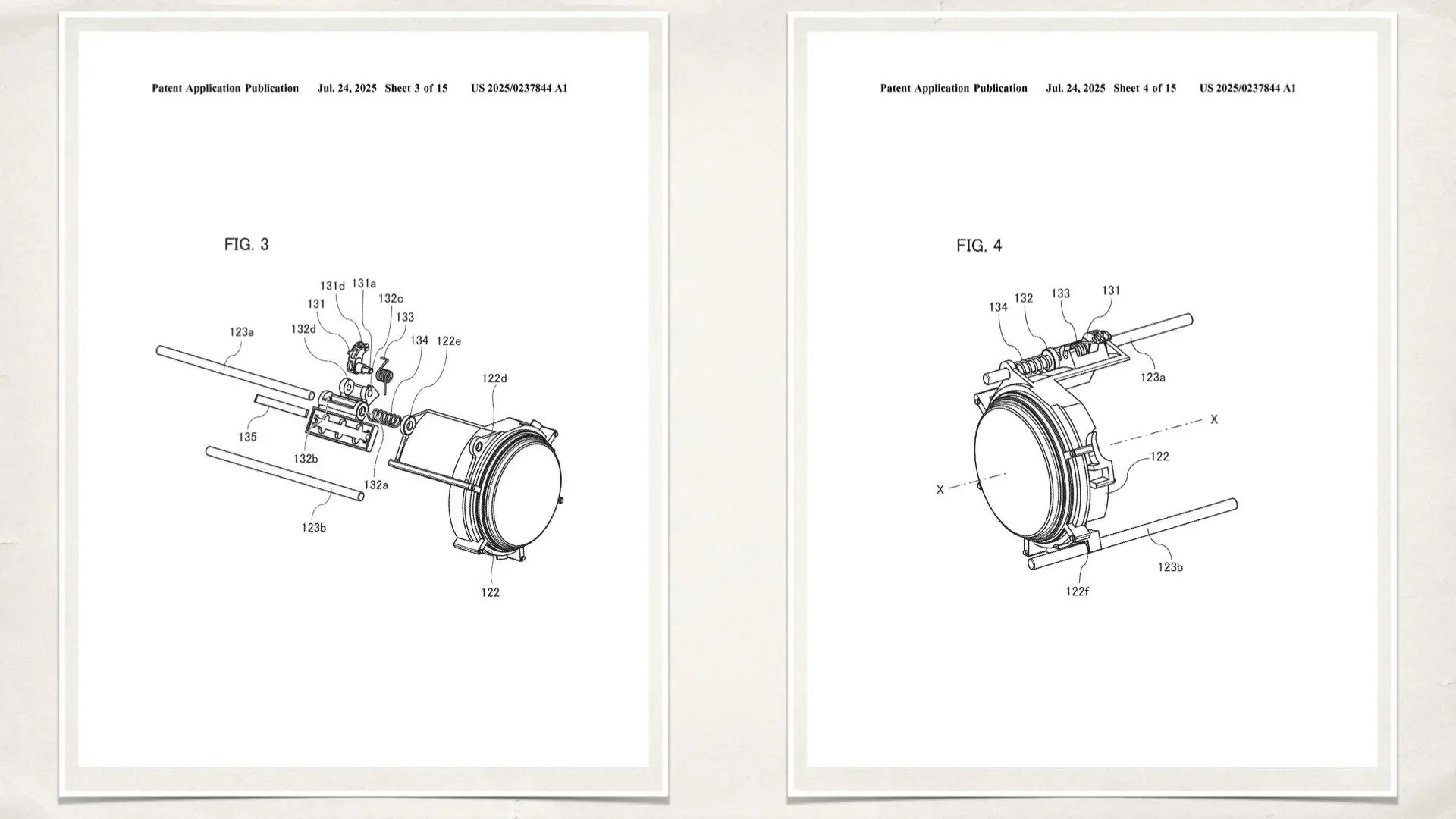
The Magic: Springs, Sensors, and Smart Retraction
Here’s how it works in simple terms:
-
The focus lens group (called L4 in the patent) is driven by a linear ultrasonic motor, the same type often found in high-end cinema and still lenses.
-
The zoom group (L5) moves adjacent to it, and sometimes into the same space, especially during fast manual zooms.
-
If the zoom group moves too far too fast, instead of damaging the motor or lenses, Canon’s dual spring system lets the focus lens retract smoothly out of the way.
-
Meanwhile, sensors still track the real-time position of all the moving parts, even during retraction. This ensures the system never loses track of focus.
The result? Faster, safer internal movement with minimal mechanical clearance, allowing for a shorter lens barrel overall.

Why This Matters to Filmmakers
This design solves a real pain point for cinematographers:
-
Shorter cinema zooms mean better balance on gimbals, drones, and handheld rigs.
-
It allows Canon to build zooms with more range in smaller packages, while still maintaining autofocus performance.
-
The use of ultrasonic motors and absolute-position sensors means focus accuracy won’t degrade even in fast or chaotic motion, essential for video.
And importantly, this mechanism is video-centric. It accounts for what happens when power is cut or zooms happen manually, something stills shooters rarely face, but filmmakers constantly do.

Part of a Bigger Plan?
This patent fits into a broader puzzle of Canon’s recent innovations aimed at filmmakers. We’ve already seen (and covered) signs that Canon is developing groundbreaking sensor and lens tech:
-
In Canon’s 24K Full-Frame Monster Sensor Is Ready, we explored their push toward ultra-high-res imaging, requiring extremely precise lens systems.
-
Their vision for Mainstream 3D Filmmaking also hinges on tightly choreographed internal optics.
-
Canon has even experimented with gimbal-integrated cameras, another area where compactness is everything.
-
Meanwhile, innovations like Canon’s smarter wiring design and their new cooling system show they’re laser-focused on building smaller, cooler, more capable video tools.
This lens barrel design could be the mechanical backbone behind those ambitions, especially for RF-mount cinema zooms. Compactness is the new game here!

The Takeaway
Canon’s patent doesn’t promise a specific product yet. But it solves a meaningful engineering problem in a way that’s elegant, scalable, and production-ready. If you’re a filmmaker who values compact gear that doesn’t cut corners, this could be the beginning of a smarter generation of Canon cinema lenses, ones that zoom faster, focus sharper, and fit better in the world of modern digital production.