This article continues Y.M.CINEMA’s new series spotlighting emerging cinematographers and the craft behind their work. The first installment, Championing the Art of Filmmaking Through True Craft, set the tone, and now we’re proud to share the insights of another rising voice. Jessica Arzate’s work is a quiet rebellion against the sterile and overproduced. Born in Mexico City and now based in Los Angeles, the AFI-trained cinematographer brings a poetic realism to every frame, whether it’s captured on 35mm film or a Panavised RED Monstro. In this in-depth conversation, Arzate opens up about her hybrid workflow, her love for lenses with character, and why film still commands a rare kind of respect on set. She also reflects on the moment a cinematographer changed her life, and how staying curious about tools, formats, and even failures continues to guide her evolving craft. From vintage glass to virtual production, this is a glimpse into the mind of a cinematographer who finds beauty in imperfection and power in intentionality.
Tech and Workflow
YMCinema: What cameras have you used most frequently in your recent projects, and why did you choose them?
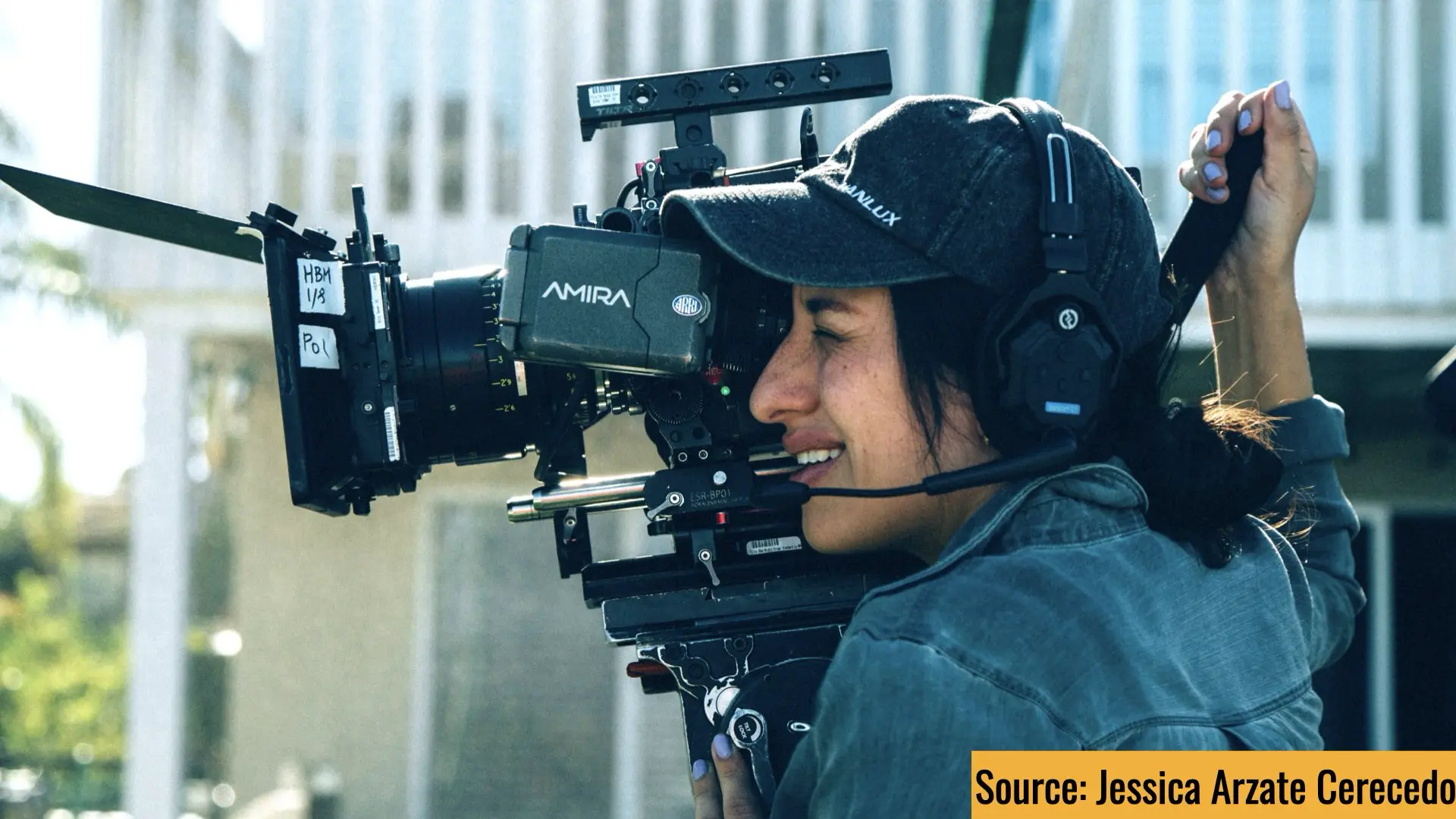
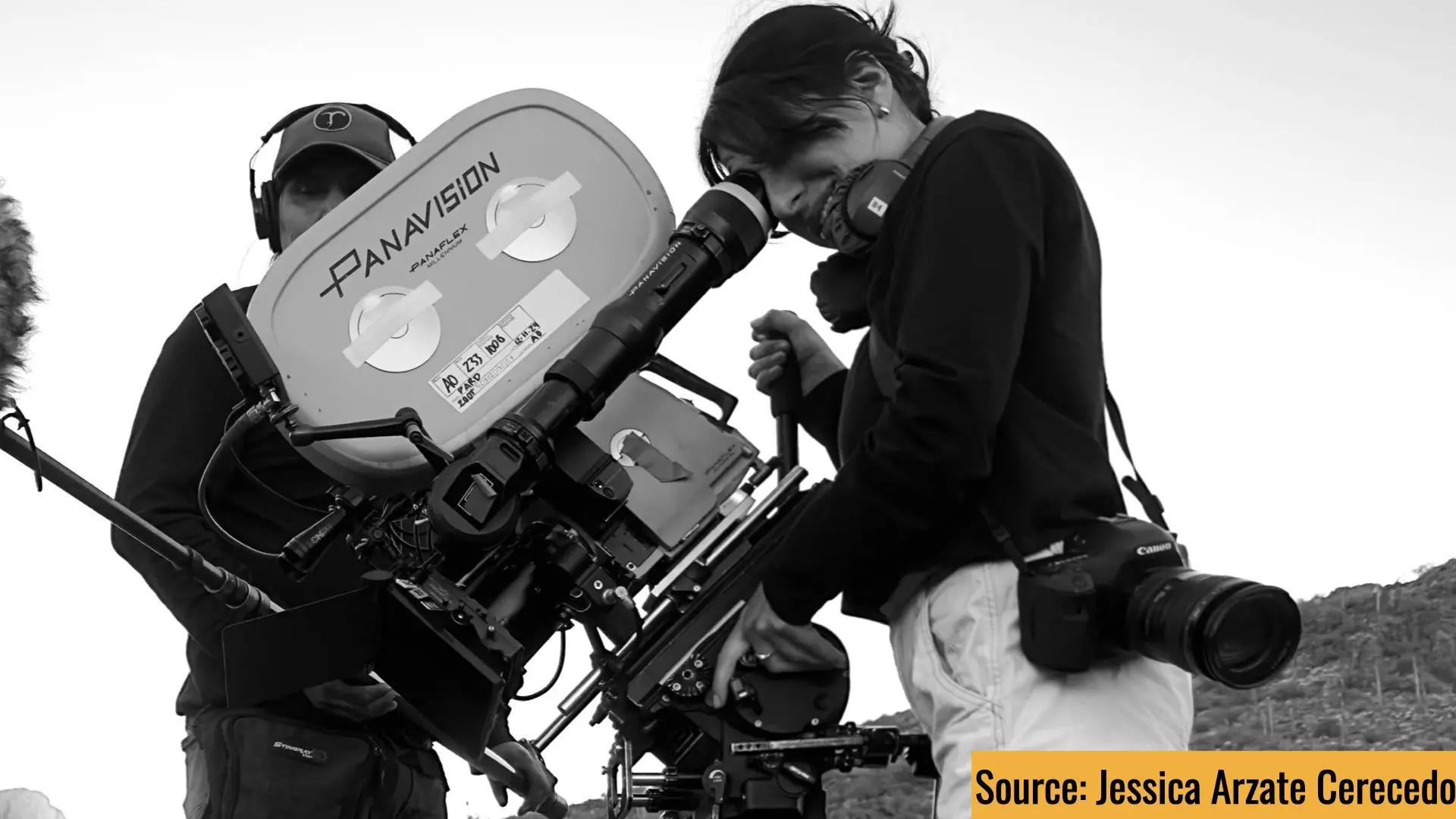
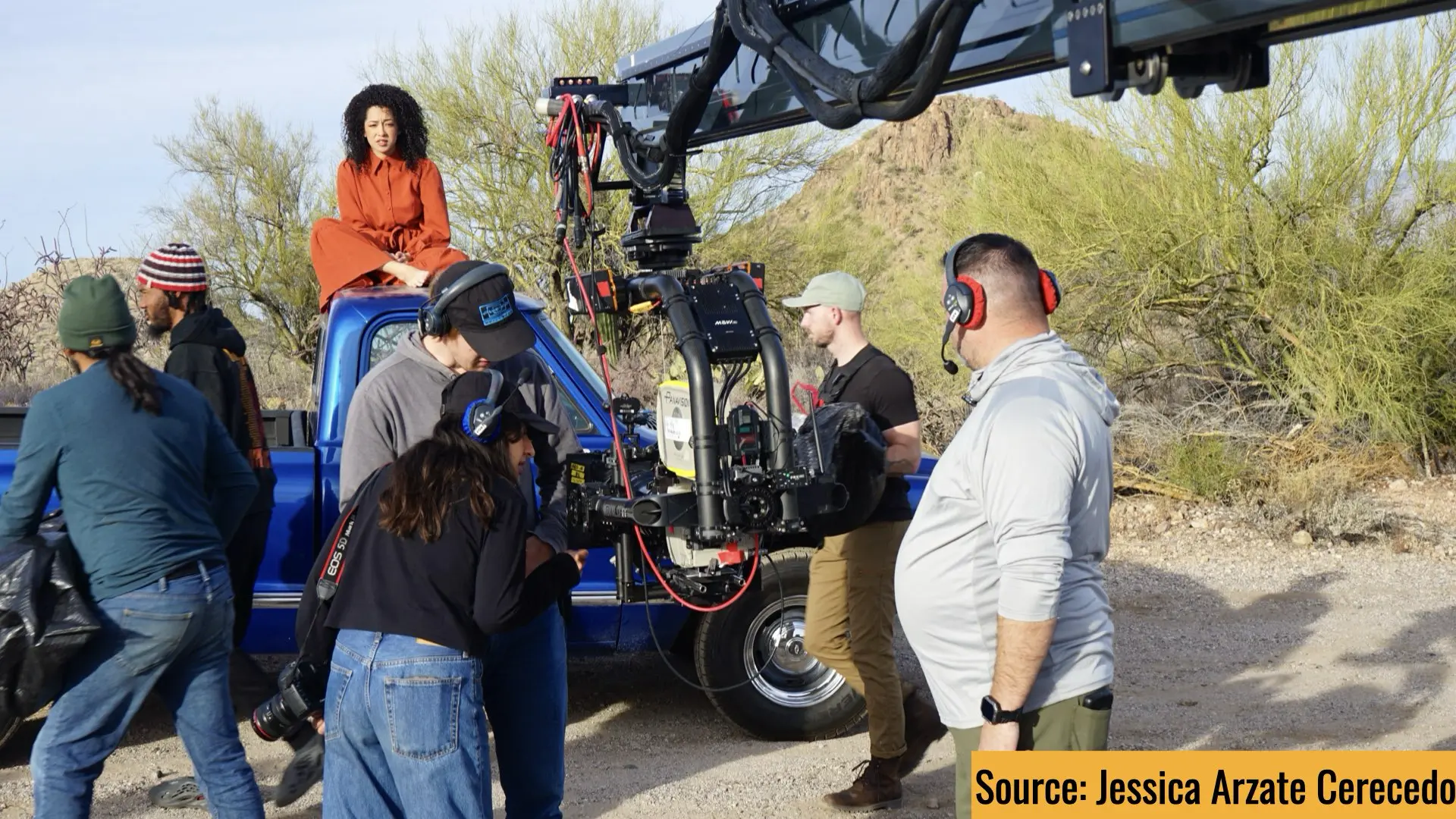
Arzate: I’ve mostly been working on narrative projects, usually a mix of digital and film. On the digital side, I tend to gravitate toward ARRI. I’m really comfortable with their workflow at this point, especially their color science and how their cameras handle dynamic range. I haven’t had the chance to try the Alexa 35 yet, but I’ve been using the Alexa LF quite a bit. The large format sensor has been great for adding depth and texture to the image without having to lean too heavily on glass. I also recently shot a feature through the Panavision Filmmaker’s Grant using a two-camera setup, the main camera was the DXL2, and the B-cam was a Panavision RED Monstro. Same sensor under the hood, technically. We shot a lot of night work on that film, and both cameras held up really well at ISO 3200. I was honestly impressed by how clean the shadows stayed. For 35mm, I’ve been working with Panavision’s Millennium XL2. It’s a bit bulky, especially in tighter locations, but super reliable. I got really comfortable with that camera back in film school; we used it for almost two years straight. So now I can pick up on little things, like if a sound is off or something’s not sitting right mechanically. It’s like muscle memory at this point.

I haven’t had the chance to try the Alexa 35 yet, but I’ve been using the Alexa LF quite a bit. The large format sensor has been great for adding depth and texture to the image without having to lean too heavily on glass. I also recently shot a feature through the Panavision Filmmaker’s Grant using a two-camera setup, the main camera was the DXL2, and the B-cam was a Panavision RED Monstro.
– Cinematographer Jessica Arzate
YMCinema: Do you have a favorite camera system or sensor format for your narrative or commercial work?
Arzate: Honestly, it really depends on the project, what the story needs, the pace we’re working at, and the kind of visuals we’re going for. That said, I do love the discipline that comes with shooting on film. There’s this built-in respect on set when you’re rolling film; people are more present, takes feel more intentional, and every foot of film has weight behind it. But yeah, some projects are just better suited for digital. I prefer large-format sensors—they give you that extra depth, allowing the images to feel more immersive. I also appreciate the flexibility that comes with dual native ISO systems, especially for low-light setups. I’m happy to try new cameras and features, but if I had to pick one system, I’m most used to ARRI. Their color pipeline, dynamic range, and skin tones—it’s just a workflow I know, and I can move fast with it without second-guessing things.
YMCinema: Which lenses do you gravitate toward, and how do they shape your visual language?
Arzate: I usually lean toward lenses that aren’t overly sharp or clinically clean. I grew up watching movies shot on film, on VHS tapes, and on an old square TV—so a lot of my visual memory is tied to that slightly softened, imperfect image. There was always this layer of texture between me and the screen, and I like bringing that same feeling into my narrative work. It adds character, depth, and a little bit of nostalgia. Some of my favorites have been a set of Panatars tuned by Dan Sasaki at Panavision—those lenses just have soul. I’ve also had great results with the rehoused Crystal Express and the Lomo-Cooke anamorphics from Old Fast Glass. Each of those sets has its own quirks that can really push the mood or emotional tone of a scene. And of course, 35mm paired with Panavision Primos is a classic combo I keep coming back to. The way those lenses render skin and highlights on film just feels right to me—it hits that sweet spot between technical quality and emotion.

Some of my favorites have been a set of Panatars tuned by Dan Sasaki at Panavision—those lenses just have soul.
– Cinematographer Jessica Arzate
YMCinema: Do you use filters (e.g., diffusion, ND) or in-camera LUTs in your workflow?
Arzate: Si! If I’m shooting digital, I’m almost always using some kind of diffusion, again just to break a bit of the sharpness and build layers into the image. Usually, I go with a ⅛ Hollywood Black Magic or sometimes a ⅛ or ¼ Ultra Low Con—depends on the project and scene. And yeah, I try to have a custom LUT built for each project—probably 80% of the time I am able to do it. It’s a great way to get the conversation going early with the director and producers about the final look. It helps everyone—from lighting to post—start aiming for the same thing. I’ve had situations where directors got used to seeing flat LOG or a baked-in Rec 709 temp grade, and then once we hit color, it was tough to shift their expectations. So, having a show LUT from the start just avoids all that and gets people used to the look early on.

YMCinema: Can you walk us through your typical camera package on set, from body to lens to accessories?
Arzate: It always depends on the scope and needs of the project, but let’s start with the basics: a solid tripod. It doesn’t have to be a full O’Connor heavy-duty head, but it needs to be stable and give me smooth movement. Stability is non-negotiable. For the camera body, I lean toward large format options with internal NDs and dual native ISO if possible. That gives me a lot of flexibility, especially in fast-paced setups. A small onboard monitor too, for awkward angles, but 90% of the time, I prefer to operate from the eyepiece. It’s my zen space. It just feels like the most focused place to connect with the performance and the frame. Lens-wise, I go for something with texture and character. Filtration we already talked about, but for accessories, I typically keep it lightweight: clip-on matte box, wireless video (like Teradek), follow focus… I’m lucky to work with ACs who are pros at keeping the build tight and clean—I really love a minimal camera footprint. One thing I always push for is good comms. I hate relying on walkies mid-shot. Having open comms with my key crew—gaffer, key grip, 1st AC—is a game changer for keeping the workflow fluid. And I’ll always advocate for enough monitors. I like having a dedicated one for the director and myself—it helps us stay in a creative bubble where we can really talk about the frame without distractions. If the location allows, I’ll usually request a dolly too. It’s the most efficient and precise ways to move the camera.
YMCinema: What are your preferred tools for monitoring and exposure control? (e.g., waveform, false color, external monitors)
Arzate: I was trained using a light meter, so that’s still my go-to when I need to double-check exposure, especially in the shadows. It’s kind of my safety net when I’m unsure. After years using it, I’ve built a lot of trust in it. That said, I usually only pull it out when I really need to confirm something—it’s more of a backup these days. Lately, I’ve been using the EL Zone System, and I think it’s super reliable. It gives me a solid reference, especially when I’m lighting skin tones or navigating tricky contrast. If I’m not working with a monitor that allows the EL Zone System, I fall back on standard false color. But ultimately, I try to trust my eye through the viewfinder. If something feels just a little too dark, it probably is. (Been there, learned that the hard way.)
YMCinema: Do you work with camera or lens tests before a shoot? If so, what are you usually looking to dial in?
Arzate: Yes! Test, test, test. It’s one of my favorite parts of the process when finding the look. I try to always involve the director, especially if the test is for aesthetic choices—like lenses, filters, or lighting setups—because it helps get us on the same page early. If the test is more about technical things, like understanding latitude/dynamic range, then I usually keep it smaller with just my team. I always prep a little document before going into a test. It helps keep things focused. I’ll list out the goals—what I want to discover—the methodology, the gear needed, an overhead of the setup, and a space to jot down first impressions. I also include a grid or checklist so I can easily compare lenses, filtration, formats, etc. I like to write some quick thoughts in the moment too, without overanalyzing—just how it felt.
Then, once I review the footage, I can go deeper into the technical side. And I always try to watch the test on the format closest to how the project will be seen—whether that’s a big screen, TV, laptop, or even phone. It really matters.
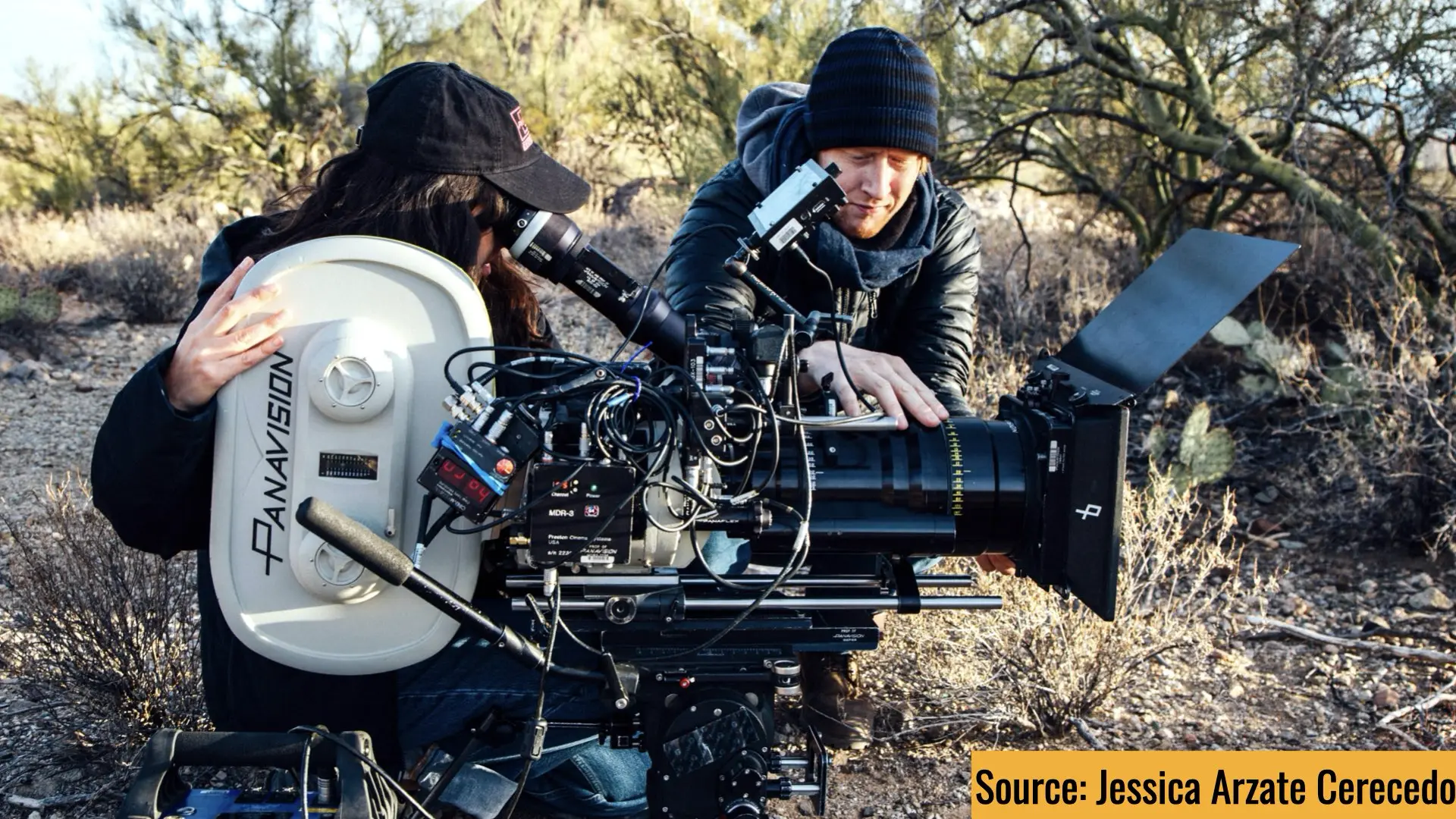
Test, test, test. It’s one of my favorite parts of the process when finding the look. I try to always involve the director, especially if the test is for aesthetic choices—like lenses, filters, or lighting setups—because it helps get us on the same page early.
– Cinematographer Jessica Arzate
Inspiration
YMCinema: What first drew you into cinematography? Was there a film or moment that sparked your passion?
Arzate: In high school, I had this vague idea that I wanted to be a filmmaker, though I didn’t really know what that meant yet. I made a short film with my brother and cousins and submitted it to a Latin America film festival . It ended up winning an award, and one of the jury members—a cinematographer—took the time to compliment the camera work. Looking back, I think part of it was him encouraging a young girl who felt a little lost, but the other part was how cool and mysterious his job sounded to me. I honestly didn’t know you could make a living by telling stories. That moment lit a fire in me, and I started researching cinematographers and their work. Fifteen years later, that spark hasn’t gone away. If anything, it’s grown stronger.

YMCinema: Who are your biggest visual influences—cinematographers, directors, artists?
Arzate: I’m really in awe of storytellers in all forms. Composers like Hans Zimmer who can evoke such powerful emotions with just a few notes. Photographers like Gordon Parks could capture the story of a whole nation and era in a single frame—that kind of storytelling power, across mediums, really inspires me.
When it comes to filmmakers, I have a lot of respect for anyone who can pull off making a strong, honest film—it’s not easy. Some films that have deeply inspired me include Paris, Texas, Lazzaro Felice, Y Tu Mamá También, Summer 1993, The Hedgehog, Nebraska, The Matrix, Mulholland Dr., Chungking Express, and many more.
YMCinema: How would you describe your visual style or philosophy in a sentence?
Arzate: I’m still discovering new layers of my style, but I’ve noticed that directors who approach me are drawn to my work because it suits a poetic and naturalistic style. I’m really drawn to finding beauty in the “normal”—so maybe they’re right about that. Understanding and developing my taste as an artist has been a beautiful but sometimes scary process, and it feels more like an ongoing search than a fixed label.

I’m interested in getting more involved with LED volumes and virtual production—there’s something exciting about blending analog craft with cutting-edge tech. Even though I love the tactile feel of analog filmmaking, I also think it’s smart to stay curious and open to what AI tools and new technologies can offer to facilitate pre-production workflows and even expand storytelling possibilities.
– Cinematographer Jessica Arzate
Future Outlook
YMCinema: What kind of stories or productions are you most excited to explore in the near future?
Arzate: Right now, I’m in pre-production on a sci-fi film, which is really exciting since it’s a genre I haven’t explored much before. I’m also looking forward to experimenting more with mixed media and working with collaborators who aren’t afraid to tell stories that are personal, vulnerable, and hopefully a little weird.
Are there any new tools, formats, or innovations in the camera world that you’re eager to experiment with? I’m interested in getting more involved with LED volumes and virtual production—there’s something exciting about blending analog craft with cutting-edge tech. Even though I love the tactile feel of analog filmmaking, I also think it’s smart to stay curious and open to what AI tools and new technologies can offer to facilitate pre-production workflows and even expand storytelling possibilities. What advice would you offer to aspiring DPs, especially those building a career internationally? Being in a city far from home can actually be a huge strength. It gives you fresh perspectives and a deeper understanding of how people perceive actions, emotions—even colors—differently. My biggest advice, which I still remind myself of, is to keep creating. Whether it’s you and your camera trying to capture a specific feeling, or shooting a dinner scene with your friends, the key is to practice and learn. That way, when you finally get to set, you’re ready to bring all that experience to the project. For me, this career has been all about patience and perseverance. Learning how to make it sustainable feels like an art form in itself. But honestly, if you can’t imagine a life without creating images, just take it steady—and keep going.

Follow Jessica Arzate:
- Website: jessicaarzate.com
- IMDb: https://www.imdb.com/name/
nm6933028 - Instagram: @jessicaarzate
Are you a cinematographer with a story to tell and the behind-the-scenes footage to back it up? Y.M.CINEMA is looking to feature more voices through this series. Contact us (via email) to share your work and be part of the conversation.