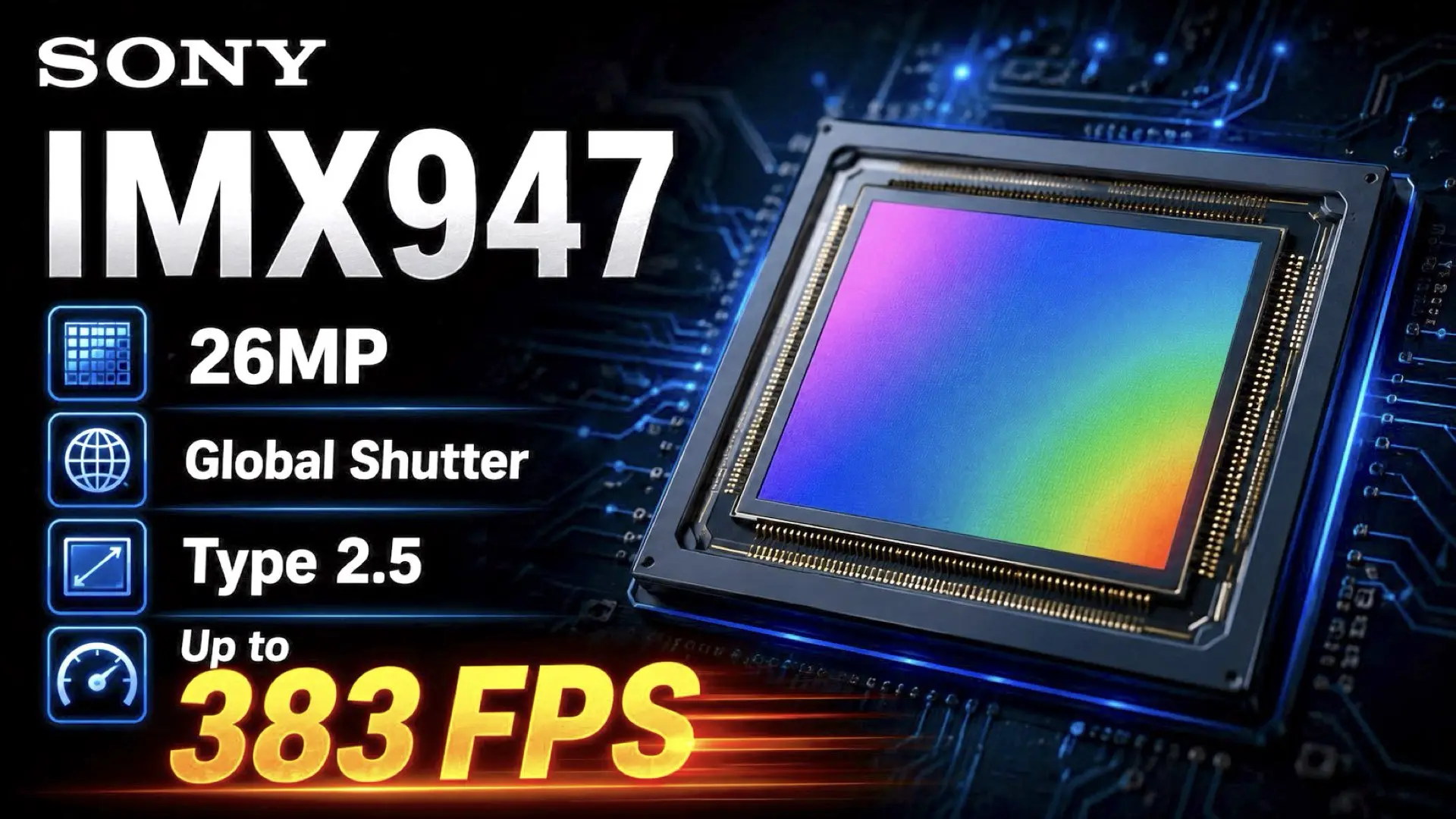
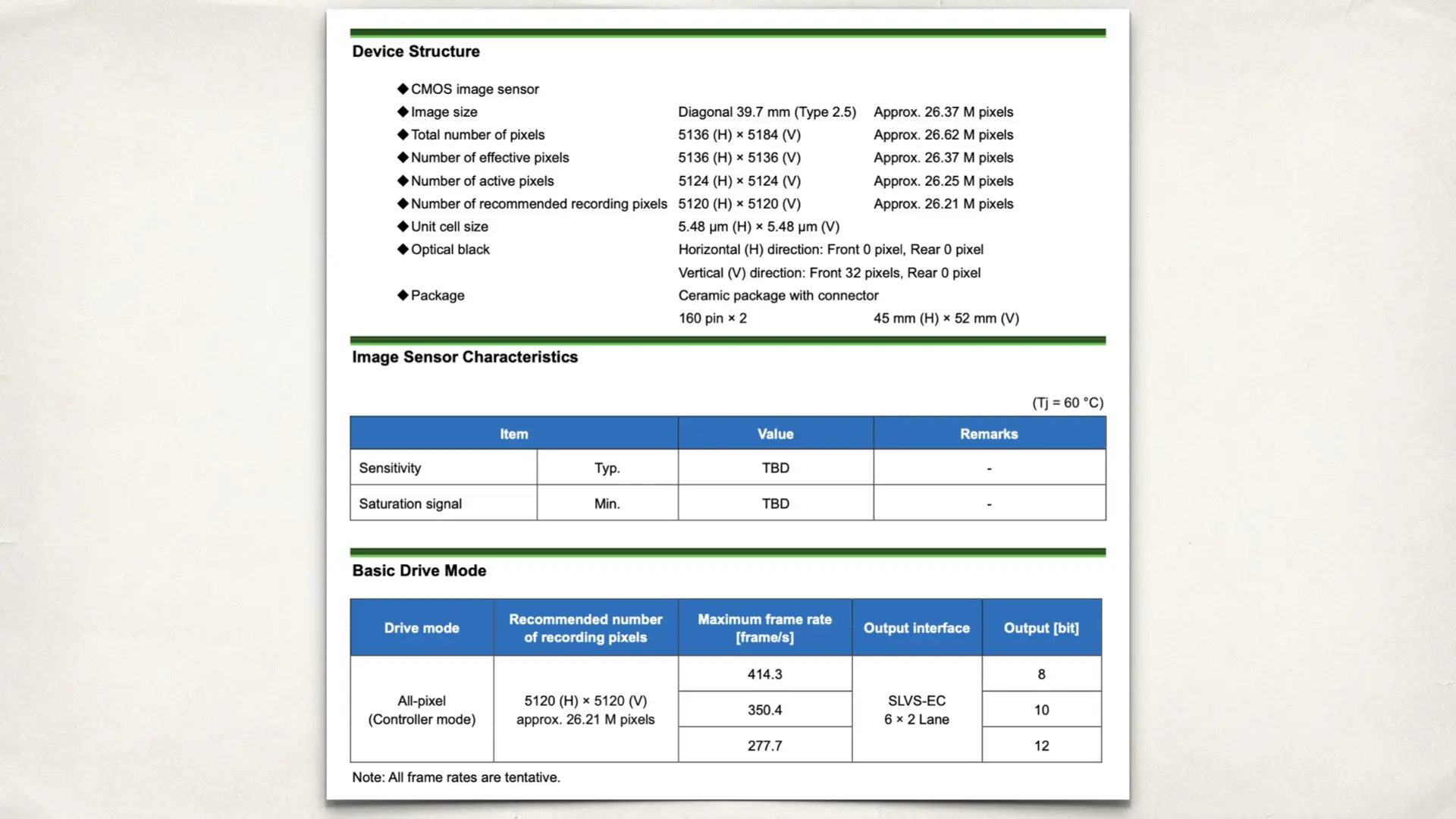
Sony Semiconductor Solutions has released product sample information for the IMX947, a new large-format global shutter CMOS image sensor aimed at industrial imaging. On paper, this is a serious sensor: Type 2.5, 26MP, square format, 5.48 μm pixels, and a maximum frame rate of 383 fps at 10 bit. The official flyer lists the IMX947-AQB as a diagonal 39.7 mm CMOS active pixel image sensor with 26.37MP effective pixels and Sony’s Pregius S global shutter technology. For the cinema and imaging community, the important point is clear. Large-format global shutter sensors are getting faster, larger, and more capable.

A massive square global shutter sensor
The IMX947 is built around a square pixel array with 5136 × 5136 effective pixels, and Sony recommends a 5120 × 5120 recording area, which equals approximately 26.21MP. The sensor has a Type 2.5 image size with a 39.7 mm diagonal, placing it in a very large imaging class for industrial cameras. The pixel pitch is 5.48 μm, which is relatively large for a 26MP sensor and should support strong light-gathering capability, although Sony currently lists sensitivity and saturation signal as TBD in the flyer. The 1:1 aspect ratio is also important. This is not a conventional 3:2, 4:3, or 16:9 camera sensor format. It is designed for machine vision, 3D vision, inspection, motion analysis, and other technical imaging applications where a square imaging area can be more useful than a traditional photographic rectangle. Sony lists the target applications as FA cameras and 3D vision cameras.
26MP at hundreds of frames per second
The hottest part of the IMX947 is its speed. Sony’s flyer lists maximum all pixel scan frame rates of 423.4 fps at 8 bit, 383.2 fps at 10 bit, and 277.7 fps at 12 bit in controller mode. The basic drive mode table on page 2 lists tentative values of 414.3 fps at 8 bit, 350.4 fps at 10 bit, and 277.7 fps at 12 bit over an SLVS EC 6 × 2 Lane interface. Sony notes that all frame rates are tentative, so the final production figures may change. Still, the direction is obvious. This is a 26MP global shutter sensor running at extremely high speed. For context, this is the kind of readout performance that matters far beyond classic factory automation. High-resolution global shutter capture is crucial for fast-moving subjects, robotics, high-speed inspection, scientific imaging, 3D reconstruction, motion capture, volumetric capture, and virtual production pipelines. The sensor is not being marketed as a cinema sensor, but the underlying technology is highly relevant to the future of digital imaging.
Pregius S and stacked global shutter technology
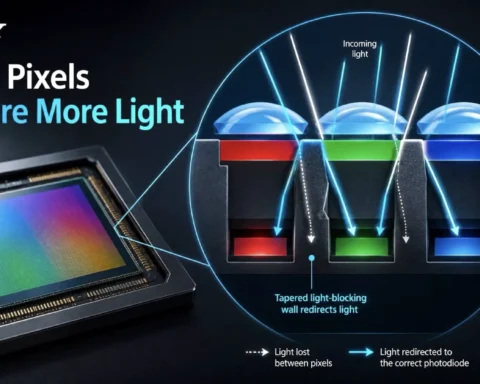
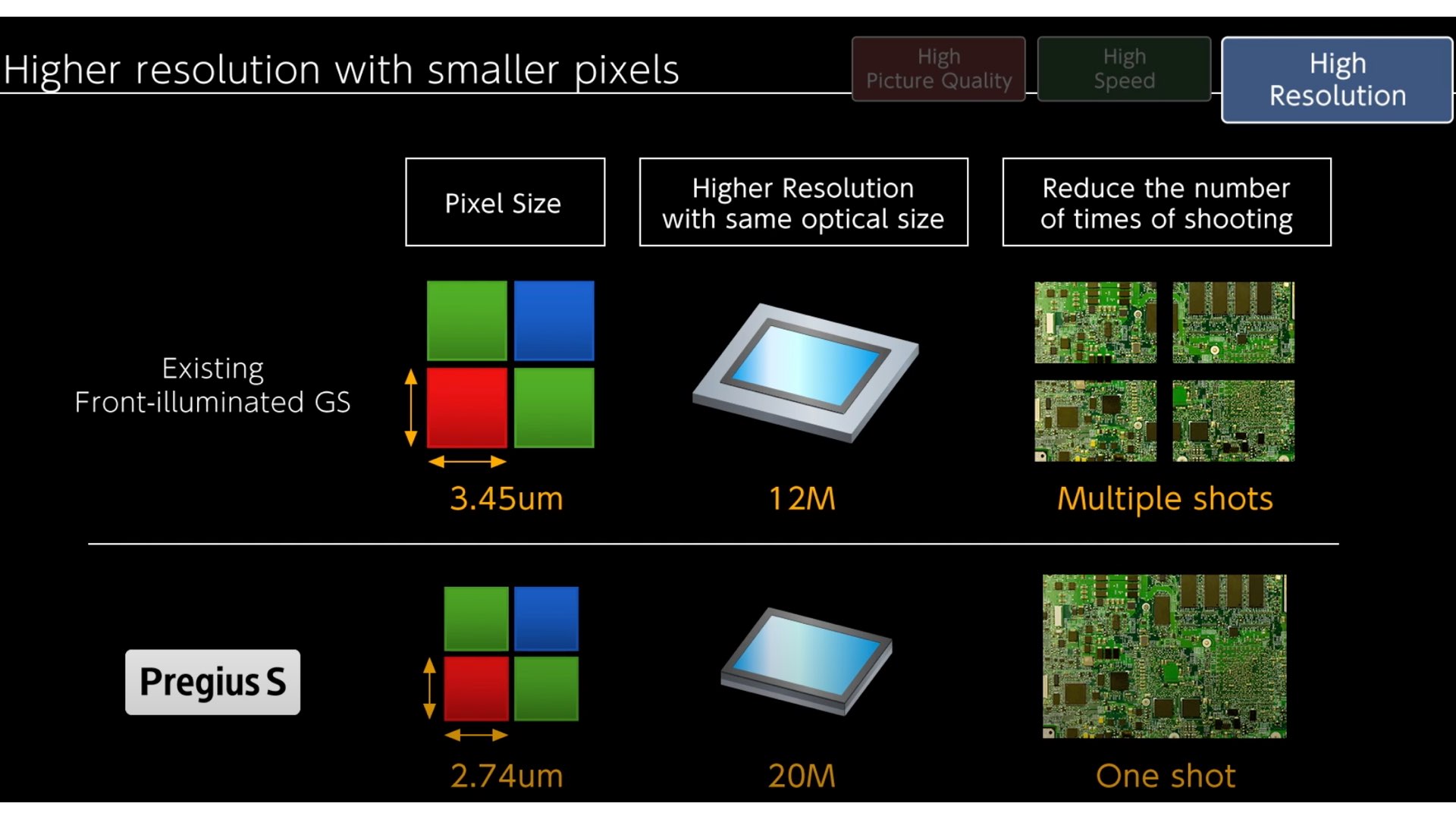
Sony identifies the IMX947 as part of the Pregius S family. According to the flyer, Pregius S is Sony’s global shutter sensor technology for active pixel CMOS image sensors, using stacked signal processing on a back-illuminated CMOS image sensor structure. The goal is to combine small chip size, high sensitivity, and high-quality global shutter pixels. That is the key technical story. Global shutter has always been desirable because it captures the entire frame at once, avoiding rolling shutter artifacts during fast motion, vibration, flashes, or rapid camera movement. The tradeoff has traditionally been sensitivity, dynamic range, cost, or readout architecture. Sony’s continued expansion of Pregius S into larger, faster sensors shows how aggressively the company is pushing global shutter performance in industrial imaging.
Why filmmakers should care
Again, the IMX947 is not a cinema camera sensor. Sony positions it for industrial applications. However, large-format global shutter technology has strong implications for filmmaking and imaging markets. Cinema cameras already benefit from innovations that first matured in industrial, scientific, and machine vision ecosystems. Faster readout, lower noise, higher sensitivity, improved ADC pipelines, and advanced global shutter pixels all eventually influence what is technically possible in creative cameras. The IMX947 is especially interesting because of its unusual combination. It is large, square, high resolution, global shutter, and extremely fast. That makes it a strong signal of where Sony’s image sensor division is moving. The sensor may never appear in a cinema camera, but the architecture, interface strategy, and global shutter development behind it are highly relevant to the next generation of high-speed imaging tools.
Sample shipment starts in April 2026
According to the product information sent by Sony, a sample shipment for the IMX947 Mono version is scheduled for April 2026. One point still needs clarification: the email refers to the Mono version, while the attached flyer identifies the IMX947-AQB and describes it as being for color cameras. That may indicate different variants, a preliminary flyer, or wording related to camera systems rather than the specific sensor version. We have asked Sony for clarification.

Sony’s IMX roadmap is getting aggressive
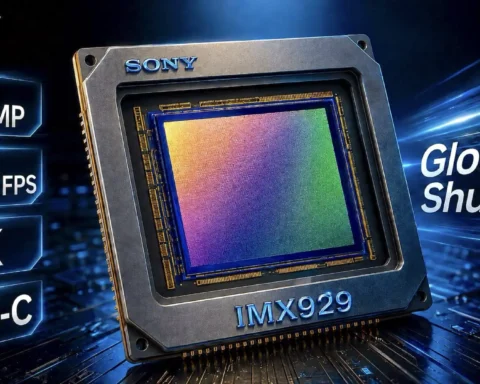
Sony’s IMX947 also joins a broader wave of innovative Sony industrial sensors that show how fast the company is advancing global shutter technology. In Sony Announces a New 10K Global Shutter Large Format Sensor, we reported on the IMX927, a massive 10K class square global shutter sensor with more than 105MP and a 39.7 mm diagonal, designed for ultra-high resolution machine vision and advanced imaging systems. Then, in Meet Sony’s 8K Global Shutter Sensor Pushing 200 fps, we covered the IMX929, an 8K class Pregius S global shutter sensor pushing high frame rates for full sensor readout. Together with the new IMX947, these sensors point to a clear direction: Sony is scaling global shutter across resolution, sensor size, and speed, from 8K high-speed capture to 10K large format imaging, and now a Type 2.5, 26MP sensor capable of hundreds of frames per second.
Final thoughts
The IMX947 is a serious reminder that Sony’s most exciting sensor work does not always arrive first in consumer cameras. Sometimes it appears in industrial imaging, where speed, precision, synchronization, and global shutter performance are mission-critical. A Type 2.5, 26MP global shutter sensor capable of hundreds of frames per second is exactly the kind of technology that can shape the next phase of high-speed imaging. For filmmakers, VFX teams, virtual production engineers, and camera geeks, the IMX947 is worth watching.