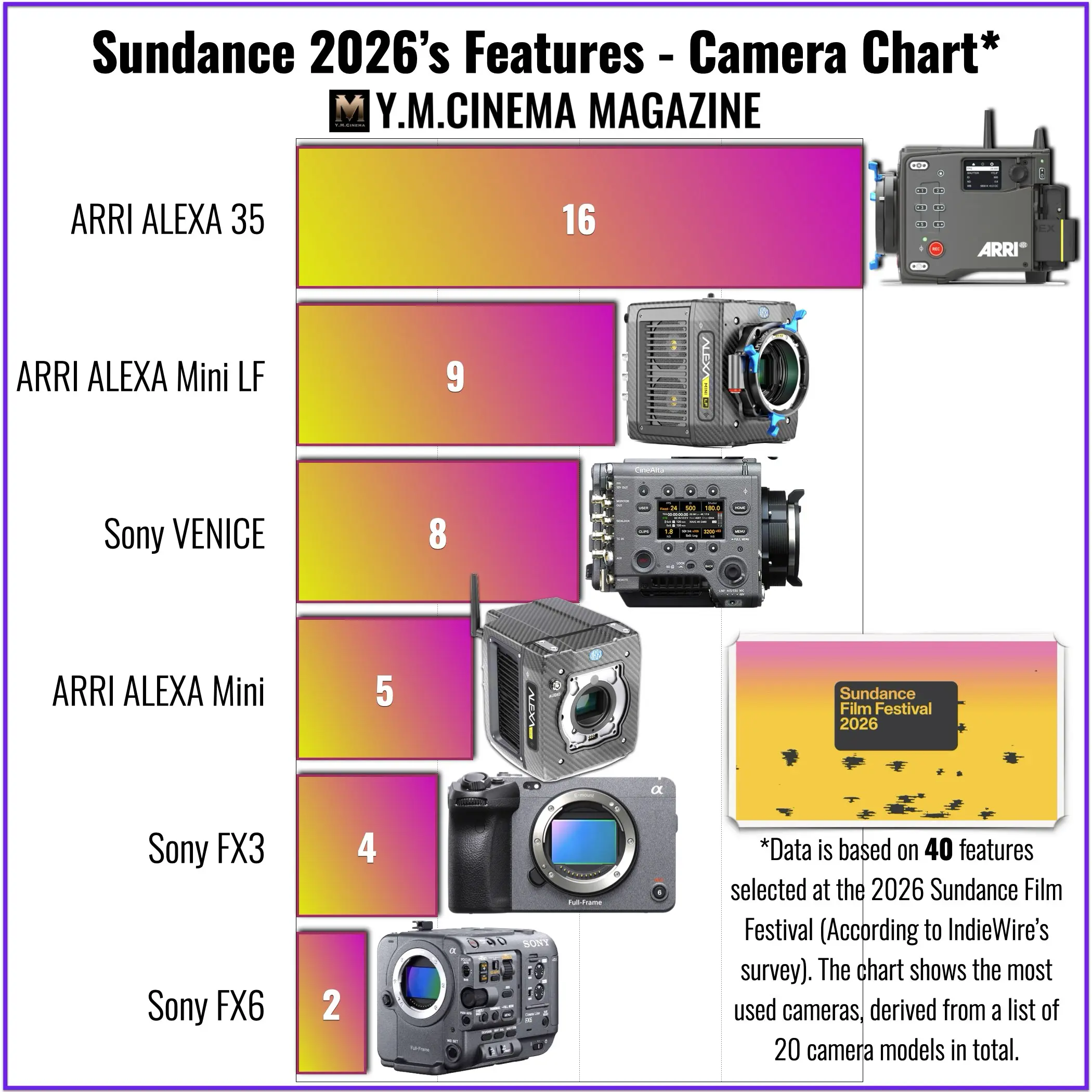
An analysis of Sundance 2026 narrative features reveals a decisive camera trend. ARRI overwhelmingly dominates feature production, led by the ALEXA 35, which appears on 16 films, followed by the ALEXA Mini LF and ALEXA Mini. Sony remains the only significant alternative, with VENICE systems and the FX3 used in more specialized roles. When compared with the far more diverse camera landscape seen in The Cameras Behind Sundance 2026 Documentaries, the data highlights a clear divide between feature and documentary workflows. Narrative films continue to prioritize dynamic range, color fidelity, and post production consistency over compactness or speed, reinforcing ARRI’s position as the dominant technical foundation at Sundance 2026.
Acknowledgment and Credit
This article is based on the 2026 Sundance Features Cameras Survey published by IndieWire as part of its How I Shot That series. The survey provides rare, first-hand insight from directors of photography on the cameras and lenses used across this year’s Sundance feature slate. We would like to thank the IndieWire editorial team and the participating filmmakers for compiling and sharing such detailed technical data. Surveys like this are an invaluable resource for cinematographers, filmmakers, and industry professionals, offering a grounded look at real-world production choices rather than marketing narratives. YMCinema’s analysis and breakdown are derived directly from this publicly available survey, with additional aggregation and trend interpretation for educational and editorial purposes.
Introduction
At Sundance 2026, the cameras chosen for feature films paint a very different technical picture than those used across the festival’s documentary slate. While nonfiction productions leaned heavily toward compact, flexible systems, the feature lineup shows a decisive return to traditional high-end digital cinema platforms. Across U.S. Competition, World Cinema, NEXT, Premieres, and Midnight sections, ARRI cameras overwhelmingly define the visual language of Sundance’s narrative features, with the ALEXA 35 emerging as the clear centerpiece.
ARRI ALEXA 35 dominates
Out of the analyzed films, the ARRI ALEXA 35 was used on 16 feature productions, making it the most deployed camera system at the festival by a wide margin. When combined with the ALEXA Mini LF and ALEXA Mini, ARRI platforms dominate principal photography across Sundance 2026 features. This trend mirrors what we did not see in documentaries. In our companion analysis, The Cameras Behind Sundance 2026 Documentaries, camera choices were far more fragmented, favoring smaller bodies, hybrid systems, and rapid deployment over consistency and maximal image control. The feature film data highlights why that divergence exists. Narrative productions consistently prioritized dynamic range, color accuracy, highlight roll-off, and post-production latitude, all areas where ARRI’s latest Super 35 sensor has proven reliable. The ALEXA 35’s 17-stop dynamic range, enhanced sensitivity modes, and ARRI Textures enabled cinematographers to work confidently in natural light, extreme contrast environments, and night exteriors while maintaining a unified visual identity across entire features.
Sony VENICE: Strong alternative to ARRI
Sony remains the only meaningful alternative at scale. Sony VENICE cameras appeared on 8 features, typically selected for productions that required modular builds, Rialto extensions, or higher ISO flexibility. The Sony FX3, used on 4 features, appears primarily as a secondary or specialty camera, echoing its much larger role in documentary production but with a different function. In documentaries, FX3-class cameras often served as primary tools; in features, they supplement larger systems rather than replace them. Taken together, the comparison between features and documentaries at Sundance 2026 reinforces a clear conclusion. When filmmakers move from observational storytelling to scripted performance and controlled visual design, ARRI remains the default technical foundation, while Sony fills targeted operational niches rather than redefining the overall aesthetic.
Sundance 2026 Feature Films. Cinematography Breakdown
| Film Title | Director of Photography | Camera System(s) | Lenses Used |
|---|---|---|---|
| Bedford Park | David McFarland | ARRI ALEXA 35 | Moviecam Primes |
| The Best Summer | Tamra Davis | Sony Hi-8 Camcorder | Integrated Zoom |
| Big Girls Don’t Cry | Maria Inés Manchego | ARRI ALEXA Mini LF | Panavision VA |
| Buddy | Zach Kuperstein | Sony Venice 2 | Fujinon B4 8.6-172mm, Canon S16 7-63mm, Lomo Standard Speeds, ARRI Signature Primes |
| Burn | Hiroaki Takeda | ARRI ALEXA Mini | Cooke S3 |
| Carousel | Dustin Lane | ARRI LT, ARRI 435 (35mm) | Cooke S4 Primes |
| Chasing Summer | Eric Branco | ARRI ALEXA Mini LF | Cooke FF Anamorphic SF |
| Extra Geography | Andrew Commis | ARRI ALEXA Mini LF | Canon K35 |
| Filipiñana | Xenia Patricia | ARRI ALEXA 35 | Canon K35 |
| Frank & Louis | Judith Kaufmann | ARRI ALEXA Mini LF | Zeiss Supreme Prime T1.5 |
| Gail Daughtry and the Celebrity Sex Pass | Kevin Atkinson | Sony Venice 2, FX3, DJI Air 3S, GoPro Hero 10, iPhone 14 Pro | Gecko G35 Vintage 66, Angenieux Optimo Ultra, Angenieux EZ-1, EZ-2 |
| The Gallerist | Federico Cesca | ARRI ALEXA 35 | Blackwing7 Binaries |
| Ha Chan, Shake Your Booty! | Daniel Satinoff | ARRI ALEXA 35 | Cooke S2/S3 TLS, Varotal 18-100, Panchro 20-60, Cinetal 25-250 |
| Hot Water | Alfonso Herrera Salcedo | Sony Venice 1, FX6, FX3 | Panavision Ultra Speed |
| How to Divorce During War | Narvydas Naujalis | ARRI ALEXA 35 | Angenieux Optimo 20.5-98, 24-290 |
| The Huntress | Maria Sarasvati Herrera | ARRI ALEXA Mini LF, ALEXA 35 | Lomo Illumina Mk I |
| If I Go They Will Miss Me | Michael Cambio Fernandez | ARRI ALEXA Mini LF | Panaspeeds |
| The Incomer | Patrick Golan | Sony Venice II | Ironglass Mk II Soviet, Zeiss Super Speeds, ARRI Master Primes |
| The Invite | Adam Newport-Berra | Panavision XL2 (35mm) | Panavision GW Primes, Panavision 11:1 Zoom |
| Josephine | Greta Zozula | ARRI ALEXA 35 | Zeiss Super Speeds, Zeiss Master Primes |
| Lady | Alana Mejia Gonzalez | Sony Venice 1 and 2 | Canon K35, Cooke 25-250 Zoom |
| Levitating | Gunnar Nimpuno | ARRI ALEXA 35, RED Raptor XL | Atlas Orion Anamorphics |
| Mum, I’m Alien Pregnant | Bayley Broome-Peake | ARRI ALEXA 35 | ARRI Master Primes, Cooke 1.8x SF Anamorphics, Atlas Orion 2x, ARRI Alura Zooms |
| The Musical | Tu Do | Sony Venice 2, FX6, FX3 | Cooke Panchro Classic FF, Angenieux Optimo 24-290, Cooke SP3 |
| Night Nurse | Lidia Nikonova | ARRI ALEXA Mini LF | Panavision Super Speeds, Cooke PV Zooms |
| The Only Living Pickpocket in New York | Sam Levy | ARRI ALEXA 35 | Bausch & Lomb Super Baltar Primes (TLS) |
| Rock Springs | Heyjin Jun | ARRI ALEXA 35 | Zeiss MKIII Super Speeds, Angenieux Zooms |
| Run Amok | NB Mager | ARRI ALEXA Mini | Zeiss Supreme Primes, Panavision Primo |
| Saccharine | Charlie Sarroff | ARRI ALEXA 35 | Canon FD-X Primes |
| See You When I See You | Jim Frohna | ARRI ALEXA 35 | Canon K35 |
| Shame and Money | Janis Mazuch | ARRI ALEXA Mini | Canon FD |
| The Shitheads | Guillermo Garza | ARRI ALEXA 35 | Panavision Pvintage Primes |
| Take Me Home | Farhad Ahmed Dehlvi | ARRI ALEXA Mini | Panavision Primo Primes |
| Tell Me Everything | Ziv Berkovich | Sony Venice | Angenieux Optimo Prime Gold |
| Undertone | Graham Beasley | ARRI ALEXA Mini LF | ARRI Signature Primes and Zooms |
| Union County | Stefan Weinberger | ARRI ALEXA Mini, ALEXA 35 | Cooke S4i, Angenieux Optimo Zooms, Canon Cine-Servo |
| The Weight | Matteo Cocco | ARRI ALEXA 35 | Vantage Hawk V-Lite Vintage 74 Anamorphic |
| Wicker | Lol Crawley | ARRI ALEXA Mini LF | ARRI Signature Primes, Impression V, Canon K35 |
| Zi | Benjamin Loeb | RED Komodo, Bolex 16mm, Sony FX3 | Super Takumar 35mm |
The Camera Chart
Click on the chart for a full-resolution view.
Discussion
Taken as a whole, the Sundance 2026 feature lineup confirms a widening technical gap between narrative and documentary filmmaking. While documentaries at the festival embraced diversity, speed, and portability as detailed in The Cameras Behind Sundance 2026 Documentaries, narrative features moved decisively in the opposite direction. Features prioritized consistency, tonal control, and post production reliability, even when budgets and production conditions remained firmly in the independent realm. The dominance of the ARRI ALEXA 35 is particularly telling. Its widespread adoption across 16 features suggests that cinematographers now view it as a complete solution rather than a specialized or transitional camera. The combination of high dynamic range, predictable color response, and ARRI Textures allowed filmmakers to work confidently in difficult lighting scenarios without sacrificing cohesion across long shooting schedules. This is evident in films that relied heavily on natural light, night exteriors, or high contrast interiors, where the camera’s ability to preserve highlight detail and shadow structure became a creative enabler rather than a technical constraint. The continued presence of the ALEXA Mini LF reinforces a parallel but slightly different priority. Large format was not used indiscriminately, but rather selectively, often paired with lenses that emphasized falloff, softness, and spatial separation. Canon K35s, Cooke S4 and S2 series, Lomo Illumina, Panavision VA, and other vintage or character-driven optics appear repeatedly across the lineup. These lens choices suggest that cinematographers were less interested in clinical sharpness and more focused on emotional texture, halation, and imperfect rendering. The pairing of modern sensors with older glass created a hybrid aesthetic that feels contemporary but not digitally aggressive. Sony’s role in the feature space is best understood as complementary rather than competitive. Sony VENICE systems appeared on several high-profile features, often where modularity, Rialto extensions, or higher ISO flexibility were required. These productions frequently involved vehicle rigs, underwater work, or complex physical constraints, areas where VENICE has clear operational advantages. However, the data shows that VENICE rarely displaced ARRI as the dominant visual anchor of a film. Instead, it functioned as a strategic choice for specific production needs rather than a default creative platform. The Sony FX3 further illustrates this division. In documentaries, FX3 class cameras often served as primary systems. In features, they were typically secondary tools, used for tight spaces, handheld inserts, or specialty shots. This reinforces the idea that feature filmmakers are willing to incorporate compact cameras, but only when they can be visually integrated into a larger, more controlled imaging pipeline. Film cameras and alternative digital systems also play an important symbolic role in the dataset. The appearance of 35mm film cameras, Bolex 16mm, RED Komodo, and RED Raptor XL highlights that Sundance remains a space for experimentation and intentional aesthetic choice. However, these systems are used sparingly and deliberately. Film is employed where texture and temporality are central to the narrative, not as a default nostalgic gesture. RED systems appear primarily in high-speed, compositing-heavy, or technically demanding sequences rather than as full-feature workhorses. Their presence adds nuance to the landscape but does not challenge the overall hierarchy. What ultimately emerges from the Sundance 2026 feature data is not a rejection of new technology, but a reaffirmation of trust. Cinematographers appear increasingly comfortable placing their films in systems that offer known behavior under pressure. In contrast to documentaries, where unpredictability demands flexibility, narrative features reward stability, repeatability, and deep familiarity with sensor response and color science. The comparison between features and documentaries is therefore less about brand loyalty and more about workflow philosophy. Documentary filmmakers prioritize access and immediacy. Feature filmmakers prioritize continuity and control. Sundance 2026 makes that distinction clearer than ever, and in doing so, it reinforces why ARRI continues to anchor the visual identity of independent narrative cinema, even as the broader camera ecosystem continues to expand.
A quiet standout. The Sony FX3
One final note deserves attention. Among the high-end cinema systems dominating Sundance 2026, the Sony FX3 stands out as the most affordable camera to make a meaningful appearance in narrative features. While it was not positioned as a primary A camera, its presence on multiple films underscores how far compact full-frame cameras have come. Used strategically for handheld work, confined spaces, vehicle rigs, and specialty shots, the FX3 proved that price alone no longer defines creative relevance. In a festival otherwise shaped by premium cinema tools, the FX3 represents a quiet reminder that capable sensors, strong color science, and thoughtful integration can still earn a place alongside the industry’s most trusted systems.
As an Amazon Associate, Y.M.Cinema earns from qualifying purchases. If you purchase through the Amazon links above, Y.M.Cinema may earn a small commission at no additional cost to you. This helps support our work.