

With its anticipated debut, the Canon Cinema EOS C50 ($3,699 on Amazon) (also dubbed “EOS RC”) is poised to redefine the compact cinema camera category, offering filmmakers a blend of cinematic specs, efficient ergonomics, and Canon’s renowned image quality.
-
Replacing the EOS R5 C ($3,199 on Amazon) , the C50 trims weight and complexity while retaining a filmmaking-first approach, eliminating the EVF and mechanical shutter to focus on streamlined video capture. Read more about the R5 C price drop and C50 implications.
-
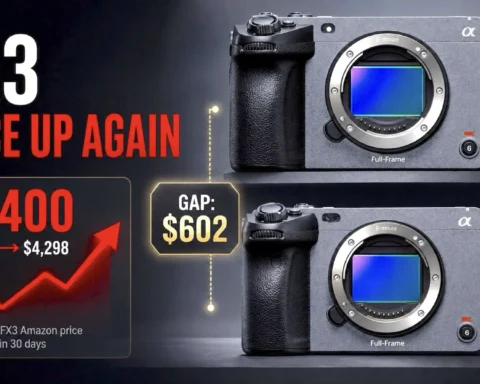
Positioned as a direct Sony FX3 ($4,298 on Amazon) competitor, Canon’s compact solution now seems tailored for creator workflows and hybrid shooters seeking agility without sacrificing cinema-level performance. Explore the FX3 rivalry in our C50 breakdown.

Deep dive: What the C50 might offer
Here’s a thorough breakdown of the rumored specs emerging from credible sources and insiders:
Sensor & recording capabilities
-
32 MP full-frame BSI CMOS sensor, offering rich detail and framing flexibility, even if final production units use a 45 MP sensor architecture (R5 II-derived).
-
7K at 60 fps internal RAW capability is speculated, giving powerful frame-grab and post-production options.
-
4K up to 120 fps (uncropped and/or cropped options) for high frame-rate action capture.
Cinema-focused features
-
Open Gate recording, likely utilizing the full sensor area for maximum dynamic range and creative reframing in post.
-
15+ stops of dynamic range, supporting current grading standards.
-
C-Log2 and C-Log3 profiles—Canon’s cinematic tone and wide exposure latitude.
-
Dual base ISO for solid low-light performance and minimal noise at crucial stops.
Ergonomics & design
-
Lightweight body (under 700 g) measured without lens; a gimbal and handheld friend.
-
No EVF and no mechanical shutter, emphasizing silent, electronic-only operation.
-
A fully articulating LCD for flexible framing in cramped or overhead shooting.
-
Luxuries like a large red record button, tally light, and possibly an add-on XLR handle for improved audio capture.
-
Photo/Off/Video mode switch—great for hybrid workflows with quick access to stills.
Recording media & autofocus
-
Main model spec points to dual CFexpress Type B slots; some leaks suggest variants with dual SD for flexibility.
-
Dual Pixel CMOS AF II—a proven autofocus system in Canon’s cinema and mirrorless lines.
Performance & value
-
40 fps burst for stills is rumored—enough for quick take sequences or focus charts.
-
Expected price of $3,499 to $3,999 (body only), making it competitive with Sony’s FX3 and offering better integration into Canon’s lens ecosystem.

What this means for filmmakers
The C50 appears engineered to deliver professional cinema video in a compact package, ideal for:
-
Solo creators & documentarians needing a mobile, high-performance tool.
-
Hybrid shoots where both stills and video are required, without downtime or clunky transitions.
-
Gimbal operators, stealth filmmakers, and streamers looking for a streamlined, cine-grade capture system.
If these specs hold true, the C50 won’t just replace the R5 C—it could lead Canon’s small-cinema revolution.

Final thought: Canon’s goal and the philosophy behind the C50
It is tempting to look at the C50 only through the lens of specifications. Numbers are easy to compare: 7K RAW, 120 fps slow motion, 32 megapixels, dual slots. But Canon’s move with the C50 is not simply about matching or outpacing Sony’s FX3 on a technical sheet, but about staking a claim on what the future of cinema-ready cameras should look like in the hands of a new generation of filmmakers. Canon seems to be asking: what if a cinema camera could be both uncompromising in image quality and liberating in form factor? For years, the company has straddled two worlds—the uncompromising Cinema EOS line built for crews, and the hybrid EOS mirrorless bodies favored by content creators. The R5 C was a bridge between these worlds, but it still carried weight and complexity. The C50 feels like Canon’s attempt to redraw the map entirely. By eliminating the EVF, by prioritizing the articulating screen, by adding a record button and tally lamp more prominent than any stills control, Canon is acknowledging the realities of modern production. Much of today’s professional work is not carried out on massive soundstages; it happens on city streets, in small studios, on remote shoots where minimal gear is key. Indie filmmakers, documentarians, and even commercial teams demand portability without creative compromise. The C50’s rumored price point reinforces this philosophy. At under $4,000, Canon places it in a sweet spot: not a luxury flagship, but not an entry-level experiment either. It becomes a practical tool, accessible enough for working filmmakers while serious enough to anchor professional projects. This is how a company shapes not only its market position, but also its cultural relevance in the storytelling community. Perhaps the deeper goal behind the C50 is to normalize cinema cameras as everyday creative companions. Instead of being relegated to high-budget productions, a Cinema EOS camera might soon feel as ordinary in a backpack as a stills camera or a drone. If that is the case, the C50 could mark a turning point where “cinema” stops being a niche ambition and becomes a daily language for a broader group of creators. So yes, tomorrow’s (or today’s) launch will be about specs and availability. But in the long run, the conversation should also be about philosophy: Canon is proposing a new relationship between filmmaker and tool. Whether the market embraces this vision is still to be seen, but it is an intriguing question worth following closely. So, what do you think about the C50?
Gear mentioned in this article
Available on Amazon
| Product | New | Renewed | Used |
|---|---|---|---|
| Canon EOS C50 | $3,699 | — | From $3,609.41 |
| Canon EOS R5 C | $3,199 | — | From $2,495.10 |
| Sony FX3 | $4,298 | — | — |
Prices checked: Sep 19, 2026, 5:30 AM GMT+0000
As an Amazon Associate, Y.M.Cinema earns from qualifying purchases. If you buy through our links, we may earn a small commission at no extra cost to you.
Product prices and availability are accurate as of the date/time indicated and are subject to change. Any price and availability information displayed on Amazon.com at the time of purchase will apply to the purchase of this product.
CERTAIN CONTENT THAT APPEARS ON THIS SITE COMES FROM AMAZON. THIS CONTENT IS PROVIDED “AS IS” AND IS SUBJECT TO CHANGE OR REMOVAL AT ANY TIME.






The R5 C is still a better choice than the C50.
The R5 C still has advantages: higher resolution sensor (45 MP), more flexibility for hybrid shooters, and established workflows. But the C50 is clearly targeted differently: lighter body, simplified design, Open Gate, 7K RAW, and It’s less about replacing the R5 C and more about creating a compact cine tool to compete with the FX3.
Thanks for the detailed overview and thoughts on who the camera is supposed to be for !
It looks like though it’s a Cine camera it is supposed to be also appealing to “creators” like you mentioned and professionals with a more run-and-gun approach :”it happens on city streets, in small studios, on remote shoots where minimal gear is key.”
With this in mind how can one justify the absence of IBIS on this camera which is one of the rumored spec I’ve seen on other website. I really hope this is something they got wrong because otherwise I fail to understand the logic behind this move. Some mention the interest of no IBIS in drone shots or when it’s mounted on a car but how are these situations frequent enough and happening to a significant enough amount of people to completely remove a feature Canon is known to be good at ? Would love to have your thoughts on that.
Canon’s cinema design philosophy is often different from their stills/hybrid line. In the EOS C-series, stabilization is usually handled in three other ways:
Lens-based IS: Many RF and EF lenses already carry optical stabilization, which Canon considers the “first line” of defense.
Digital IS: Several cinema models (like the C70) implement electronic stabilization, which can be effective when paired with lens IS.
Rig-based solutions: For cinema workflows, gimbals, steadicams, drones, and car rigs are the standard expectation, so Canon may assume these tools replace the need for sensor-shift IBIS.
Why skip IBIS?
Precision workflows: IBIS can introduce subtle sensor shifts that complicate VFX, drone footage, or shots where precise sensor alignment is critical.
Heat and reliability: Removing IBIS frees up space and reduces mechanical complexity, important in a compact body designed for long recording times in formats like 7K RAW.
Market segmentation: Canon may want to keep IBIS primarily on hybrid models (R5 C, R6 II) while positioning the C50 as a cinema-first tool for filmmakers who already rely on rigs.
Does that mean creators lose out? Not necessarily. For handheld run-and-gun, pairing the C50 with RF lenses that have excellent optical IS, plus Canon’s digital stabilization, can still produce stable results. It won’t replace the buttery IBIS of an R-series hybrid, but it’s consistent with how Canon draws the line between “Cinema EOS” and “Hybrid EOS.”
In short: the absence of IBIS looks like a deliberate design choice to optimize heat, size, and reliability for cinema applications. It may frustrate hybrid shooters, but for Canon it reinforces the C50’s identity as a pure cinema tool rather than a crossover camera.
Cheers and THX!
On my R5C I like the EVF, especially for stills. I like a larger sensor size (I think I do…?). But: I really want an R5C top handle that takes XLRs, and not have to juggle a bolt on top handle with the Tascam XLR2d. I really want full size HDMI port. I like the slightly reduced profile and lighter weight of the C50. This looks like a great camera but definitely cine not stills centric. I’m going to hold on to my R5C a while longer – not least to see what bumps in the road appear for the C50. Unless anyone wants to buy my R5C now – it’s in great condition….
You’ve summed up really well what many hybrid shooters are probably feeling. The C50 clearly leans into the “cine-first” philosophy—Canon seems to have made some intentional choices to separate it from the R5 C.
EVF vs no EVF: For stills shooters the R5 C still holds a big advantage. Canon seems to want the C50 to be stripped down for video, especially with its compact body and reliance on external monitoring.
Sensor & video pipeline: The move to a 7K open-gate BSI sensor gives it new cinema-focused strengths, but you’re right—it shifts away from the hybrid appeal.
Top handle with XLRs: This is an area where Canon did listen. The detachable XLR handle directly integrates without the Tascam workaround you mentioned. That makes the audio workflow much cleaner for run-and-gun setups.
Connectivity: Full-size HDMI and timecode support are big wins compared to the R5 C, especially if you’re working with external recorders or in multicam environments.
Form factor: The weight and profile make the C50 easier to rig, but as you noted it does sacrifice the hybrid versatility.
So in a way, the C50 isn’t designed to replace the R5 C, but to sit beside it: one as a hybrid cinema/stills bridge, the other as a streamlined cinema tool. Your plan to hold onto the R5 C makes a lot of sense—especially if you value the EVF and stills capabilities—while keeping an eye on how the C50 performs in the real world.
THX for commenting. Cheers!