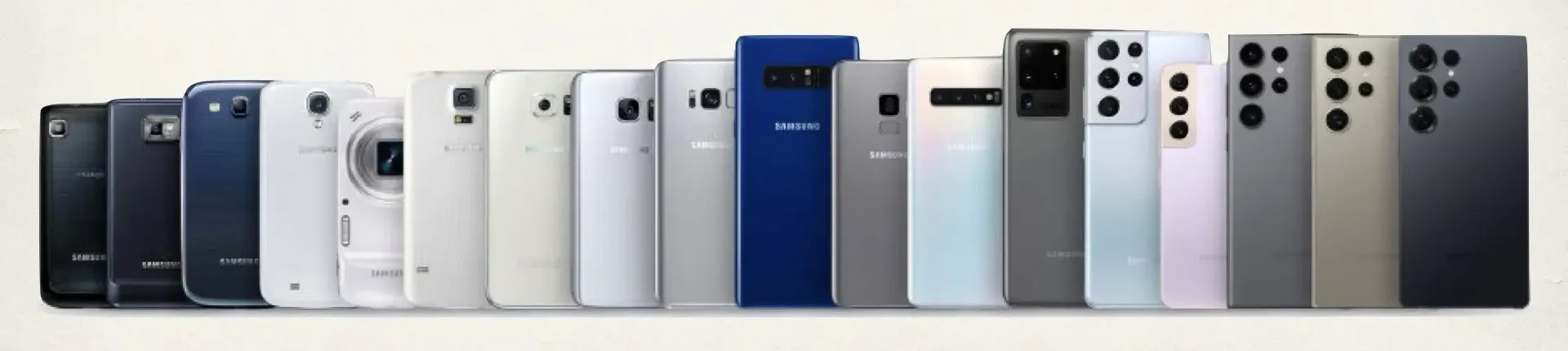
Smartphone cameras have gone from simple tools to pro-grade imaging systems. Samsung’s Galaxy journey captures that transformation. In just 15 years, the series leaped from a 5 MP rear camera in 2010 to a 200 MP DSLR-like setup in the Galaxy S ($339.99 on Amazon) 25 Ultra. This evolution is about how far mobile technology has pushed into the world of cinema. Samsung Presents: 15 Years of Galaxy Camera Innovation. Check it out.
From 5 MP to pro autofocus
The first Galaxy S in 2010 offered a modest 5 MP rear camera. Just a year later, the Galaxy S II delivered 8 MP, LED flash, and 1080p video at 30 fps. The Galaxy S III in 2012 brought zero shutter lag and HDR, marking the beginning of computational photography. By 2013, the Galaxy S4 Zoom took the bold step of introducing 10x optical zoom in a smartphone, a move that hinted at Samsung’s cinematic ambitions.
Stabilizing the image
The Galaxy S5 in 2014 added phase detection autofocus, a first for smartphones. A year later, the Galaxy S6 introduced optical image stabilization, reducing blur in low-light shooting. The Galaxy S7 in 2016 raised the bar further with dual pixel autofocus, the same principle used in DSLRs, applied across the entire 12 MP sensor for lightning-fast focusing in challenging conditions.
Multiple lenses, cinematic control
In 2017, the Galaxy S8 improved the front camera with autofocus, while the Galaxy Note8 ($169.99 on Amazon) introduced Samsung’s first dual rear cameras for wide and telephoto. Portrait mode was born. The Galaxy S9 in 2018 added dual aperture for automatic exposure control and super slow-motion recording at 960 fps. These features pointed directly at cinematic tools once reserved for dedicated cameras.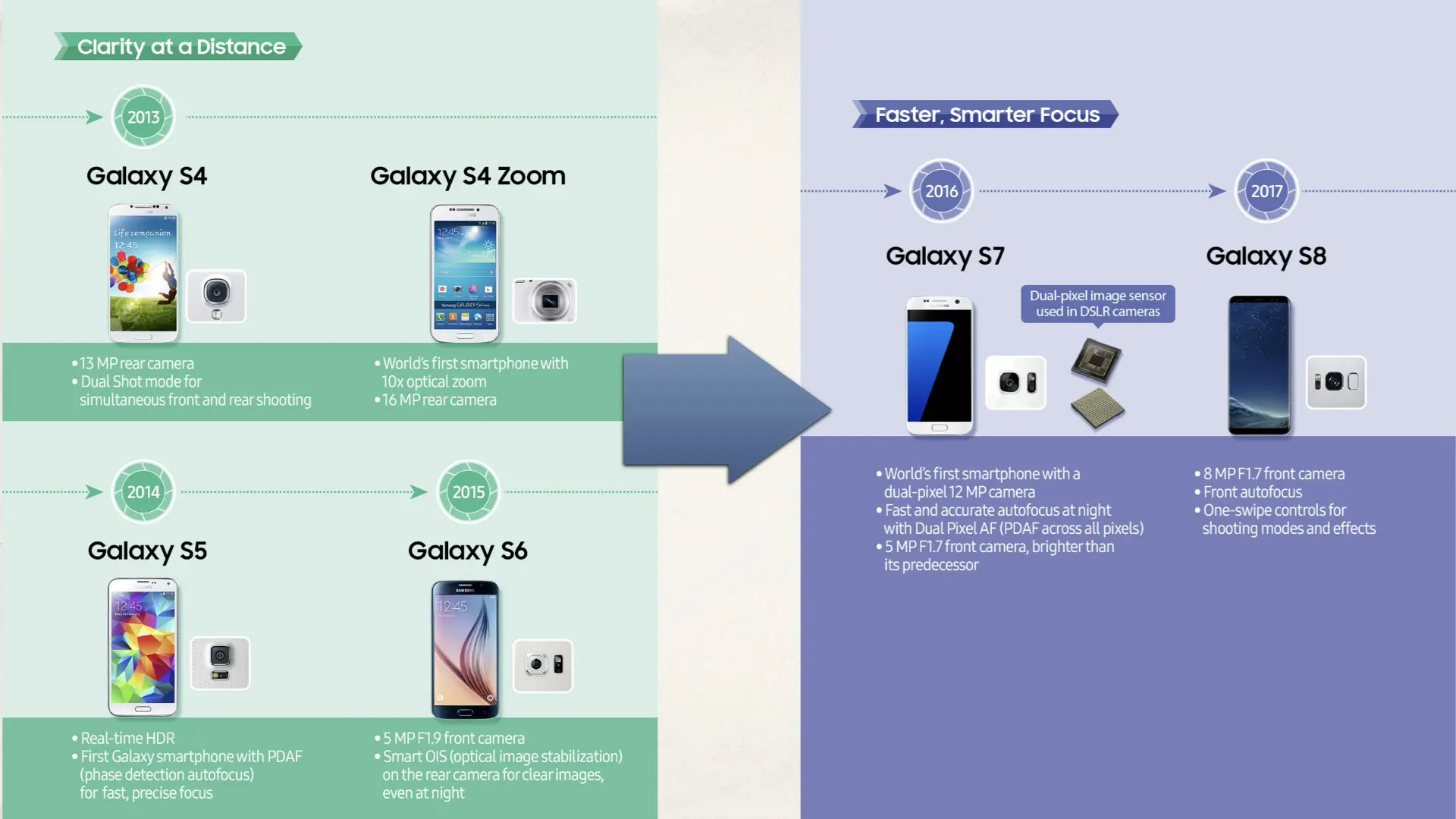
The jump to ultra resolution
The Galaxy S10 ($184.99 on Amazon) in 2019 cemented the era of multiple lenses, shipping with telephoto, wide, and ultra-wide cameras. But it was the Galaxy S20 Ultra ($229.99 on Amazon) in 2020 that redefined resolution, introducing a 108 MP main sensor, 8K video capture, and the headline-making 100x “Space Zoom.” In 2021, the Galaxy S21 Ultra expanded the system to quad telephoto lenses and Director’s View, a function enabling simultaneous multi-camera video recording.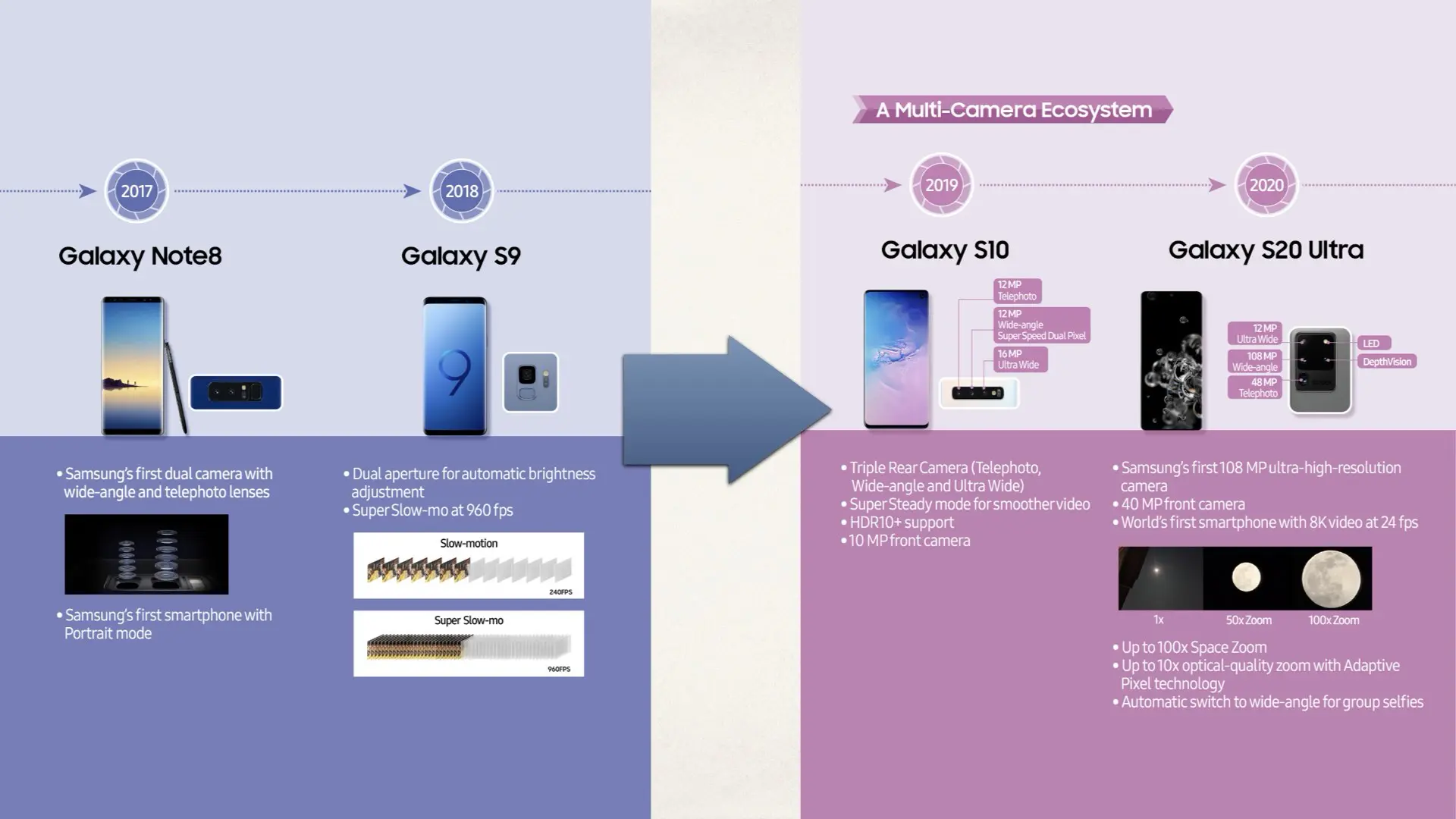
Nightography and astrophotography
Low-light creativity took center stage with the Galaxy S22 in 2022, branded under Samsung’s Nightography system. Features like advanced OIS and RAW astrophotography apps gave filmmakers new tools for shooting in extreme darkness. The Galaxy S23 Ultra in 2023 pushed resolution to 200 MP and introduced a Hyperlapse mode specifically for capturing the night sky, further blending smartphone convenience with cinematic artistry.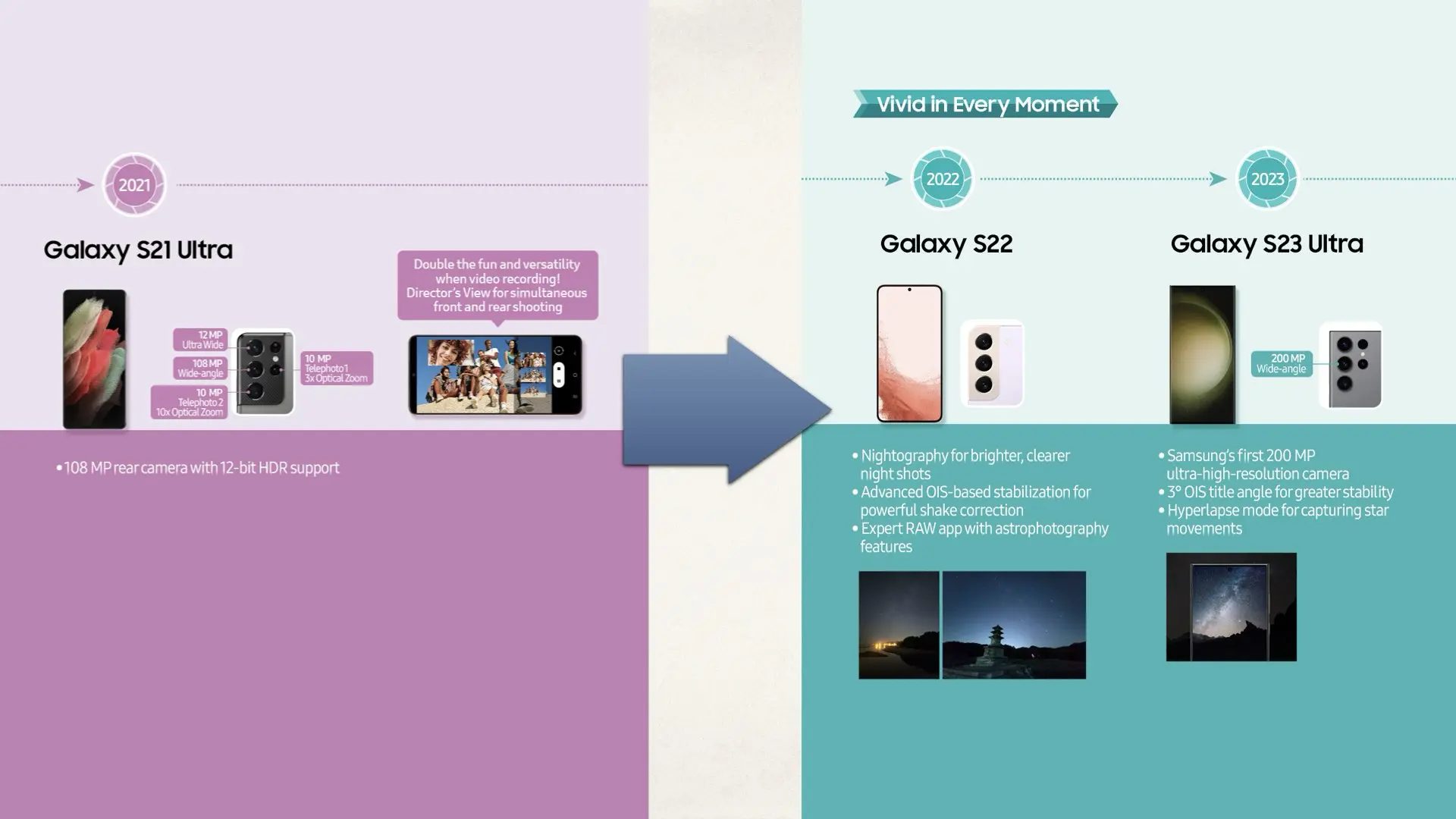
The AI imaging era
AI entered the core of Samsung’s strategy with the Galaxy S24 Ultra in 2024. Instant slow-motion, generative edits, and 4K at 120 fps created workflows that mirrored professional editing environments. The Galaxy S25 Ultra ($692.31 on Amazon) in 2025 goes further with a 200 MP main sensor, dual 50 MP telephotos, Samsung LOG for professional color correction, and a DSLR like virtual aperture. These tools transform a smartphone into a platform designed not only for casual photos but for professional video production.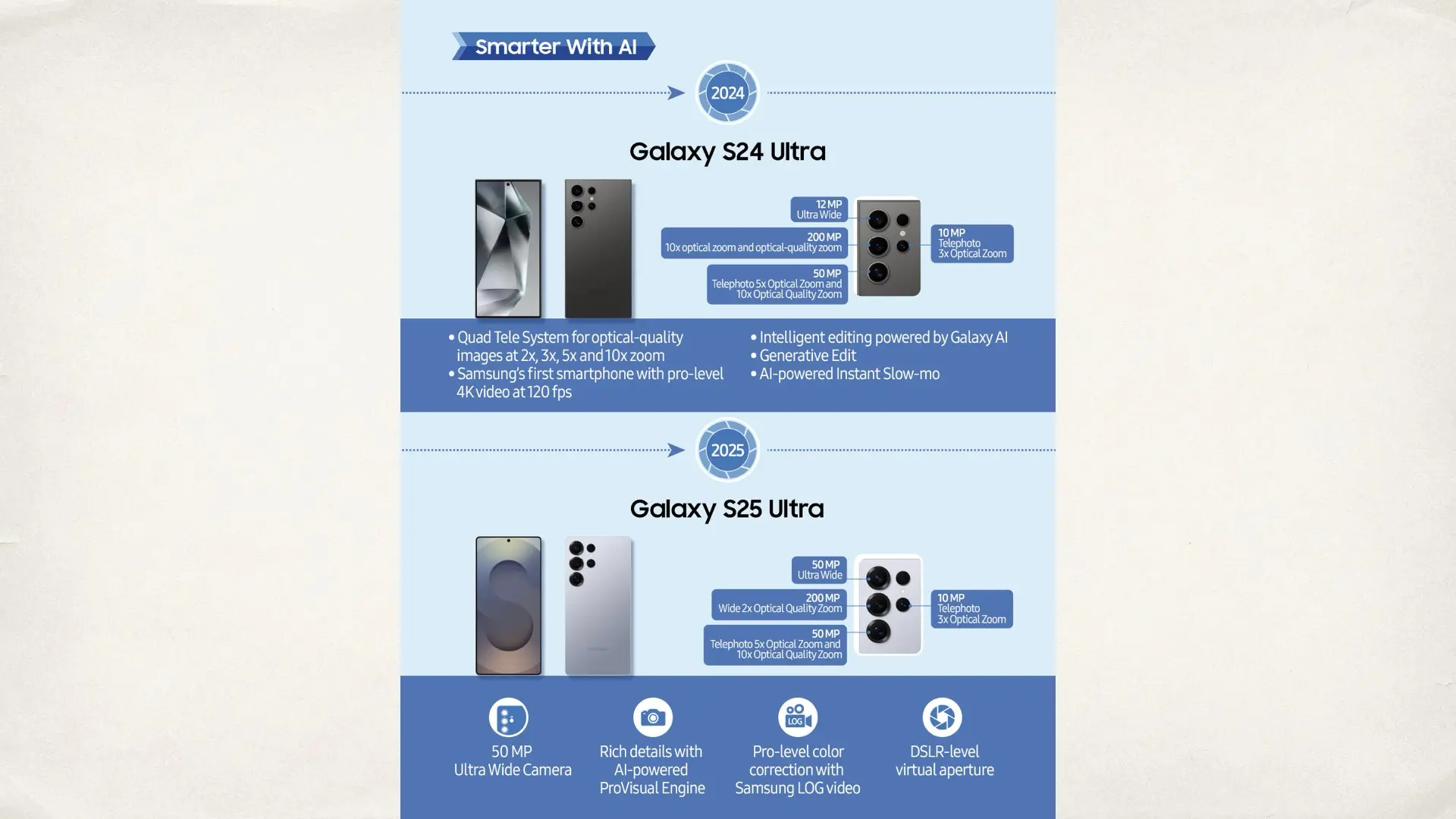
What it means for filmmakers
Cinema cameras remain unmatched in dynamic range, lens interchangeability, and raw power. Yet the trajectory of Samsung’s Galaxy cameras proves that smartphones are absorbing more and more cinematic language. Features like LOG color profiles, astrophotography apps, quad telephoto systems, and AI-driven editing tools are no longer experiments, but standard. For filmmakers, this means having a pocket device that can serve as a B-camera, a scouting tool, or even a main unit in documentary and live broadcast scenarios. The line between phone and cinema gear is not disappearing, but it is being redrawn every year.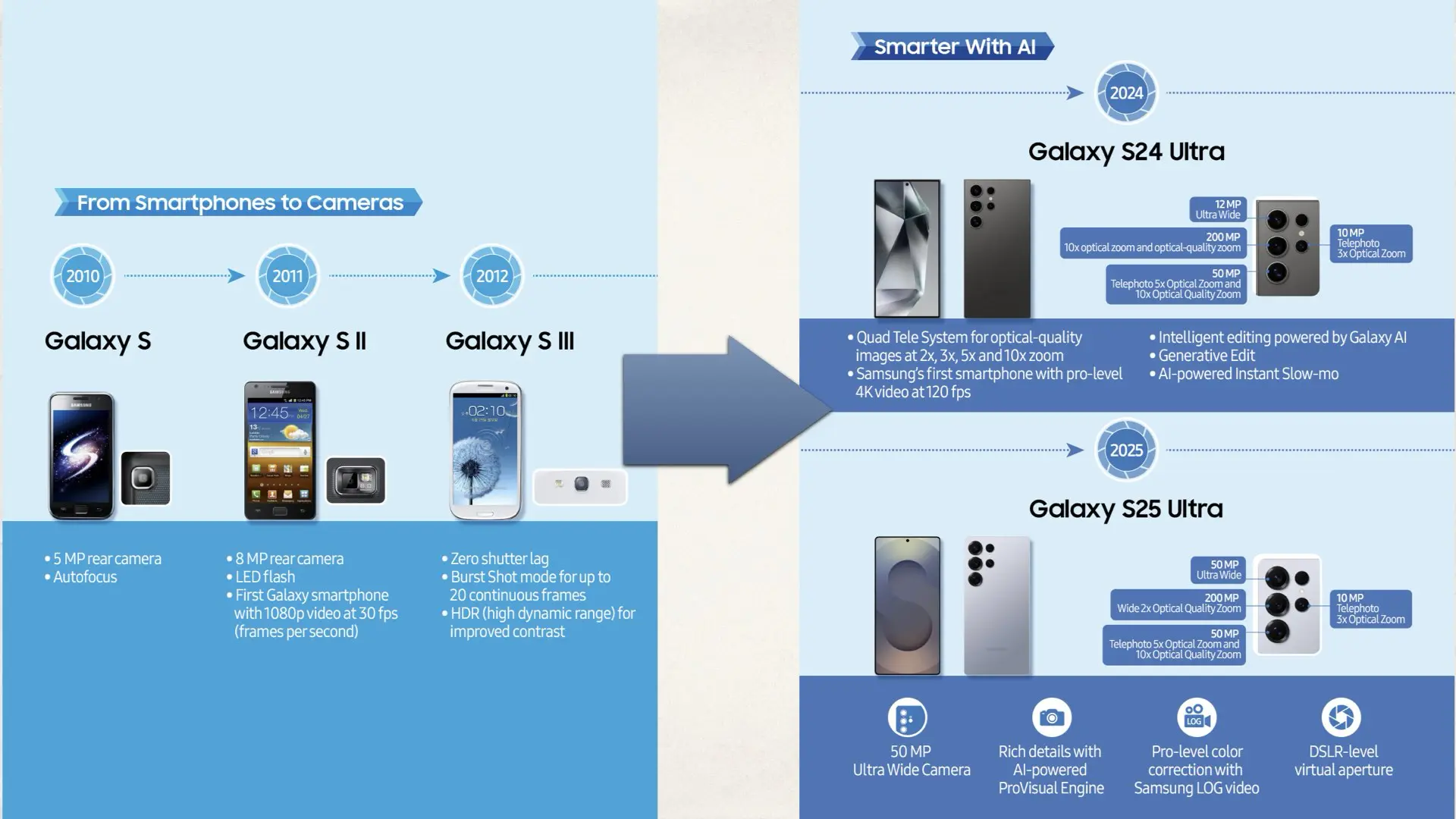
Spotlight: Samsung innovations in YMCinema coverage
Over the years, YMCinema has followed Samsung’s more experimental and forward-thinking imaging technologies — the kind of research that hints at where mobile cinematography is heading.
-
NanoPrism tech for filmmaking
In 2025, YMCinema reported on Samsung’s NanoPrism technology, designed to bend and control light inside ultra-thin modules. This could improve low-light performance, reduce lens flare, and boost cinematic contrast. -
Compact magnetic aperture module
Another 2025 story explored Samsung’s compact magnetic aperture system. By replacing mechanical iris blades with a magnetic actuator, Samsung aims to give smartphone shooters DSLR-like control over depth of field in a slim form factor. -
Strengthened sub-camera sensors for video
In 2024, YMCinema revealed Samsung’s push to strengthen sub-camera sensors. The goal was to make every module — wide, telephoto, and ultra-wide — capable of producing professional-grade video. -
Isocell HP1 and 8K mobile sensor
Back in 2021, YMCinema covered Samsung’s presentation of the Isocell HP1 8K sensor, which pointed to new standards in mobile resolution and throughput. -
16K resolution sensor for 8K video
That same year, YMCinema also reported on Samsung’s 16K resolution sensor concept. While experimental, it demonstrated how Samsung was already anticipating the demands of oversampling and next-generation video workflows.
Together, these breakthroughs show Samsung’s strategy of blurring the boundary between mobile photography and professional cinematography. Many of these innovations later feed directly into Galaxy Ultra devices, closing the gap between lab research and everyday filmmaking.

Takeaway
In 15 years, Samsung has transformed Galaxy cameras from simple autofocus shooters into AI-driven, DSLR-like systems that can handle pro-level video. The leap from 5 MP to 200 MP tells a story of ambition. And as mobile cameras continue to climb toward professional workflows, YMCinema will keep tracking how close they can get to true cinema. Stay tuned.
Gear mentioned in this article
Available on Amazon
| Product | New | Renewed | Used |
|---|---|---|---|
| Samsung Galaxy S | $339.99 | — | — |
| Samsung Galaxy S25 Ultra | $692.31 | — | — |
| Samsung Galaxy S III | — | — | From $39.95 |
| Samsung Galaxy S4 Zoom | — | — | From $334.99 |
| Samsung Galaxy S5 | — | — | From $38.49 |
| Samsung Galaxy S6 | — | — | From $54.49 |
| Samsung Galaxy S7 | — | — | From $74.94 |
| Samsung Galaxy S8 | — | — | From $99 |
| Samsung Galaxy Note8 | $169.99 | — | — |
| Samsung Galaxy S9 | — | — | From $112 |
| Samsung Galaxy S10 | $184.99 | — | — |
| Samsung Galaxy S20 Ultra | $229.99 | — | — |
| Samsung Galaxy S21 Ultra | $265 | — | — |
| Samsung Galaxy S22 | $242.99 | — | — |
| Samsung Galaxy S23 Ultra | $424.10 | — | — |
| Samsung S24 Ultra | $639.99 | — | — |
Prices checked: Sep 9, 2026, 5:30 AM GMT+0000
As an Amazon Associate, Y.M.Cinema earns from qualifying purchases. If you buy through our links, we may earn a small commission at no extra cost to you.
Product prices and availability are accurate as of the date/time indicated and are subject to change. Any price and availability information displayed on Amazon.com at the time of purchase will apply to the purchase of this product.
CERTAIN CONTENT THAT APPEARS ON THIS SITE COMES FROM AMAZON. THIS CONTENT IS PROVIDED “AS IS” AND IS SUBJECT TO CHANGE OR REMOVAL AT ANY TIME.