

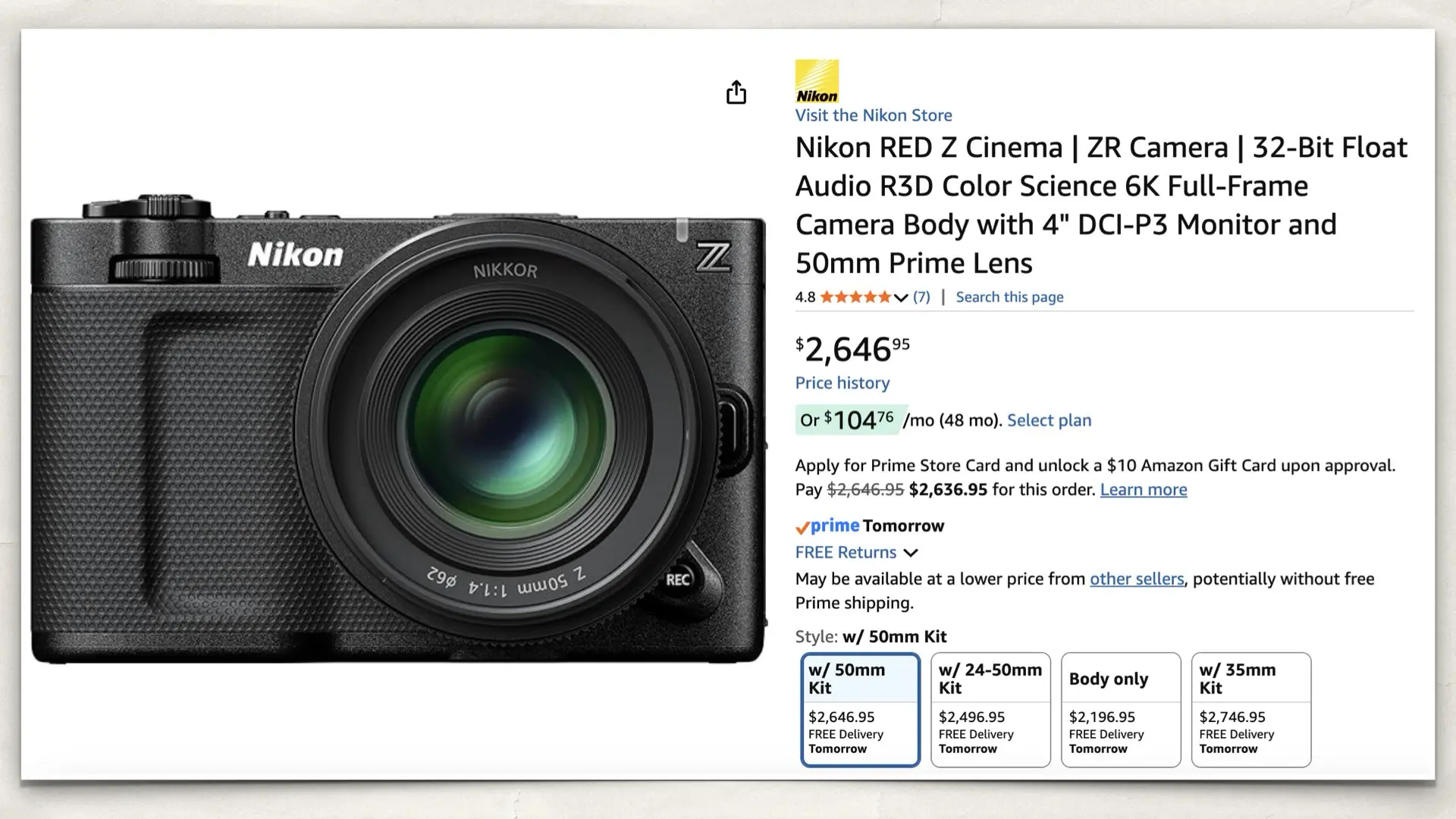
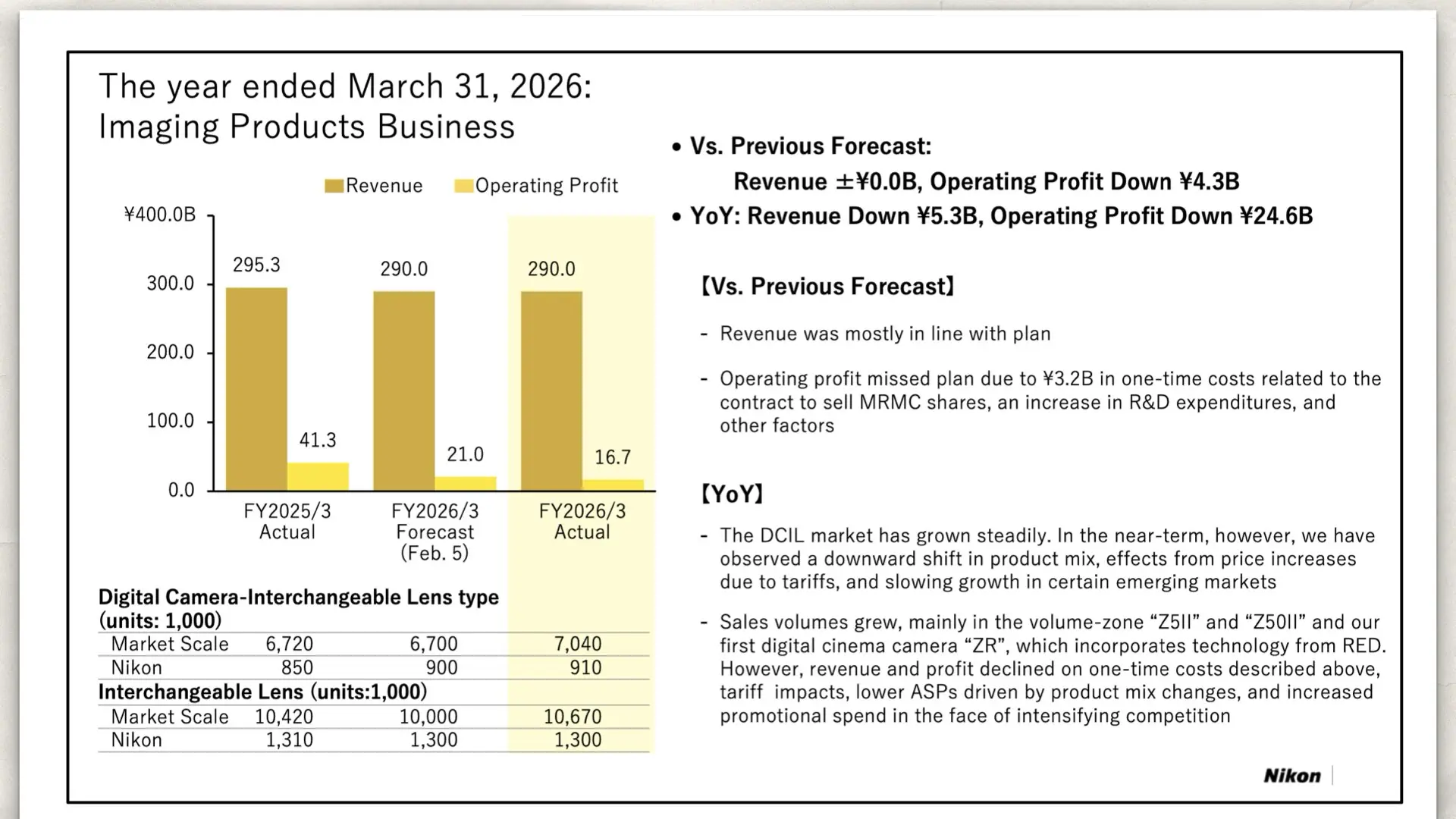
Nikon’s FY2026 financial documents reveal a clear shift inside the Imaging Products business. The company sold 910,000 digital interchangeable lens camera bodies in the fiscal year ended March 31, 2026, up from 850,000 in the previous year. That means Nikon moved 60,000 more mirrorless cameras year over year. According to Nikon, the increase was mainly driven by the volume zone Z5II ($2,296.95 on Amazon), Z50II ($1,499.99 on Amazon), and the ZR ($2,196.95 on Amazon), its first digital cinema camera incorporating technology from RED.

The ZR is now part of Nikon’s growth story
The ZR was not described as a side project or a symbolic RED acquisition product. Nikon placed it directly inside the explanation for camera body unit growth. That does not mean the ZR was Nikon’s best-selling camera. Nikon provides no model-by-model sales breakdown, and its wording suggests that the Z5II and Z50II remain the major volume drivers. The ZR is the first clear sign that RED technology is moving into Nikon-branded cameras in a practical, market-facing way. Instead of keeping RED as a separate high-end cinema brand, Nikon is already using RED technology to strengthen its own camera lineup.
Nikon sees video as a market creation tool
The more strategic statement appears in the Q&A document. Nikon was asked how it plans to expand profits in Imaging Products despite weakness in the market. The company said it remains confident in the broader imaging market, especially as smartphones continue to expand the need to capture, edit, and view images in the US and Japan. Then Nikon added that it aims to strengthen video functionality to develop and create markets, making Imaging Products a stable source of revenue. For years, Nikon was respected mainly for stills, lenses, ergonomics, color, and optical engineering, while Sony, Canon, Blackmagic, and Panasonic dominated much of the video conversation. The ZR changes the tone. Nikon now has RED technology, a cinema-labeled product, and a public financial statement connecting video functionality to future market creation.
More cameras sold, less profit earned
The headline number is positive, but the financial reality is more complex. Nikon’s Imaging Products revenue declined from 295.3 billion yen to 290.0 billion yen, while operating profit dropped from 41.3 billion yen to 16.7 billion yen. Nikon attributes the decline to one-time costs, tariff impact, lower average selling prices caused by product mix changes, and higher promotional spending in a more competitive market. This explains why unit growth alone does not tell the whole story. Nikon sold more camera bodies, but those cameras likely carried lower margins than previous higher priced models. The company specifically mentions a downward shift in product mix. In other words, the Z5II, Z50II, and ZR helped Nikon grow volume, but the Imaging Products business still faced heavy pressure from pricing, competition, tariffs, and costs.

The lens number tells another story
Nikon also sold 1.3 million interchangeable lenses, slightly down from 1.31 million in the previous year. That creates an interesting contrast. Camera body sales increased, while lens sales were basically flat. For Nikon, this is an important signal because lenses are the long-term ecosystem play. A camera body can bring a user into the system, but lenses keep that user inside the system. If Nikon wants its mirrorless and cinema strategy to become stronger, body growth needs to translate into lens growth, accessory adoption, and deeper system commitment. The ZR can help with that because cinema users often build rigs around a camera. They buy lenses, cages, monitors, audio tools, filters, media, and power solutions. If Nikon can make the ZR attractive to filmmakers, it may create a different kind of ecosystem behavior compared with traditional stills-focused mirrorless buyers.

RED gives Nikon a sharper identity
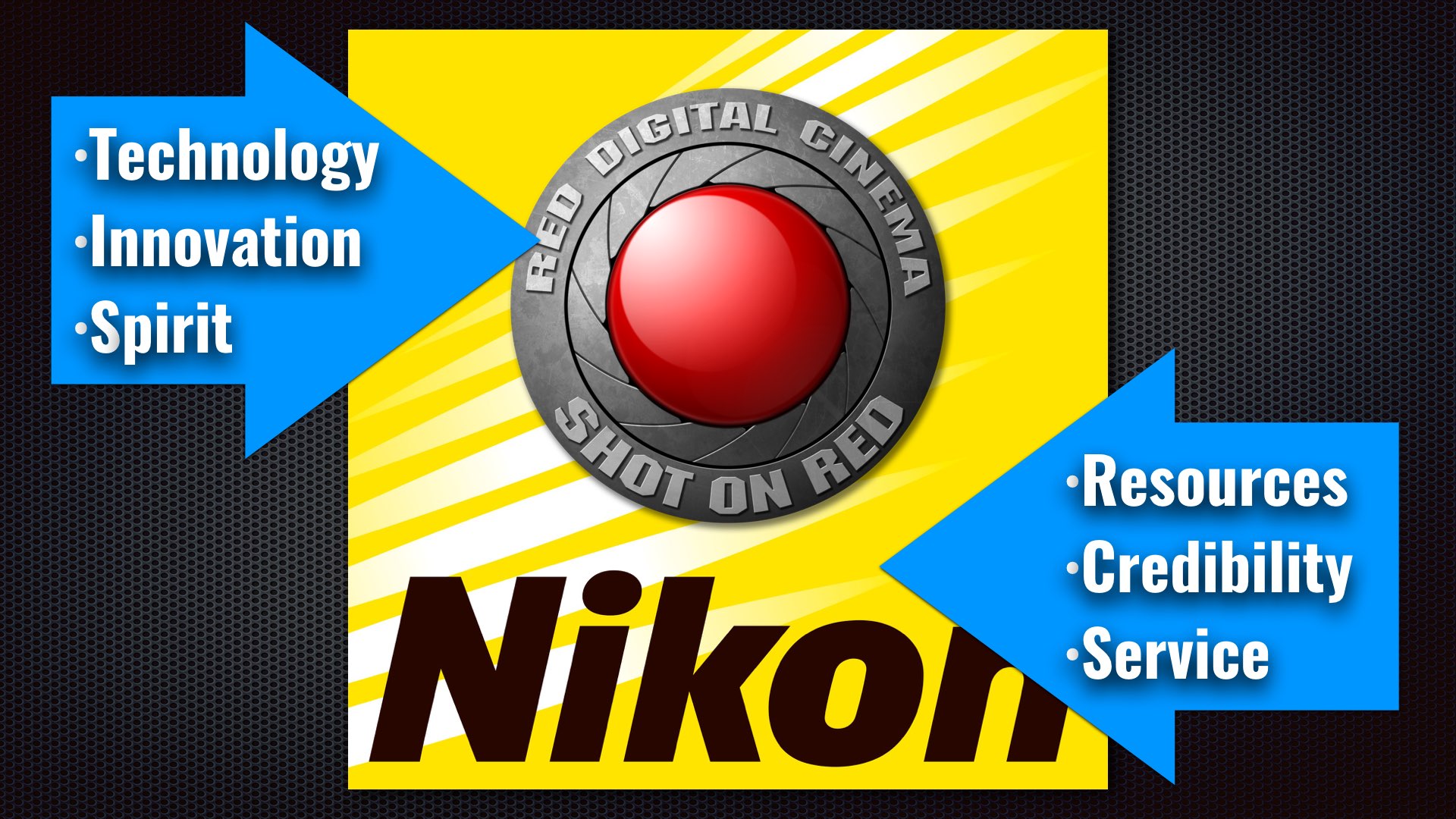
Sony is associated with hybrid video dominance. Canon has Cinema EOS. Blackmagic owns a powerful Creator Cinema identity. Panasonic has long been linked to video-centric mirrorless cameras. Nikon had strong credibility in still photography, but it was rarely the first brand filmmakers mentioned when discussing digital cinema. RED gives Nikon a different identity. The ZR is the first proof point. By highlighting the ZR as Nikon’s first digital cinema camera incorporating RED technology, Nikon is using RED as a bridge into a market where it previously lacked a clear voice. The financial documents show that this is already part of Nikon’s investor narrative, not just a marketing line for camera enthusiasts.
Final thoughts
Nikon sold 910,000 mirrorless camera bodies in FY2026, and the company says the growth was mainly driven by the Z5II, Z50II, and ZR. The ZR should not be described as Nikon’s best-selling camera, because Nikon does not provide that data. However, its appearance in Nikon’s own growth explanation is highly meaningful. For the filmmaking community, RED technology is already shaping Nikon’s camera business. The ZR is Nikon’s first visible step into a more serious cinema-oriented strategy, while the company openly says that strengthening video functionality will help create new markets. Nikon still faces profit pressure, a flatter lens path, and a highly competitive mirrorless market, but the direction is clear. The RED-powered ZR is already part of Nikon’s growth narrative, and that makes Nikon’s next video moves much more important to watch.
As an Amazon Associate, Y.M.Cinema earns from qualifying purchases. If you purchase through the Amazon links above, Y.M.Cinema may earn a small commission at no additional cost to you. This helps support our work.
Gear mentioned in this article
Available on Amazon
| Product | New | Renewed | Used |
|---|---|---|---|
| Nikon Z5II | $2,296.95 | — | From $2,204 |
| Nikon Z50 II | $1,499.99 | — | — |
| Nikon ZR | $2,196.95 | — | — |
Prices checked: Oct 7, 2026, 1:30 PM GMT+0000
As an Amazon Associate, Y.M.Cinema earns from qualifying purchases. If you buy through our links, we may earn a small commission at no extra cost to you.
Product prices and availability are accurate as of the date/time indicated and are subject to change. Any price and availability information displayed on Amazon.com at the time of purchase will apply to the purchase of this product.
CERTAIN CONTENT THAT APPEARS ON THIS SITE COMES FROM AMAZON. THIS CONTENT IS PROVIDED “AS IS” AND IS SUBJECT TO CHANGE OR REMOVAL AT ANY TIME.



![Nikon Is Developing Nine NIKKOR Z CINEMA T1.9 VV Lenses for RED V RAPTOR [X]](https://ymcinema.com/wp-content/uploads/2026/09/Nikon-Is-Developing-Nine-NIKKOR-Z-CINEMA-T1.9-VV-Lenses-for-RED-V-RAPTOR-X.001-480x384.webp)










The Nikon ZR is a fascinating camera. If they provide better H.265 recording with a firmware update then its going to be formidable competition with its 32 bit float internal audio recording, RAW video and 4″ – 3 million dot – 1,000 nit screen.