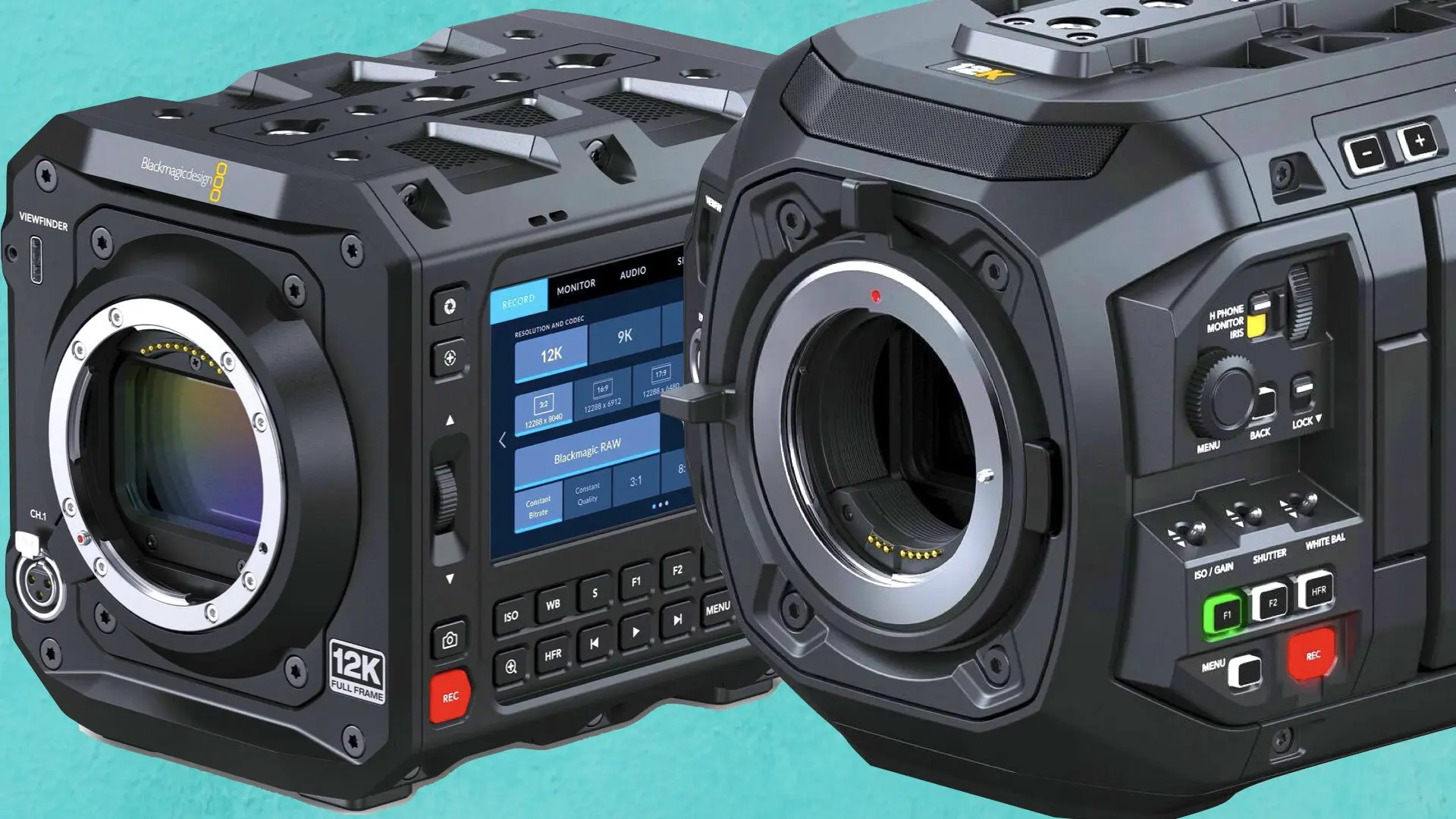
Blackmagic released 2 of the most intriguing cinema cameras of 2025. On paper, the Blackmagic URSA Cine 12K LF and the Blackmagic PYXIS 12K share the same 12K RGBW sensor and 16 stops of dynamic range. In practice, they represent 2 different philosophies of filmmaking. To understand the difference beyond technical specifications, it is useful to examine the perspectives of 2 working cinematographers who have used both extensively: filmmaker Florent Piovesan and cinematographer Kofi Yeboah. Both agree on image parity. Where they diverge is in workflow, engineering priorities, and production logic.
Blackmagic’s strategic decision was not to differentiate these cameras through image quality tiering. Instead, they separated them through ergonomics, power systems, frame rate ceilings, and physical architecture. The result is 2 cameras that share the same visual DNA but target distinct production environments.
The shared foundation
At the core of both cameras is the same 12,288 × 8,040 RGBW sensor developed by Blackmagic Design. This means identical resolution architecture, comparable color science, and similar dynamic range performance. Both Piovesan and Yeboah make a crucial point: in real-world production environments, outside controlled lab testing, the images are extremely difficult to distinguish. If a cinematographer actively searches for fractional highlight differences or marginal ISO shifts, they may find them. In practical documentary, commercial, or narrative scenarios, the visual output is fundamentally the same. That shifts the conversation away from image quality and toward application.
Why 12K matters in a 4K world
Neither filmmaker treats 12K as a delivery format. Instead, both frame it as acquisition headroom. Downsampling 12K into 4K concentrates detail, improves perceived sharpness, and enhances noise characteristics. In that sense, both cameras function as exceptionally strong 4K tools. The resolution is not about the exhibition. It is about flexibility in post, reframing, and oversampling advantages. From this perspective, the URSA Cine 12K LF and the PYXIS 12K can be understood as high-density 4K platforms rather than pure 12K machines.
Florent Piovesan’s angle: versatility and scale
Florent Piovesan approaches the comparison through the lens of practical production experience. He has used both cameras across documentary, commercial, and narrative work, sometimes on the same project. His framing is grounded in usability and scale rather than engineering abstraction. For him, the PYXIS 12K represents mobility without compromise. It is compact enough to travel with, manageable for handheld work, and flexible enough to scale up for commercial shoots. He positions it as an ideal tool for solo shooters and smaller crews who still demand high-end image performance. In contrast, he describes the URSA Cine 12K LF as a workhorse cinema system. Internal ND filters, dual XLR inputs, dual screens including an assist display, higher frame rate ceilings, and extensive connectivity give it the feel of a complete production platform. Piovesan does not argue that one image is superior to the other. Instead, he argues that one camera is optimized for agility while the other is optimized for infrastructure. His perspective is shaped by how a camera integrates into real sets and travel scenarios rather than by technical charts. Check out his video below:
Kofi Yeboah’s angle: engineering and workflow mechanics
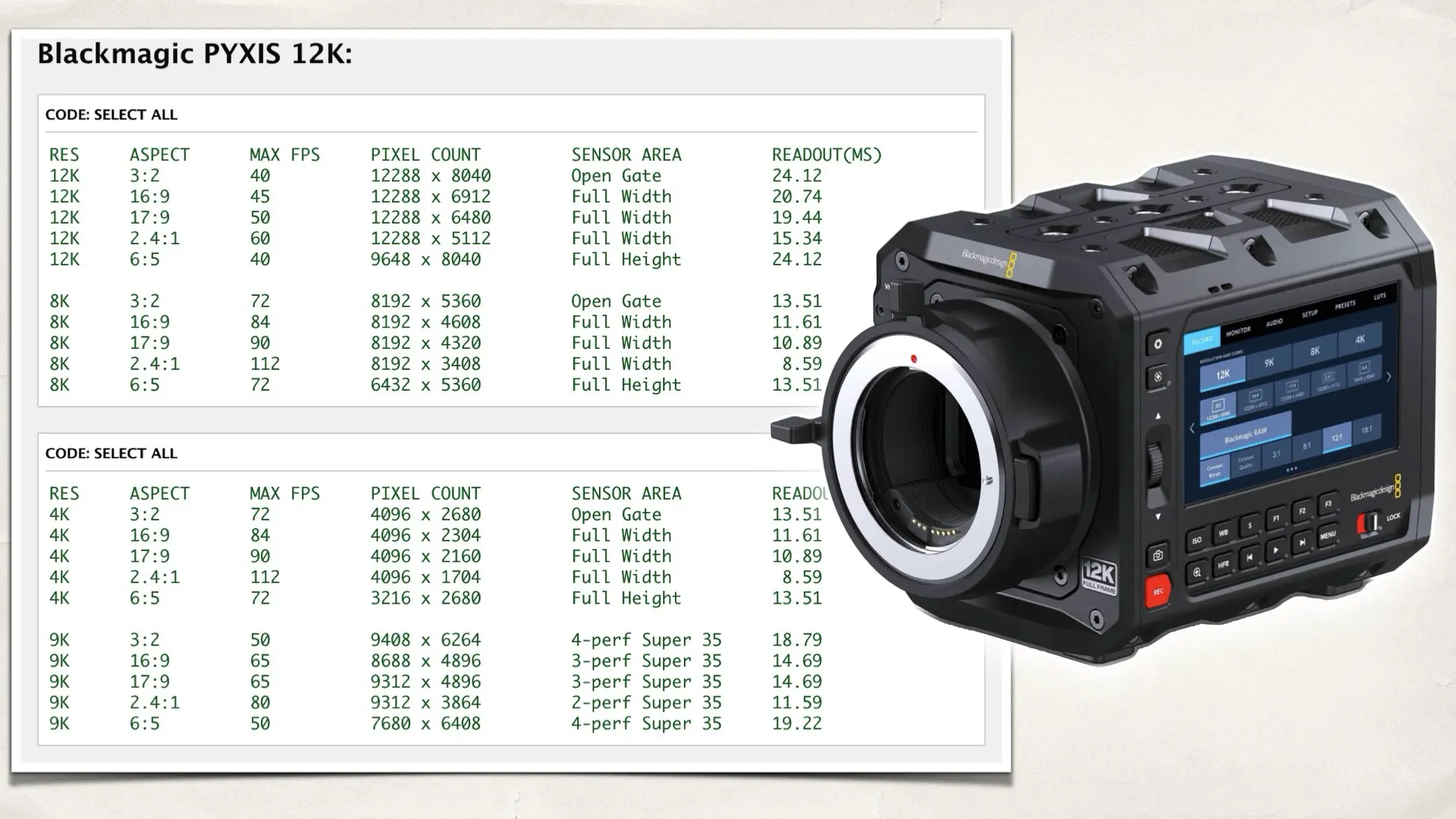
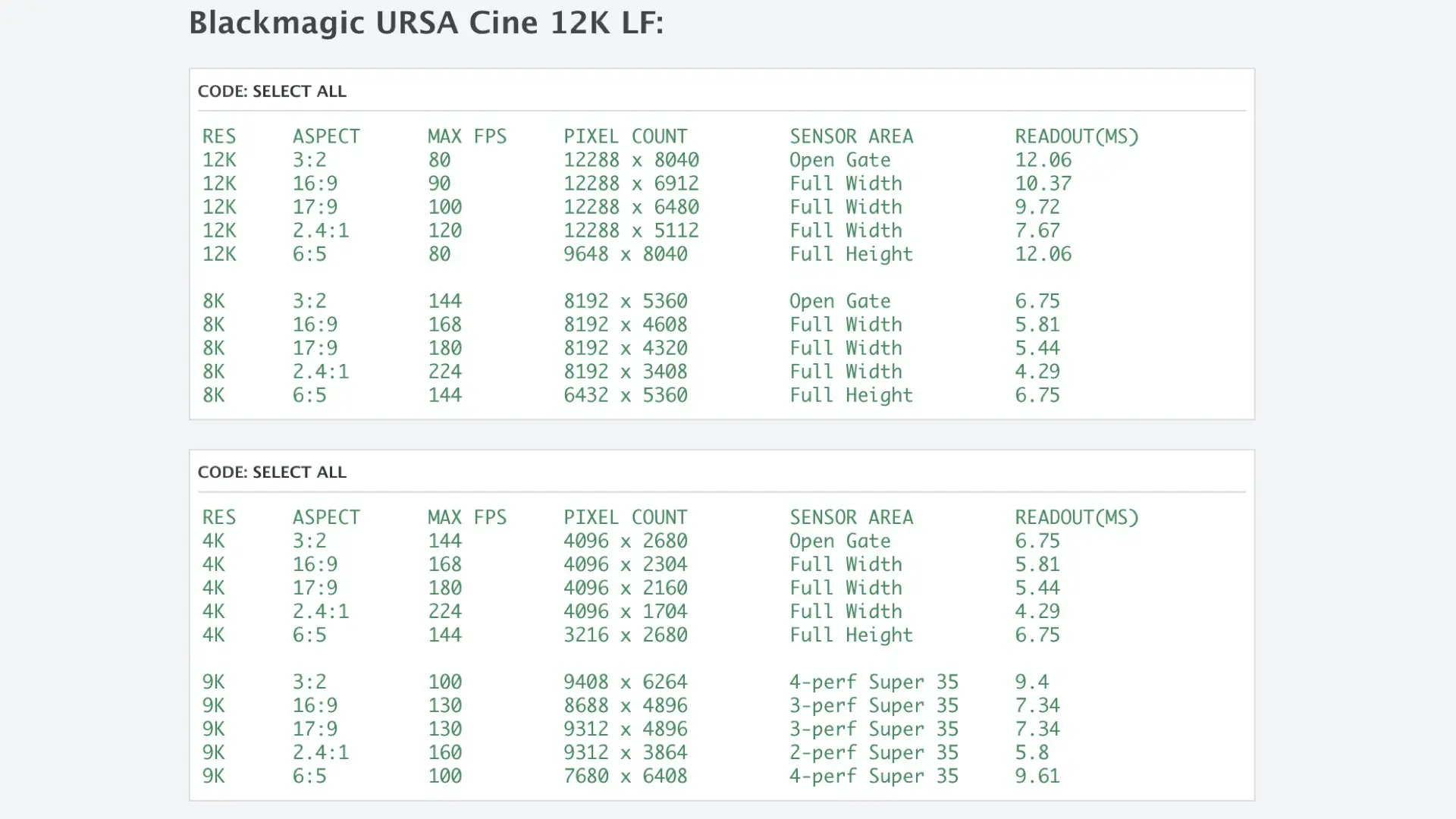
Kofi Yeboah approaches the comparison from a more technical and system-driven perspective. While he agrees that the image quality is largely indistinguishable in practice, he emphasizes the structural differences that affect workflow. One of his key observations concerns rolling shutter and readout speed. He notes that the PYXIS sensor readout is effectively slower than the URSA Cine’s, resulting in greater rolling shutter under extreme motion and lower maximum frame rates. For shooters working with fast action or heavy slow motion demands, this becomes a meaningful distinction. Yeboah also highlights power architecture. The URSA Cine 12K LF requires higher voltage battery systems to unlock its full frame rate capabilities. Using standard 14V batteries limits certain performance aspects, while 26V batteries allow access to the highest frame rates. This introduces cost and logistical considerations. The PYXIS, using BP U batteries, does not throttle frame rates in the same way. For Yeboah, this is less about which camera is better and more about understanding how hardware design influences real-world production planning. He also underscores the scale of integration. The URSA Cine body offers more ports, more buttons, more expansion potential, and a broader ecosystem. It is built for structured cinema environments. The PYXIS, by contrast, prioritizes compactness and modularity. In his framing, everything the smaller camera can do, the larger one can do more of. The question becomes whether that additional capability is necessary for a given workflow. Check out his video below:
Two philosophies, one image
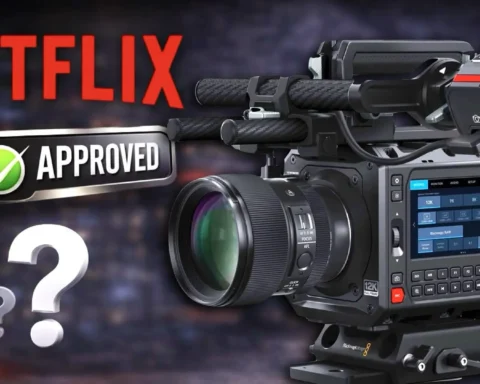
When both perspectives are considered together, a clear pattern emerges. Neither filmmaker argues that one camera produces a dramatically superior image. Instead, both articulate that the difference lies in system design. The URSA Cine 12K LF embodies a traditional cinema infrastructure mindset. It assumes crew support, larger rigs, integrated audio, and high-performance expansion. The PYXIS 12K embodies a mobility-driven mindset. It assumes agility, travel, gimbal operation, and streamlined setups. Blackmagic’s strategic decision was not to differentiate these cameras through image quality tiering. Instead, they separated them through ergonomics, power systems, frame rate ceilings, and physical architecture. The result is 2 cameras that share the same visual DNA but target distinct production environments. For filmmakers evaluating these options, the most important question is not which one looks better. It is the one that aligns with how you actually work. BTW, for Netflix production, you won’t have any choice but to choose the URSA as it’s the only Netflix-approved here.