

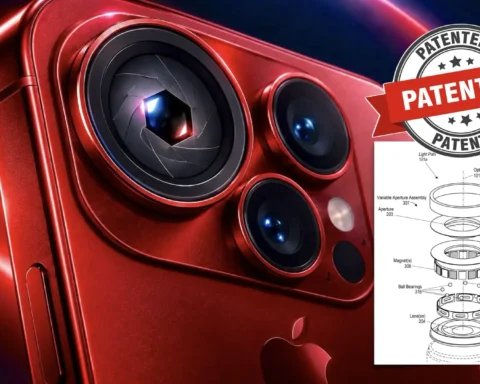
An Apple patent application filed in 2016 and granted in 2021, titled “Camera apparatus and methods” shows a stereoscopic camera that was designed to capture 3D imagery. Interestingly, the application demonstrates the implementation of a large image sensor (size not specified) in a camera with interchangeable lenses. It might indicate Apple’s strategy to develop a cinema camera.

Apple’s patent: “Camera apparatus and methods”
Patents can constitute an indication of a company’s strategy, even if there’s no actual product in development. That’s exactly how we can examine this patent by Apple. It must be noted that this patent is not so new. It was filed in 2016, and grated in 2021. But it presents a very unique product, that could be demonstrated as a new and fascinating approach to what Apple is cooking in the field of professional videography and cinematography. The patent titled “Camera apparatus and methods” presets a stereoscopic camera with interchangeable lenses and big sensors. Below you can find selected quotations from the application.

The camera: Sensor, lens mounts, and filters
“A camera apparatus, e.g., a stereoscopic camera apparatus, includes a dual element mounting plate, a pair of individual lens mounts, and a pair of sensor holders, each sensor holder holding an image sensor. The lens mounts and sensor holders are secured to the dual-element mounting plate. Multiple dual-element mounting plates corresponding to camera pairs may be secured to a base plate. Various features facilitate achieving and maintaining alignment between a lens and a corresponding image sensor, as well as between camera pairs and sets of camera pairs. The present application relates to camera apparatus and methods and, more particularly, to methods and apparatus for mounting multiple cameras, e.g., one or more stereoscopic camera pairs, and/or camera accessories, e.g., filters”.

Background of the patent: Facilitating 3D moviemaking
“As 3D movies and other programs have grown in popularity, there is a growing desire for camera hardware and apparatus which can support the capture of images that are suitable for use in generating 3D content, e.g., videos that may be used as part of a movie, advertisement, program, or even for viewing of an event in real or near real-time. One way of generating 3D content is by capturing stereoscopic image data, e.g., pairs of images that can be used as left and right eye images, using stereoscopic camera systems including a pair of left and right cameras for capturing left and right eye images. In the case of stereoscopic image capture where pairs of cameras are used, e.g., to capture images corresponding to left and right eye views, alignment of the cameras in the camera pair, sometimes referred to as a stereoscopic camera pair, can be important. As part of the alignment, the spacing and orientation between the cameras needs to be set as desired and maintained after configuration so that it is reasonably consistent for a period of time in which images, e.g., video images, are captured. Unfortunately, with many existing camera mounting systems, which are designed primarily with the mounting of single cameras in mind, relatively loose fitting lenses and limited adjustment capabilities can make aligning a pair of cameras and maintaining the alignment over time difficult”.


Swapping lenses
“A first camera lens can be inserted through a hole in the first lens mount. A second camera lens can be inserted through a hole in the second lens mount”. That means the camera will have the option of swapping the lenses.


‘Big’ sensors
As stated: “In some embodiments, the first sensor holder is a first camera body, e.g., a first camera body including a first image sensor and a first processor; and the second sensor holder is a second camera body, e.g., a second camera body including a second image sensor and a second processor”. It’s important to mention that although the sensor units are presented multiple times in the application, a size specification is not defined. However (!), by examining the dimensions described in the applications, we can conclude that it’s a big sensor since the dimensions of the filters are about 5 centimeters. So we assume these are two sensors of Micro-Four-Thirds each. That would be considered large sensors, especially for a stereoscopic camera.


Closing thoughts
Although this patent presents a stereoscopic camera that is designed to facilitate 3D moviemaking, it’s no doubt that Apple is examining a very intriguing strategic direction. According to the dimensions mentioned in the application, the sensors could be anywhere between Micro-Four-Thirds to Super 35 millimeters or even, a full-frame. That with the ability of interchangeable lenses, brings us to the conclusion that Apple might be working on an advanced cinema camera with special features (although Apple said before that the iPhone 15 Pro Max can rival a large $20,000 camera). Let us know your insights about it.
Watch the article:




Pictures looks like exactly as a pair of old, Blackmagic Design Micro Cinema Camera Camcorder.
Even the HDMI and comm ports placement as well.
The initial images show two BM Micro Studio (or Cinema) cameras paired with two Fujinon 2.7mm lenses which is a combination that has been used by many companies over the years to produce VR180 and 360 content.
another attempt at 3D cinema nobody wants