

Canon’s latest patent shows the company’s clear ambition: making immersive optics compact enough to look like normal glasses. Instead of bulky headsets, the design folds light three times inside the lens, letting Canon deliver a wide view and sharp images in a thin frame. This fits directly into Canon’s AR/VR roadmap, which we explored in Canon’s AR VR Glasses Patent: A Counterstrike to Apple Vision Pro Aiming at the Masses. Read on!
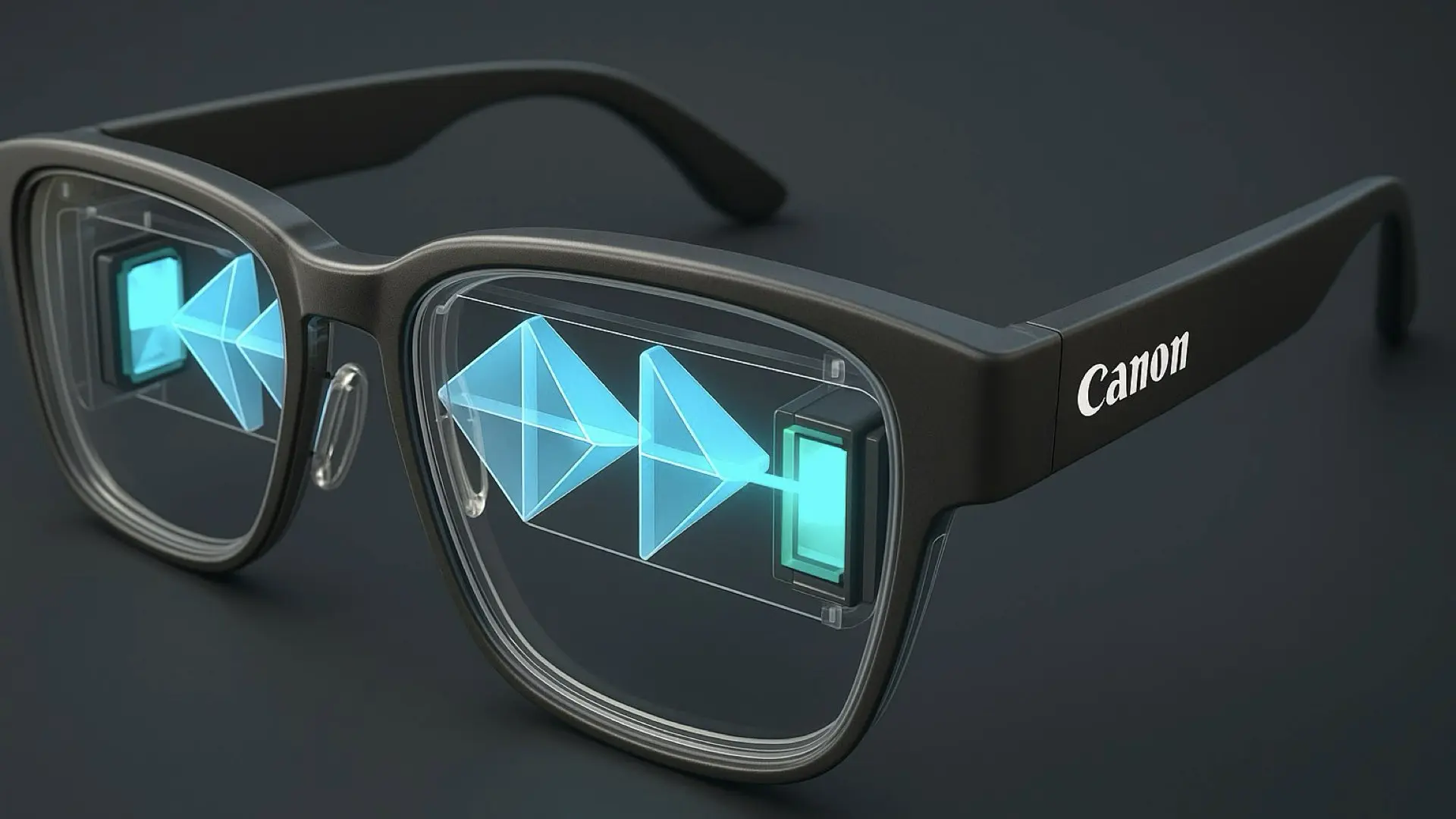
Folding light to save space
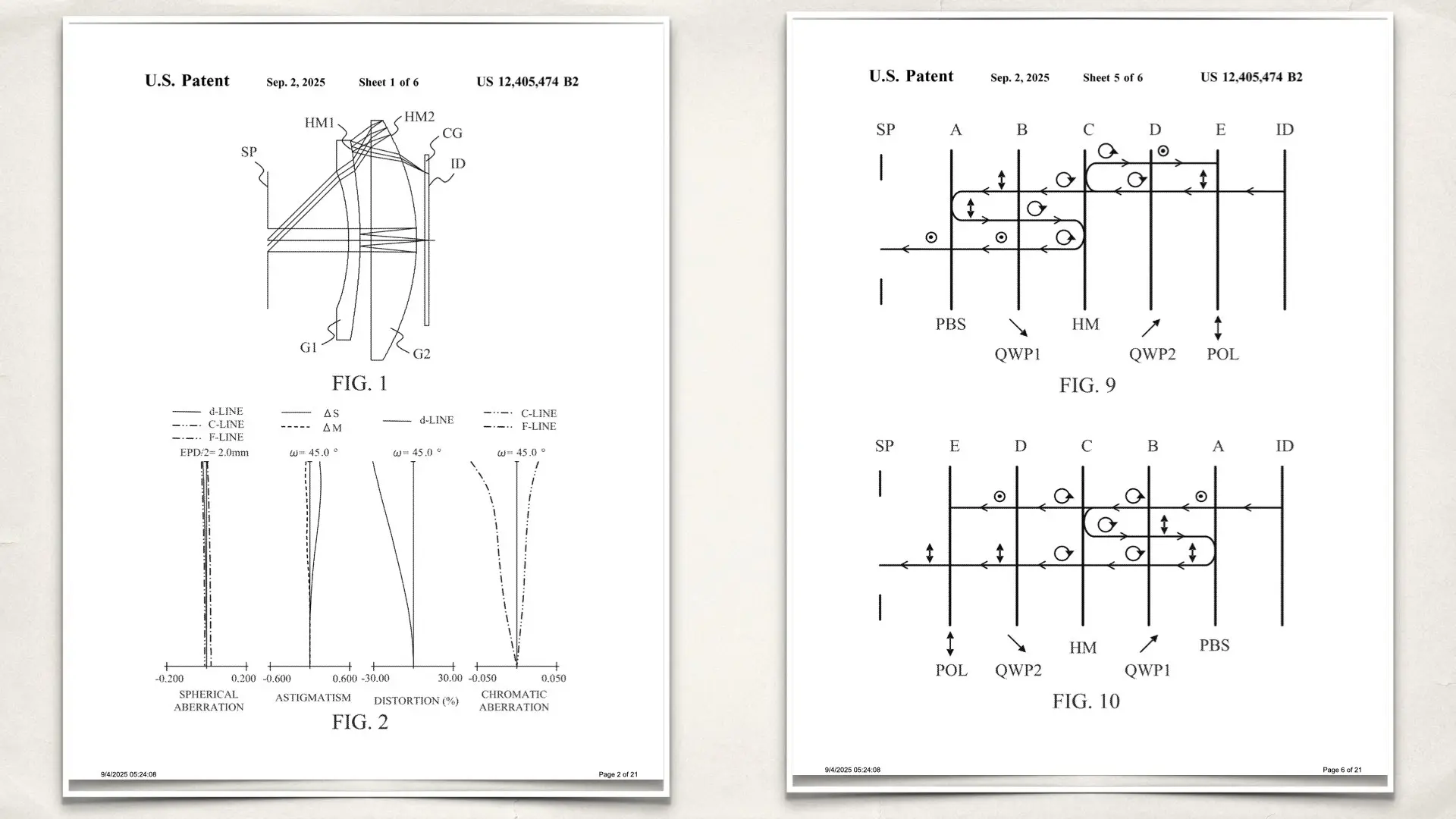
The patent describes a triple-pass optical system. Light from the microdisplay bounces between two half-mirror layers before reaching the eye. By folding the optical path, Canon avoids the long tubes or thick lenses typical in VR headsets. The result is a wide field of view inside a frame that could sit comfortably on your face. (See rendered mockup above). To keep the image sharp, Canon adds one negative-power lens in a spot where light passes through it only once. This detail is important: it fixes chromatic aberration and flattens the image without forcing the optics to grow thicker. It’s the engineering move that keeps the design thin but precise.
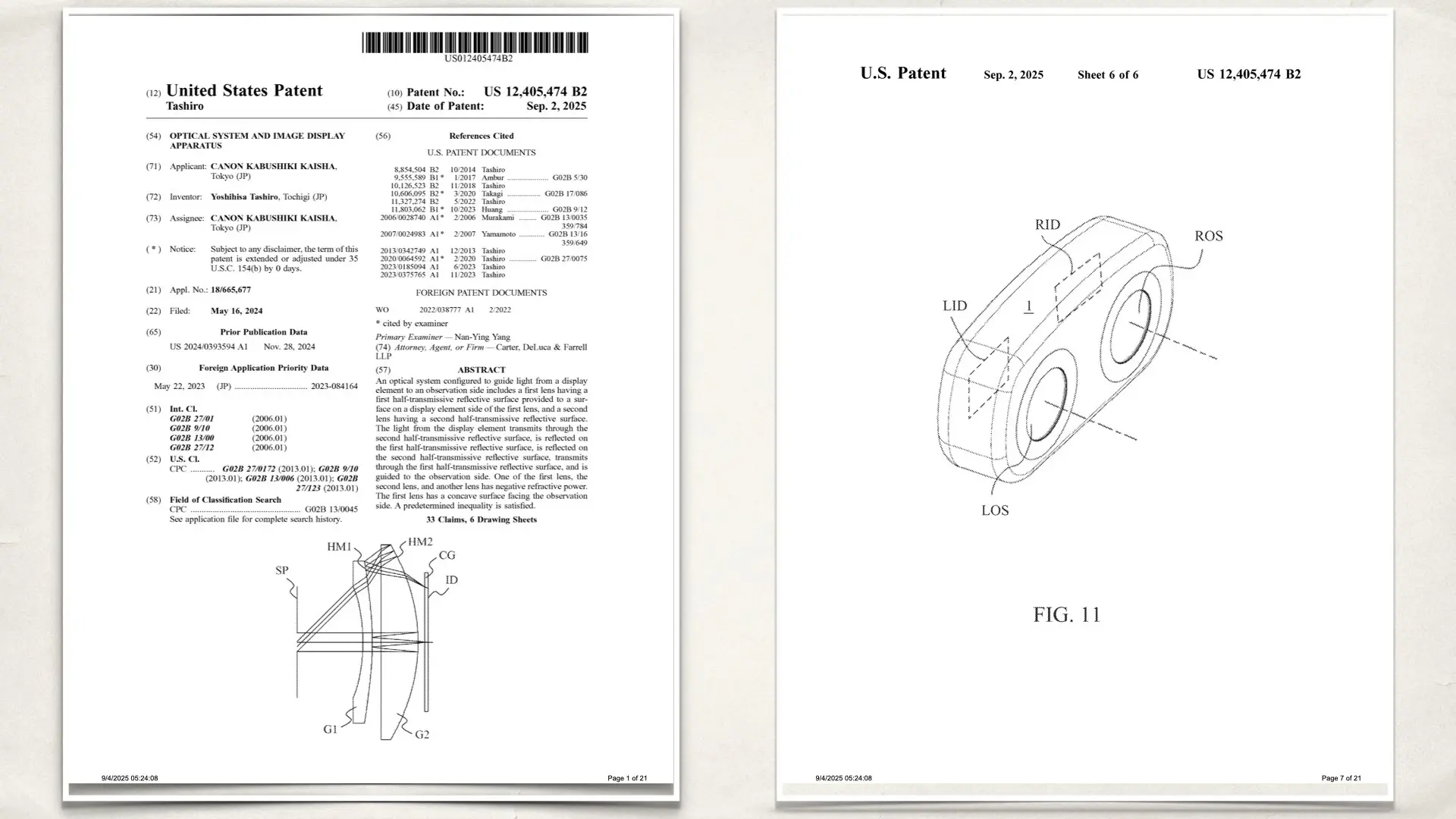
An optical system configured to guide light from a display element to an observation side includes a first lens having a first half-transmissive reflective surface provided to a surface on a display element side of the first lens, and a second lens having a second half-transmissive reflective surface. The light from the display element transmits through the second half-transmissive reflective surface, is reflected on the first half-transmissive reflective surface, is reflected on the second half-transmissive reflective surface, transmits through the first half-transmissive reflective surface, and is guided to the observation side. One of the first lens, the second lens, and another lens has negative refractive power. The first lens has a concave surface facing the observation side. A predetermined inequality is satisfied.
– From the Canon patent
From headset to glasses form factor
Taken together, these innovations show Canon’s intent to minimize AR/VR eyewear. Instead of looking like a helmet, the goal is to offer glasses that resemble everyday eyewear. This makes the concept far more consumer-friendly and puts Canon in the same conversation as Apple’s lightweight headset project in Vision Air: Apple AR Glasses, and even the fast-moving Chinese competition we covered in Vivo Vision: Chinese Clone of Apple Vision Pro.
Why it matters
Consumers are unlikely to wear bulky goggles for long periods. The industry knows miniaturization is the gateway to mass adoption. Canon’s patent shows a concrete optical pathway to that goal: a wide field of view, color correction, and low ghosting, all packed into what looks like normal glasses.

Takeaway
This filing makes Canon’s direction clear. The company isn’t just experimenting with VR optics — it is chasing the form factor shift that could finally move immersive hardware from niche professional use to mainstream daily wear. Shrinking VR into ordinary glasses may be Canon’s most important counterstrike yet.










what about Lenovo’s LEGION GLASS Gen 2? It’s already resemble an ordinary glasses form factor though
Lenovo’s LEGION GLASS Gen 2 does push closer to the ordinary-glasses form factor….but it’s essentially a display-only viewer. Canon’s patent is different because it focuses on the optical system inside the lenses: folding the light path and adding a single-pass negative element to keep the frame thin while maintaining a wide field of view and corrected color.
In other words, Lenovo shows that sleek form factors are possible, while Canon is working on the deep optical engineering needed to make everyday eyewear truly immersive for AR/VR.