

Nikon is exploring a new image sensor architecture that could improve camera dynamic range by changing the way different parts of the sensor are exposed. The idea appears in a Nikon patent titled “Image Capturing Element and Image Capturing Apparatus.” Instead of treating the whole image sensor as one large area with the same exposure timing, Nikon divides the sensor into smaller groups of pixels. Each group can potentially use a different exposure time depending on how much light reaches that area. In simple terms, bright and dark parts of the same image could be treated differently directly at the sensor level.
Different exposure times across the sensor
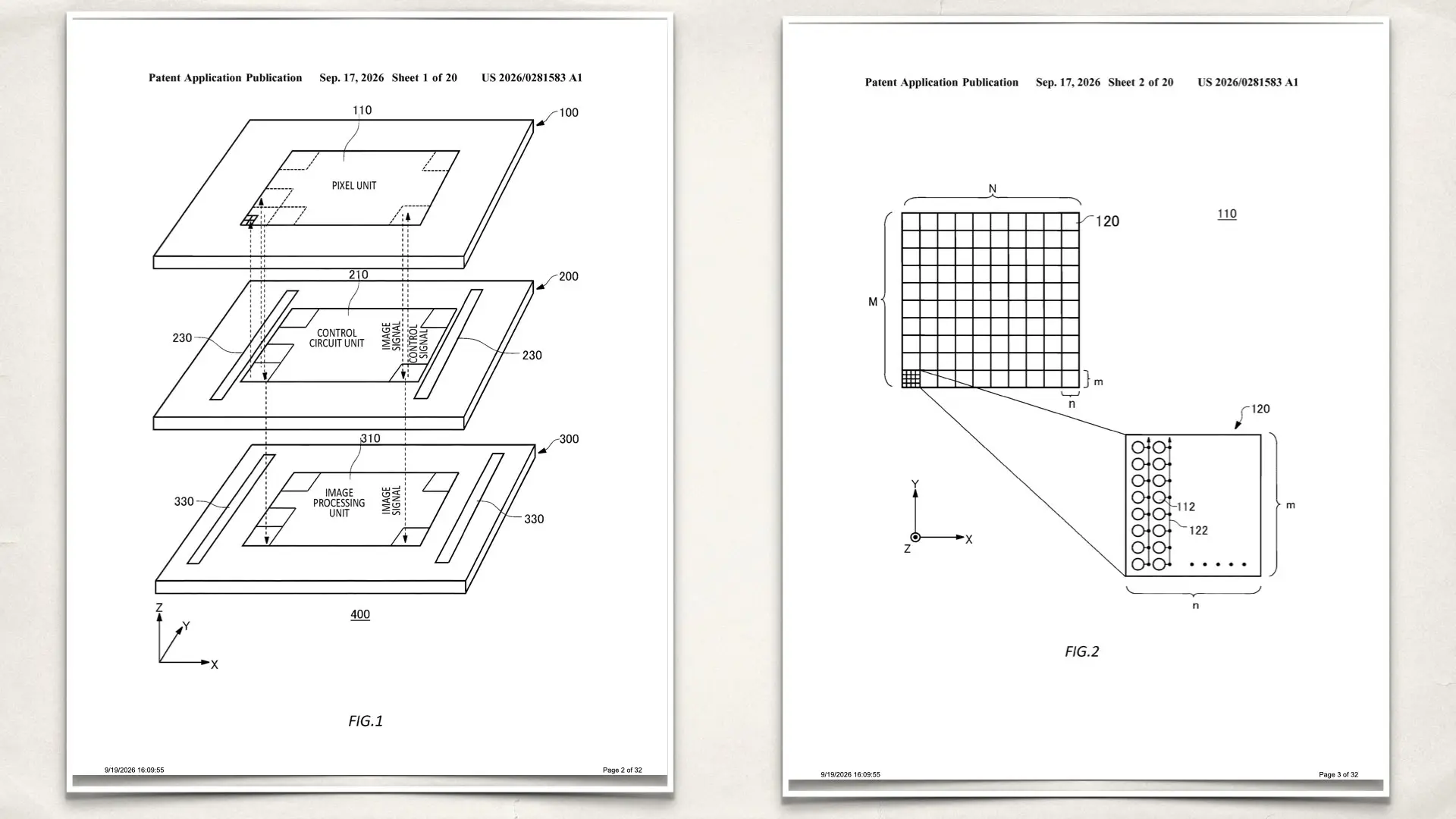
The patent describes an image sensor divided into multiple pixel blocks. Nikon gives one example of a block containing 16×16 pixels, although the design is not limited to that size. Pixels inside one block can share the same exposure time, while another block can use a different exposure time. This could be useful in scenes with a very wide brightness range. Imagine shooting a person inside a dark room with a bright window behind them. In a conventional exposure, the camera has to balance the dark interior against the much brighter exterior. With Nikon’s proposed design, the area covering the bright window could theoretically use a shorter exposure, while darker areas could use a longer one. Nikon specifically says that controlling exposure time for different pixel blocks according to the amount of incoming light can expand dynamic range. The patent does not say how much additional dynamic range could be achieved. There is no figure given in stops or dB.
A three-layer stacked sensor
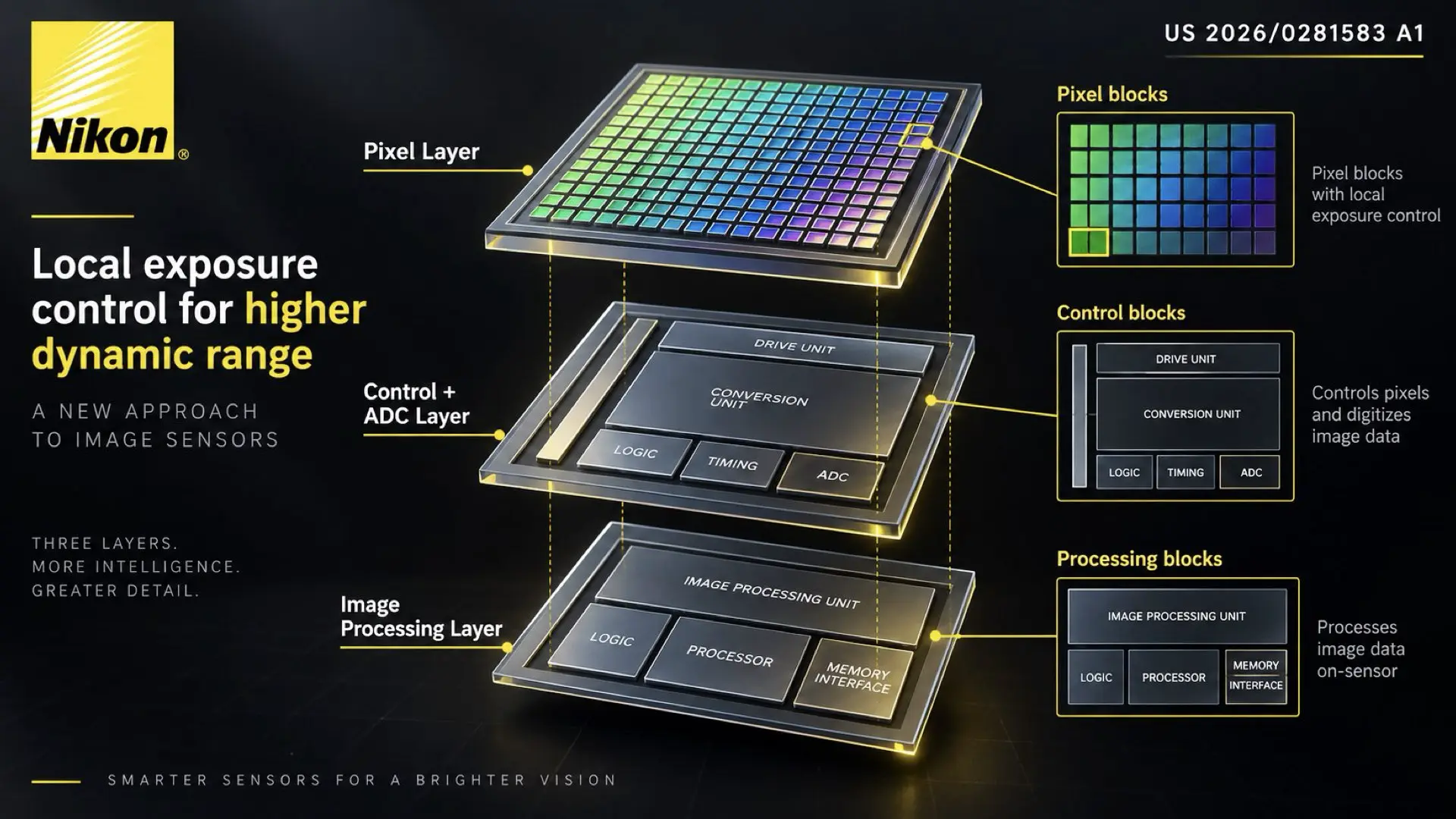
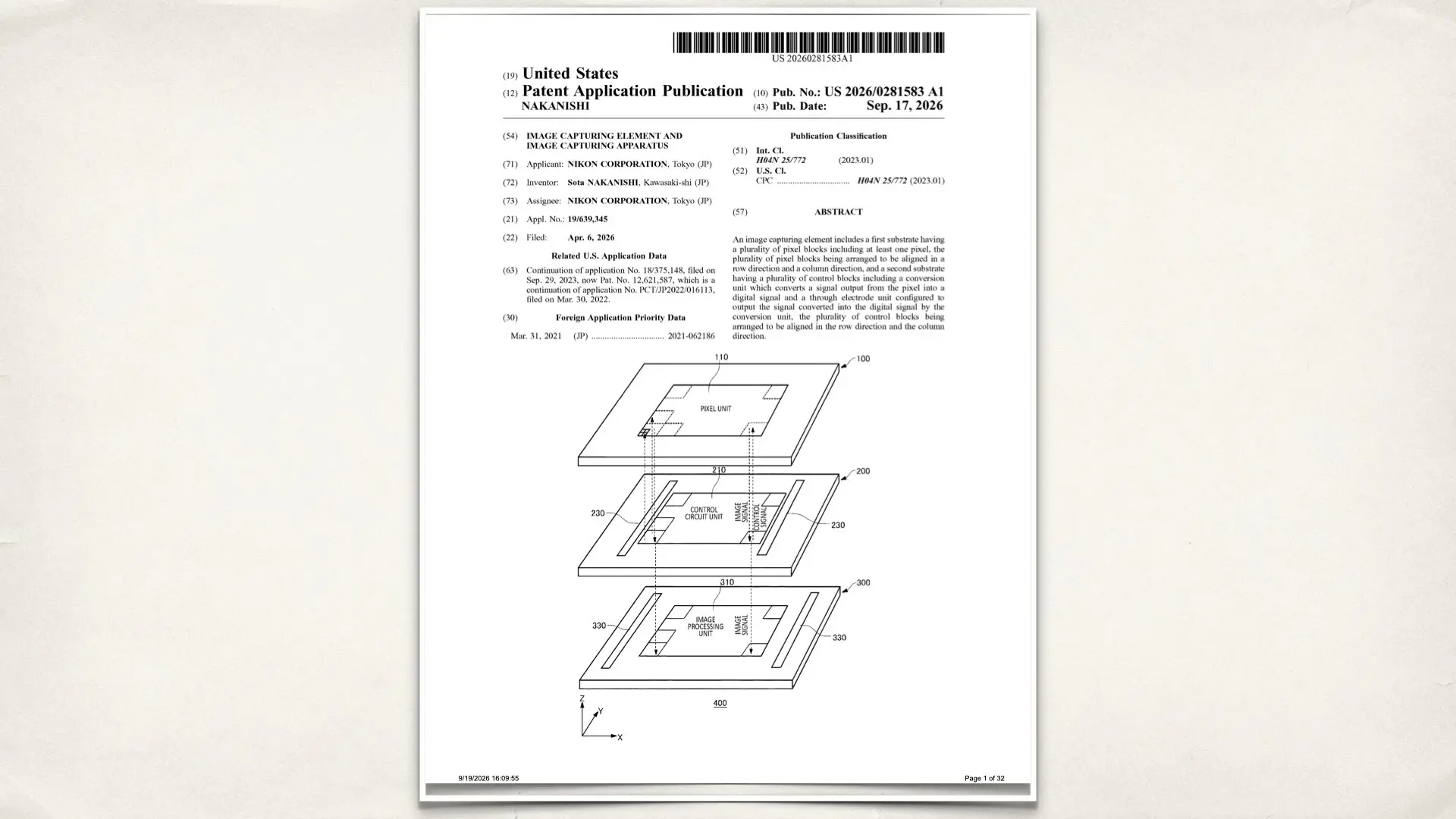
The patent also describes a stacked sensor built from three separate layers. The first layer contains the pixels that capture light. The second layer contains control circuitry and analog-to-digital conversion. It receives the pixel signals and converts them into digital information. The third layer handles additional image processing. That means part of the image processing can happen very close to the pixels themselves, rather than sending all raw sensor information immediately to a separate image processor. Nikon also describes processing such as data compression on this third layer. For photographers and cinematographers, however, the most interesting part is still the local exposure control.
The relevance for cameras
Dynamic range is one of the most important characteristics of a modern cinema camera. More dynamic range allows a camera to preserve more information in bright highlights while still maintaining useful detail in darker parts of the image. Camera manufacturers already use several techniques to improve dynamic range, including dual-gain sensor designs, multiple readout modes, and computational HDR processing. Nikon’s patent explores another approach: changing exposure timing across different areas of the sensor itself. If implemented successfully, this could allow the sensor to react more intelligently to different brightness levels inside the same frame. However, this remains a patent. The document does not confirm that Nikon has manufactured this sensor, and it does not connect the technology to a specific Nikon Z or Z CINEMA camera. There are also no specifications for sensor size, resolution, frame rate, rolling shutter performance, or maximum dynamic range.
An older idea that remains relevant
Note: The patent family itself is not completely new. The filing states that it continues earlier applications going back to a Japanese patent application filed in March 2021. That is important context. This should not be interpreted as confirmation that Nikon has suddenly developed a finished new sensor in 2026. Instead, the patent shows one direction Nikon has been researching for future image sensor design. The most interesting part is the concept itself: rather than exposing every area of the sensor in exactly the same way, Nikon is looking at a sensor capable of adapting exposure locally across the image. Whether that idea eventually reaches a production camera remains to be seen.













Trying to think HOW this would work, and the best I can come up with is: a compare circuit.
IF the average charge (of pixels in a 16×16 block) reaches a given value quickly, then the picture is “bright” – and exposure time is short.
FAIL to reach the target, and that area is “dim” – and exposure time is extended.
The patent does describe independently changing the exposure time of each pixel block according to incident light intensity. However, it doesn’t specify an average charge/comparator mechanism. What Nikon does describe is controlling the start/end timing of exposure at the block level through the pixel drive circuitry. So the decision logic could work along the lines you suggest, but the patent appears to leave that part open.
Love your article