
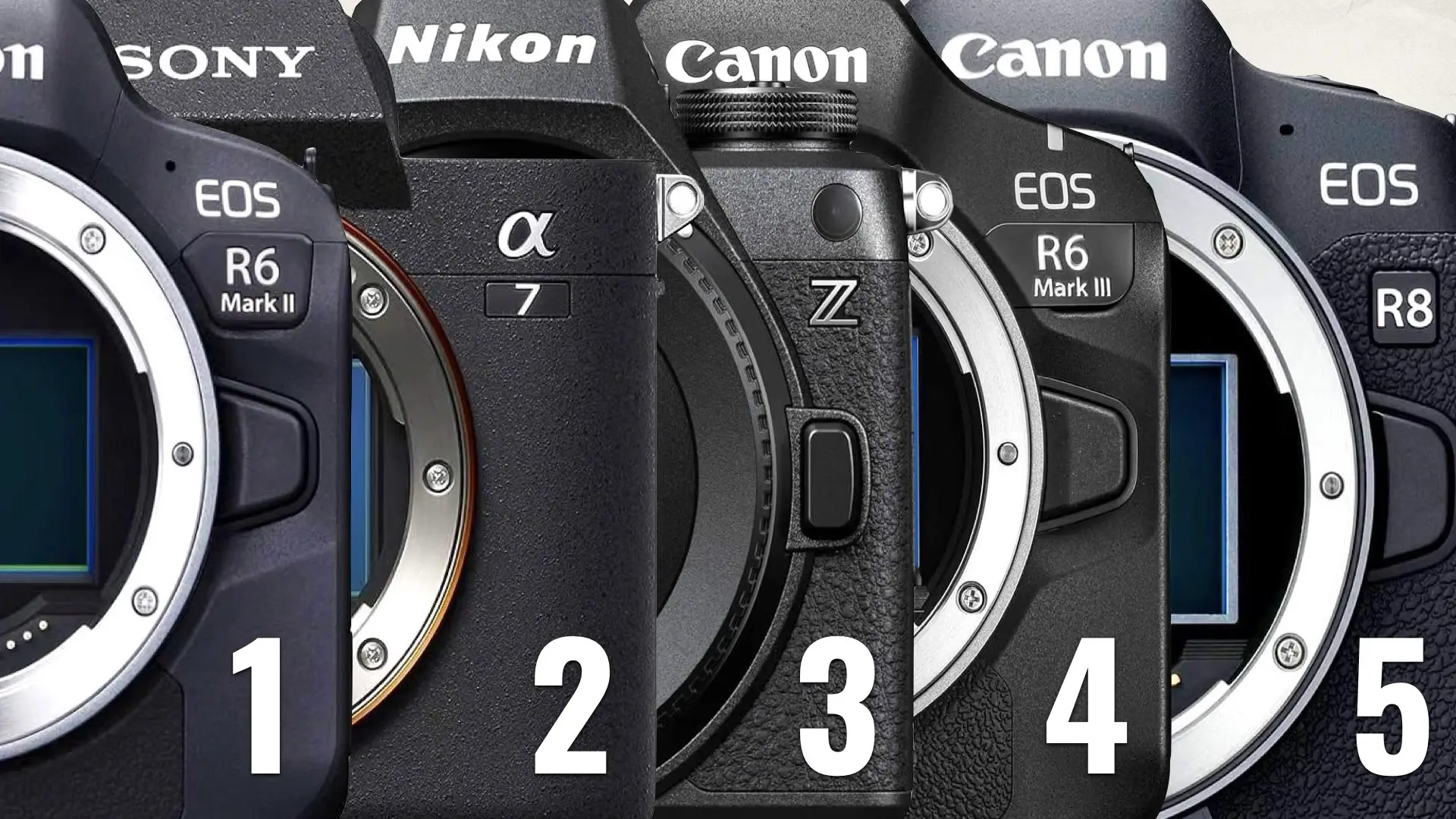
Amazon’s current full-frame camera ranking reveals a particularly competitive point in the mirrorless market. The three best-selling bodies are the Canon EOS R6 Mark II ($1,999 on Amazon), Sony Alpha 7 IV ($1,998 on Amazon) and Nikon Z6 III ($2,196.95 on Amazon), and all three are currently selling for essentially the same price: around $2,000. According to Amazon’s ranking, the top five full-frame bodies are the Canon EOS R6 Mark II, Sony Alpha 7 IV, Nikon Z6 III, Canon EOS R6 Mark III ($2,799 on Amazon) and Canon EOS R8. What makes the list interesting is not only which cameras occupy the top positions, but how differently they approach the same market.
The ~$2,000 full-frame battleground
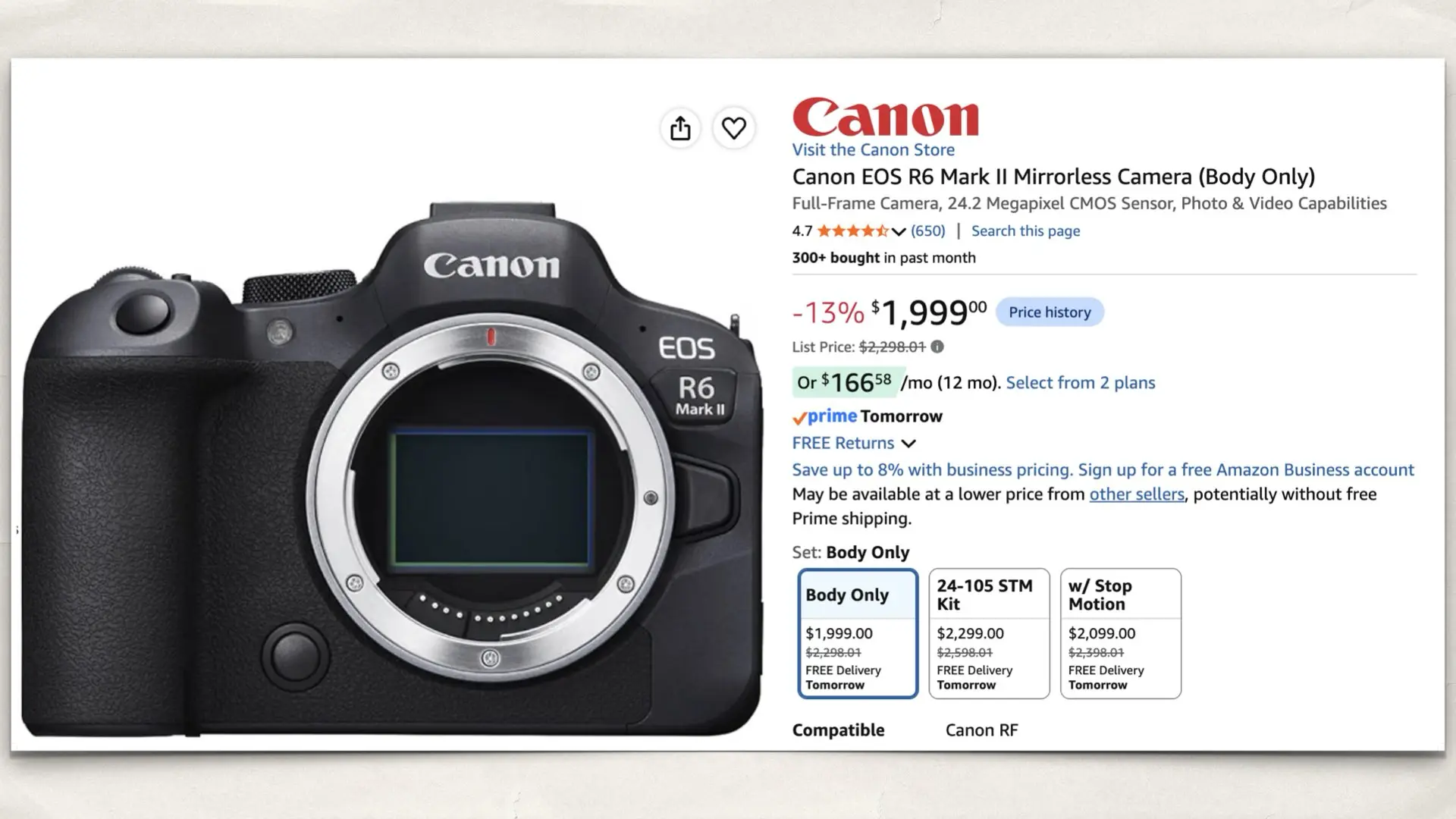
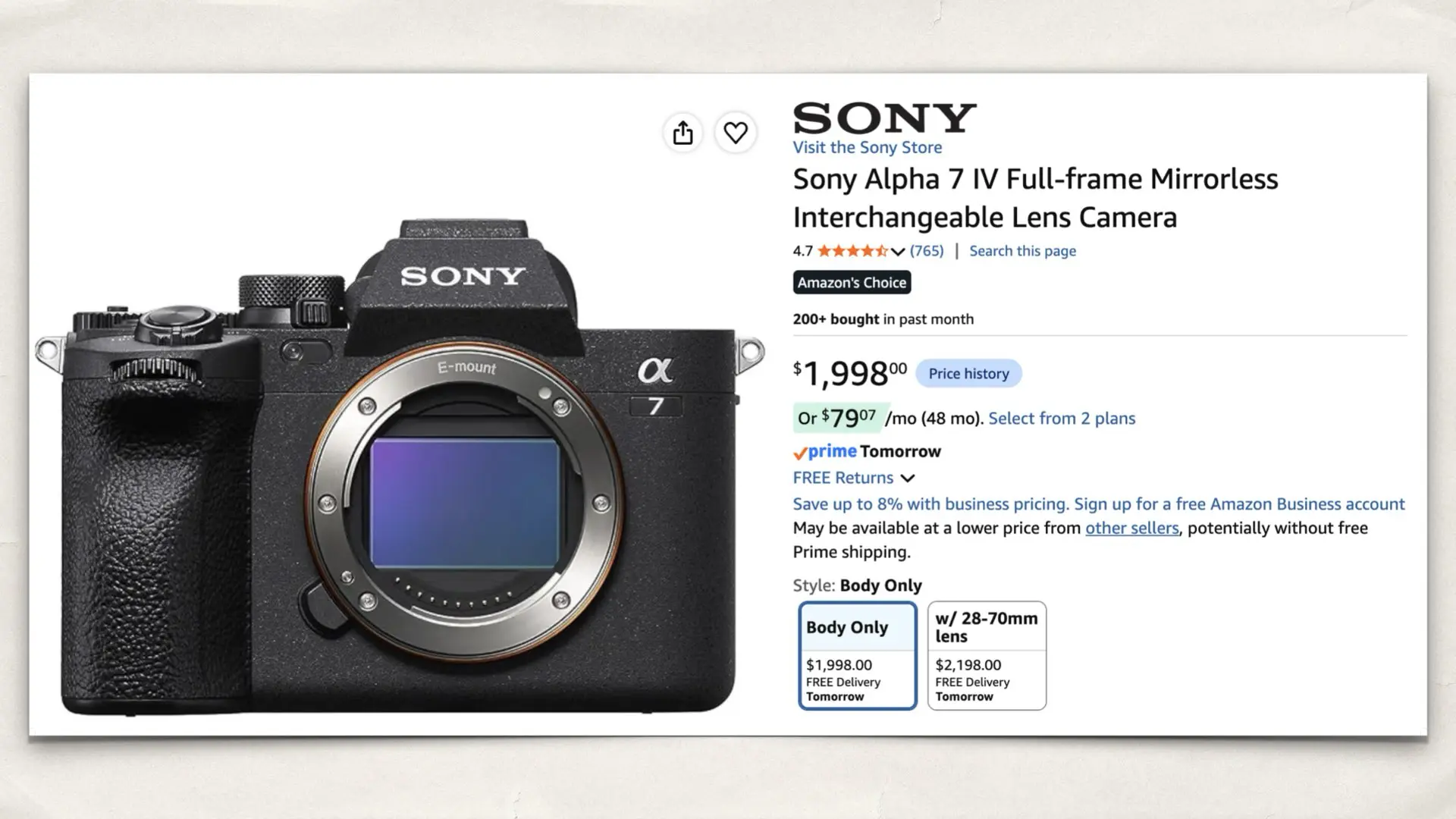
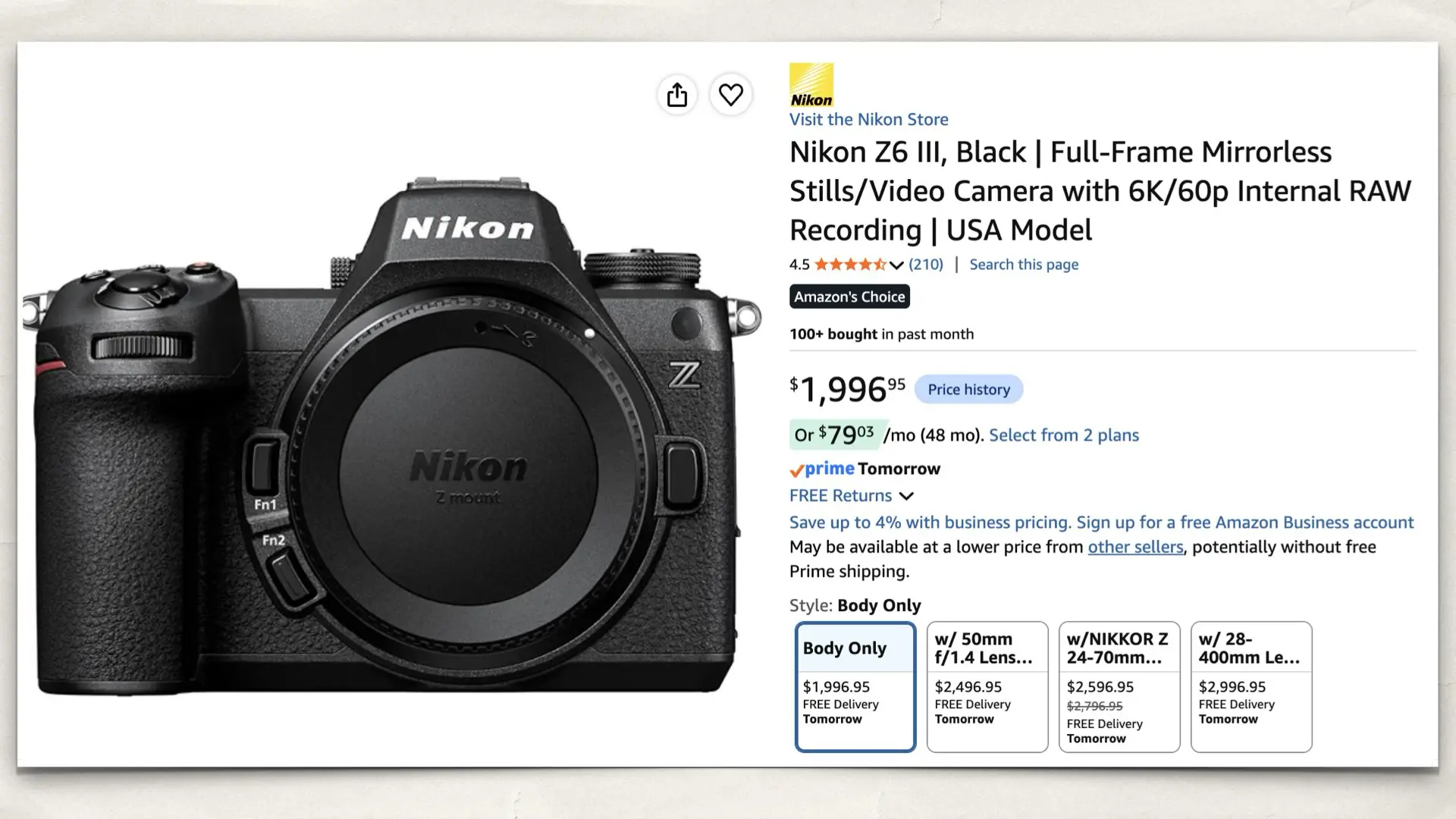
At the time of writing, Amazon lists the Canon EOS R6 Mark II at $1,999, the Sony Alpha 7 IV at $1,998 and the Nikon Z6 III at $1,996.95. That means only $2.05 separates Amazon’s three best-selling full-frame bodies. At this point, price is almost irrelevant when choosing between them. The decision is instead about sensor architecture, resolution, video formats, autofocus, lens ecosystem and the type of production the camera will be used for. The three cameras also illustrate how broad the definition of a modern hybrid camera has become.
#1 Canon EOS R6 Mark II – $1,999
The EOS R6 Mark II (See on Amazon) remains Amazon’s best-selling full-frame body in this ranking. It uses a 24.2MP full-frame CMOS sensor and Canon’s DIGIC X processor. Canon supports 6K-oversampled uncropped 4K recording up to 60p, while the camera also includes in-body image stabilization and dual UHS-II SD card slots. The R6 Mark II sits in a particularly useful middle ground. Its 24.2MP resolution is sufficient for the majority of photography applications without producing unnecessarily large files, while its video feature set is considerably more serious than what was traditionally expected from a stills-oriented EOS body. It is also worth looking at the R6 Mark II in the context of the newer R6 Mark III. The older camera is now $800 cheaper on Amazon. That price difference changes its position considerably. It is no longer simply the previous generation; it is now a substantially less expensive route into Canon’s higher-end full-frame hybrid system. For users who do not require the additional resolution, recording formats and media architecture of the Mark III, the R6 Mark II remains a highly practical body.
#2 Sony Alpha 7 IV – $1,998
Sony’s Alpha 7 IV (See on Amazon)takes second place and is perhaps the most interesting camera on the list from a longevity perspective. The a7 IV uses a 33MP full-frame back-illuminated Exmor R CMOS sensor and records 4K up to 60p. Sony currently lists the body at $1,999.99, down from its previous $2,499.99 price. Its 33MP resolution remains one of its key advantages in this particular group. It provides noticeably more latitude for cropping and still photography than the 24MP-class R6 Mark II and Z6 III without moving into the much larger files associated with 45MP or 60MP high-resolution cameras. The a7 IV is also an important reminder that a camera does not need to be new to remain commercially relevant. Sony has already moved further ahead with newer Alpha bodies, yet the a7 IV continues to sell because it occupies a mature position in the E-mount ecosystem. Sony users have access to an enormous selection of native lenses from Sony and third-party manufacturers, and that ecosystem remains a major factor when evaluating the body rather than looking at specifications alone. For hybrid shooters, the a7 IV remains fundamentally balanced: relatively high stills resolution, capable autofocus and serious video functions without being designed specifically as a cinema-oriented camera.
#3 Nikon Z6 III – $1,996.95
The Nikon Z6 III (See on Amazon)may be the most technically aggressive camera among the three bodies clustered around $2,000. It uses a 24.5MP full-frame sensor and can record 5.4K up to 60p, 4K up to 120p and Full HD up to 240p. It also supports CFexpress Type B/XQD alongside SD media. This makes the Z6 III particularly interesting for video-focused buyers. Its resolution is close to the R6 Mark II, but Nikon has built a considerably more advanced recording platform around it. The faster media option is important because higher-bandwidth codecs and high-resolution recording modes place very different demands on storage than conventional 4K recording. The Z6 III therefore occupies an unusual position at its current Amazon price. It competes directly with the R6 Mark II and a7 IV financially, but its video specifications move closer to more expensive hybrid and production-oriented cameras. For filmmakers already using Nikon Z lenses, or photographers looking for a body that can handle considerably more ambitious video work, that makes the Z6 III particularly relevant.
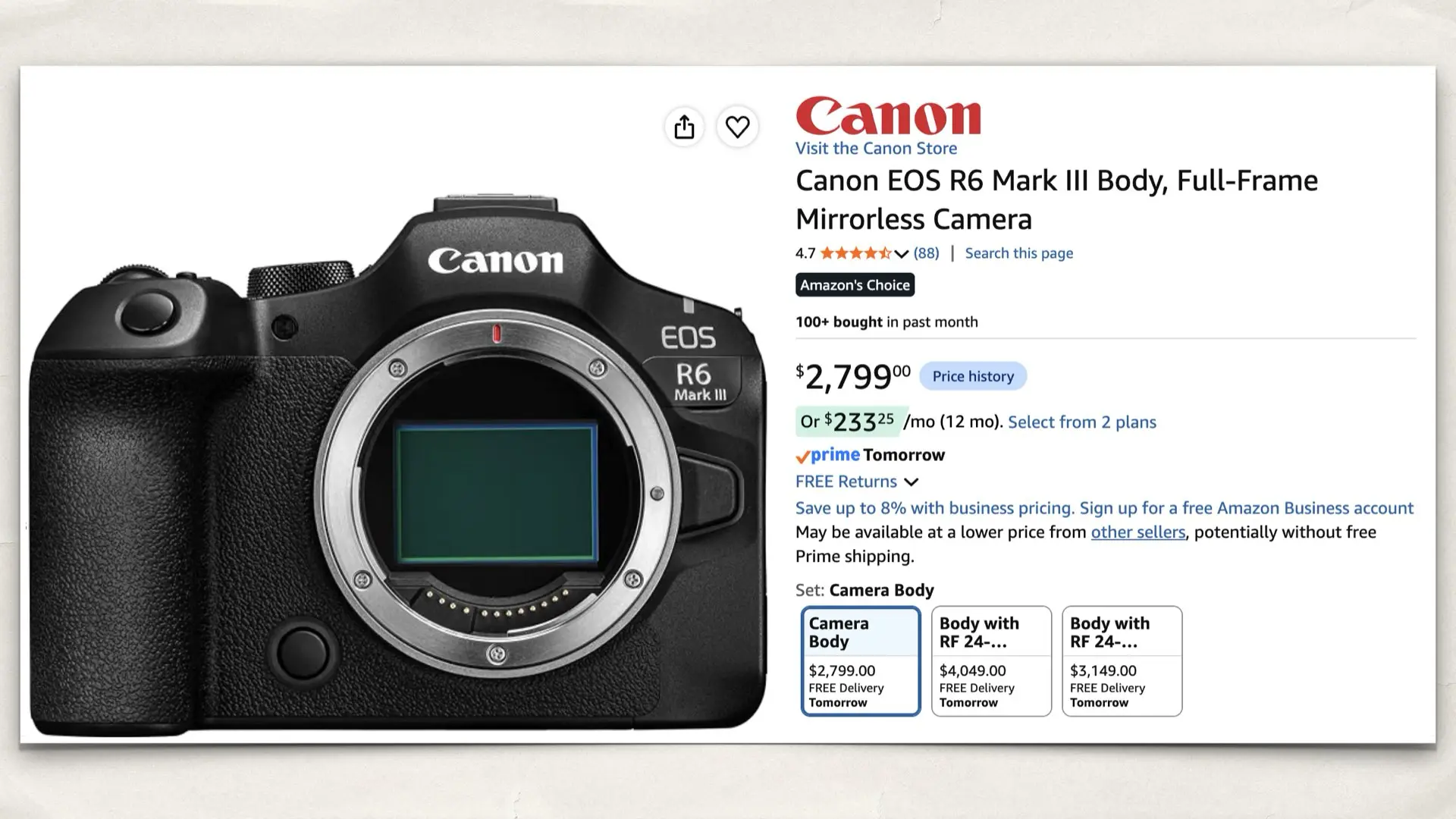
#4 Canon EOS R6 Mark III – $2,799
The EOS R6 Mark III (See on Amazon) is the premium body in Amazon’s top five and costs substantially more than the three cameras above it. Canon increased the sensor resolution to 32.5MP and introduced a CFexpress Type B slot alongside a UHS-II SD slot. The camera can internally record 7K up to 59.94p in 12-bit Canon RAW Light, while Open Gate recording is available up to 7K 29.97p. It also supports 4K recording up to approximately 120p. These changes explain much of the $800 difference compared with the R6 Mark II. The R6 Mark III is no longer simply a modest generational update. The higher-resolution sensor improves its stills capability, while CFexpress and internal 7K RAW move the video side considerably further toward professional production. The key distinction is therefore not simply Mark II versus Mark III. The R6 Mark II remains the more straightforward hybrid camera. The R6 Mark III provides more resolution, considerably more recording bandwidth and a much deeper video feature set. That difference is reflected directly in the price.
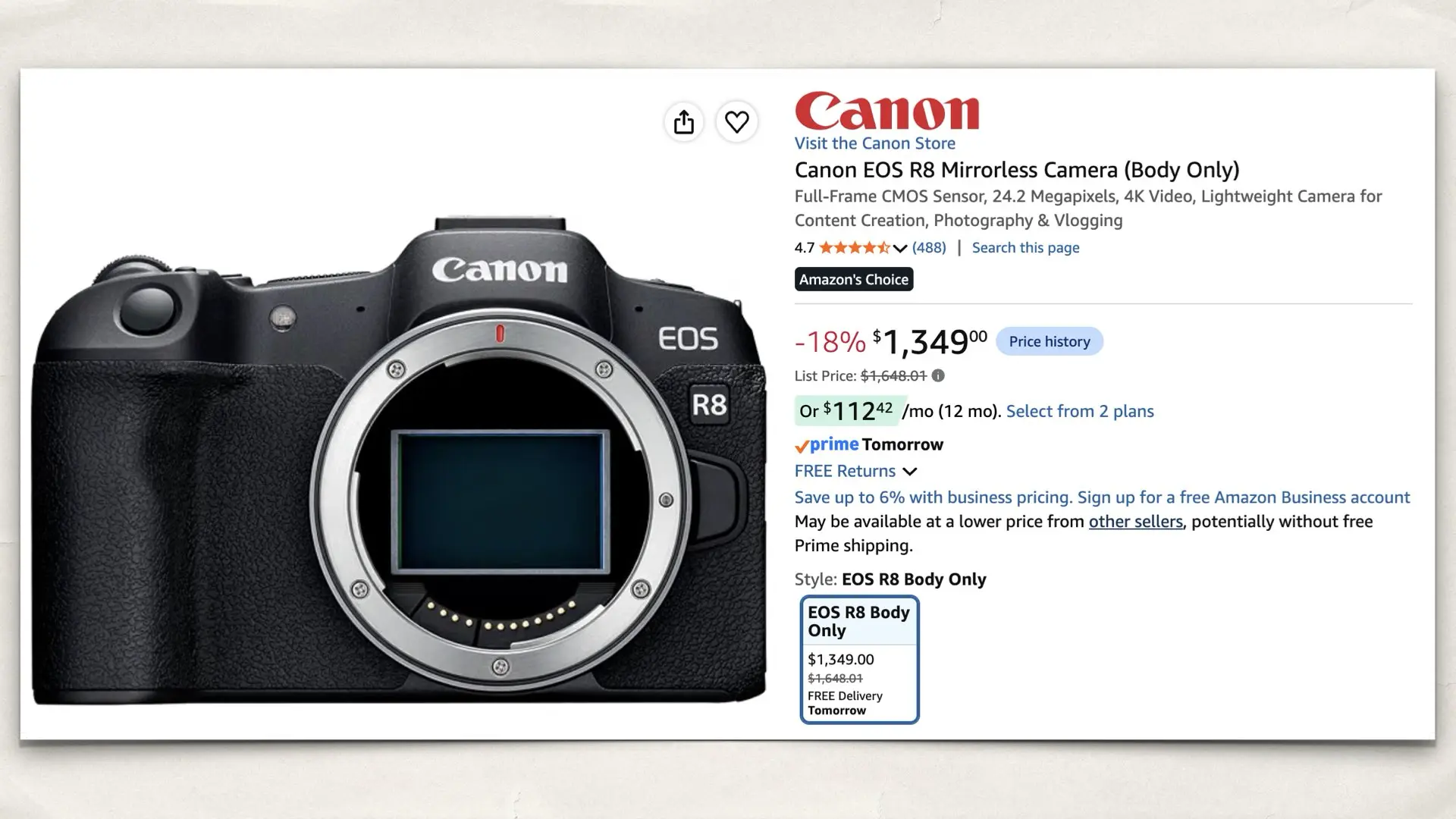
#5 Canon EOS R8 – $1,349
The Canon EOS R8 (See on Amazon) sits at the opposite end of the list. At $1,349 on Amazon, it is roughly $650 cheaper than the three cameras clustered around $2,000. The R8 uses a 24.2MP full-frame CMOS sensor with Canon’s DIGIC X processor. It records to a single UHS-II SD card and is also one of Canon’s lightest full-frame bodies, weighing less than one pound body-only. Its appeal is relatively easy to understand. The R8 provides access to Canon’s RF full-frame system and essentially mainstream full-frame image quality without requiring the larger investment associated with the R6 line. The trade-offs are in the body architecture. The R8 does not provide the same media redundancy, body design or professional-oriented feature set as the R6 cameras. For event shooters and production environments where dual card recording or more robust handling is important, those differences matter. For travel, lightweight production, photography and users entering the RF system, however, the lower price is significant.
Five cameras, three very different price levels
Amazon’s current top five effectively divide into three groups. The EOS R8 establishes the lower end at $1,349. The R6 Mark II, a7 IV and Z6 III form an extremely tight $2,000 middle tier. The R6 Mark III then jumps to $2,799. The middle tier is where the comparison becomes particularly interesting because price no longer provides a meaningful separator. The Sony offers the highest stills resolution of the three at 33MP. The Canon R6 Mark II provides a balanced 24.2MP hybrid platform with strong autofocus and stabilization. The Nikon Z6 III pushes furthest toward advanced video functionality with 5.4K, 4K/120p and faster media support. These are very different cameras being sold for effectively the same amount of money.
Canon occupies three of the five positions
Another notable aspect of Amazon’s ranking is Canon’s presence. Three of the five bodies are EOS R cameras: the R6 Mark II at number one, R6 Mark III at number four and R8 at number five. More importantly, Canon is represented at three different price points. The R8 covers the more accessible full-frame segment, the R6 Mark II competes directly at approximately $2,000, and the R6 Mark III addresses users willing to spend more for higher resolution and significantly expanded video capabilities. Sony and Nikon currently occupy the other two positions with cameras that compete almost dollar-for-dollar against the R6 Mark II.
Bottom line
Amazon’s full-frame sales ranking provides a useful snapshot of the current hybrid camera market. The most striking part is not that Canon, Sony and Nikon all appear in the top three. It is that their three best-selling bodies have converged at virtually the exact same price. At approximately $2,000, the Canon EOS R6 Mark II, Sony Alpha 7 IV and Nikon Z6 III are no longer competing primarily on cost. They are competing on what matters after the purchase: sensor resolution, video formats, autofocus, storage, ergonomics and, perhaps most importantly, the lens system surrounding the camera. For buyers, that makes the current $2,000 full-frame market unusually straightforward in one respect: the price difference has almost disappeared. The differences between the cameras have not.
Gear mentioned in this article
Available on Amazon
| Product | New | Renewed | Used |
|---|---|---|---|
| Nikon Z6 III | $2,196.95 | — | From $1,949 |
| Canon EOS R6 Mark II | $1,999 | — | From $1,899.95 |
| Sony a7 IV | $1,998 | — | From $1,789 |
| Canon EOS R6 Mark III | $2,799 | — | From $2,423.39 |
Prices checked: Oct 7, 2026, 1:31 PM GMT+0000
As an Amazon Associate, Y.M.Cinema earns from qualifying purchases. If you buy through our links, we may earn a small commission at no extra cost to you.
Product prices and availability are accurate as of the date/time indicated and are subject to change. Any price and availability information displayed on Amazon.com at the time of purchase will apply to the purchase of this product.
CERTAIN CONTENT THAT APPEARS ON THIS SITE COMES FROM AMAZON. THIS CONTENT IS PROVIDED “AS IS” AND IS SUBJECT TO CHANGE OR REMOVAL AT ANY TIME.





They sure aren’t $2,000 where I live…and many others too, I’m sure.