In early 2025, Apple premiered an unprecedented immersive concert experience with Metallica, shot specifically for its Vision Pro headset. What seemed like a celebratory moment for spatial entertainment may have been something more strategic: a full-scale sandbox test of a highly secretive and proprietary Apple camera system designed to capture immersive, high-resolution, stereoscopic 3D video. As the industry speculates, and as patent filings and strategic partnerships emerge, the signs are all pointing to one highly likely conclusion—Apple is building its own cinema-grade immersive cameras.

The Metallica Moment: A Massive Field Test in Plain Sight
The Metallica concert wasn’t just content—it was a controlled, technical exercise. According to Apple, the event was captured using 14 “Apple Immersive Video” cameras, rigged in an elaborate configuration that included stabilized, cable-suspended, and remote-controlled dolly systems. These weren’t standard rigs. These were highly specialized tools for capturing 8K stereoscopic 3D content with Spatial Audio—custom built for the Apple Immersive Video format. The concert offered Apple the ideal playground to push its imaging tech in a real-world setting.
To capture the band’s full performance from multiple perspectives, and the energy of over 65,000 passionate Metallica fans, Apple built a custom stage layout featuring 14 Apple Immersive Video cameras using a mix of stabilized cameras, cable-suspended cameras, and remote-controlled camera dolly systems that moved around the stage.– Apple
Early Clues: Apple’s Long Road to Camera Development
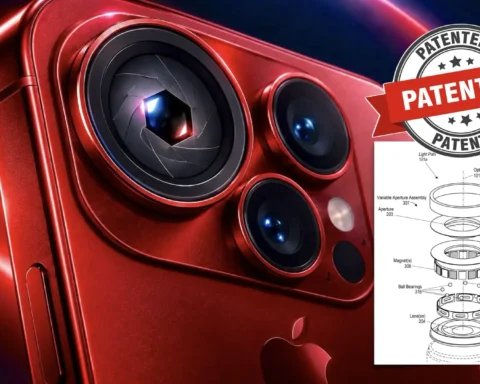
The idea of Apple venturing into the realm of dedicated cinema cameras might sound improbable—until you trace the breadcrumbs. As early as 2016, Apple filed a patent for a modular stereoscopic camera system featuring dual sensors and interchangeable lenses. The patent, later granted in 2021, laid the groundwork for what would become a recurring theme: Apple’s quiet but deliberate interest in immersive video hardware. Y.M.Cinema’s deep dive into the patent reveals Apple’s vision of a spatially aware, modular, and professional-grade camera—built not for photography, but for capturing new dimensions of reality.

A Direct Challenge to Cinema Camera Kings
In late 2024, Apple made its boldest move yet. With little fanfare, the company unveiled its own 8K 3D immersive cinema camera, purpose-built for the Vision Pro. The camera, featuring dual large-format sensors (speculated to be MFT or Super 35), was used to shoot a short film called Submerged with Academy Award-winning director Edward Berger. This was Apple showing its hand, albeit quietly. Y.M.Cinema’s coverage underscores the camera’s high-end nature—powerful enough for cinema, yet deeply integrated with the Apple ecosystem. But the road ahead won’t be without competition. Blackmagic Design has introduced its own 8K stereoscopic camera, the URSA Cine Immersive, built specifically for the same Apple Immersive Video format. As discussed here, Blackmagic’s entry could pose a serious challenge to Apple, especially in the independent and professional filmmaking sectors. Yet it also validates Apple’s direction—the format is real, growing, and ripe for cinematic storytelling.

The Vision Pro Conundrum: Hardware Without Content?
Apple’s interest in camera systems isn’t just about innovation—it’s about survival (let’s be a bit overdramatic here :-). The Vision Pro, despite its technical brilliance, has struggled to find mainstream traction. As Y.M.Cinema points out, immersive 3D cinema hasn’t yet captured public imagination. The chicken-and-egg problem persists: no content, no viewers—no viewers, no content. By building its own camera system, Apple is taking the risk of becoming both the platform and the studio, seeding its ecosystem with the tools to create content from within.

Should Apple Just Acquire Blackmagic?
Which begs the question: If Apple is already deeply entwined with immersive video, and Blackmagic is producing compatible hardware, why not merge forces? In a provocative editorial, Y.M.Cinema explored the potential of Apple acquiring Blackmagic Design. With its heritage in cinema hardware and robust developer tools like DaVinci Resolve, Blackmagic offers Apple both credibility and community. Such a move could fast-track Apple’s dominance in the spatial media space. There’s more at stake here. Blackmagic has the agility and cult status in the film industry that Apple lacks. Its cameras are accessible, affordable, and widely used by indie filmmakers, educators, and even Hollywood productions. By acquiring Blackmagic, Apple would instantly gain an entire filmmaking ecosystem—hardware, software, and user base—in one fell swoop. The integration of DaVinci Resolve into macOS could turn Final Cut Pro into a powerhouse of immersive post-production. The synergy between Apple’s hardware and Blackmagic’s production tools could give rise to an end-to-end pipeline that no competitor could match. Moreover, Blackmagic’s innovations—such as large sensors, raw codecs, and high-speed capture—could rapidly accelerate Apple’s own camera development. And let’s not forget the branding opportunity: imagine an “Apple x Blackmagic Studio” line that signals quality, openness, and cutting-edge cinema. The acquisition could also strategically block competitors like Adobe or Nvidia from entering the immersive video camera race by snapping up Blackmagic themselves. In many ways, acquiring Blackmagic would not just be a growth move—it would be a defensive one.
Final Thoughts: From Sandbox to Studio
In early 2025, Apple premiered an immersive Metallica concert for its Vision Pro headset. While hailed as a milestone in spatial entertainment, the event may have served a more strategic function: a public stress test for Apple’s own cinema-grade immersive camera system. With custom rigs, 8K stereoscopic capture, and a format tailored for Apple Immersive Video, the concert appears to have been less about content and more about proving hardware. Coupled with patent filings, behind-the-scenes developments, and key partnerships, all signs point to one conclusion: Apple is entering the professional cinema camera space—on its own terms, and at full scale. That would be just our two cents.