
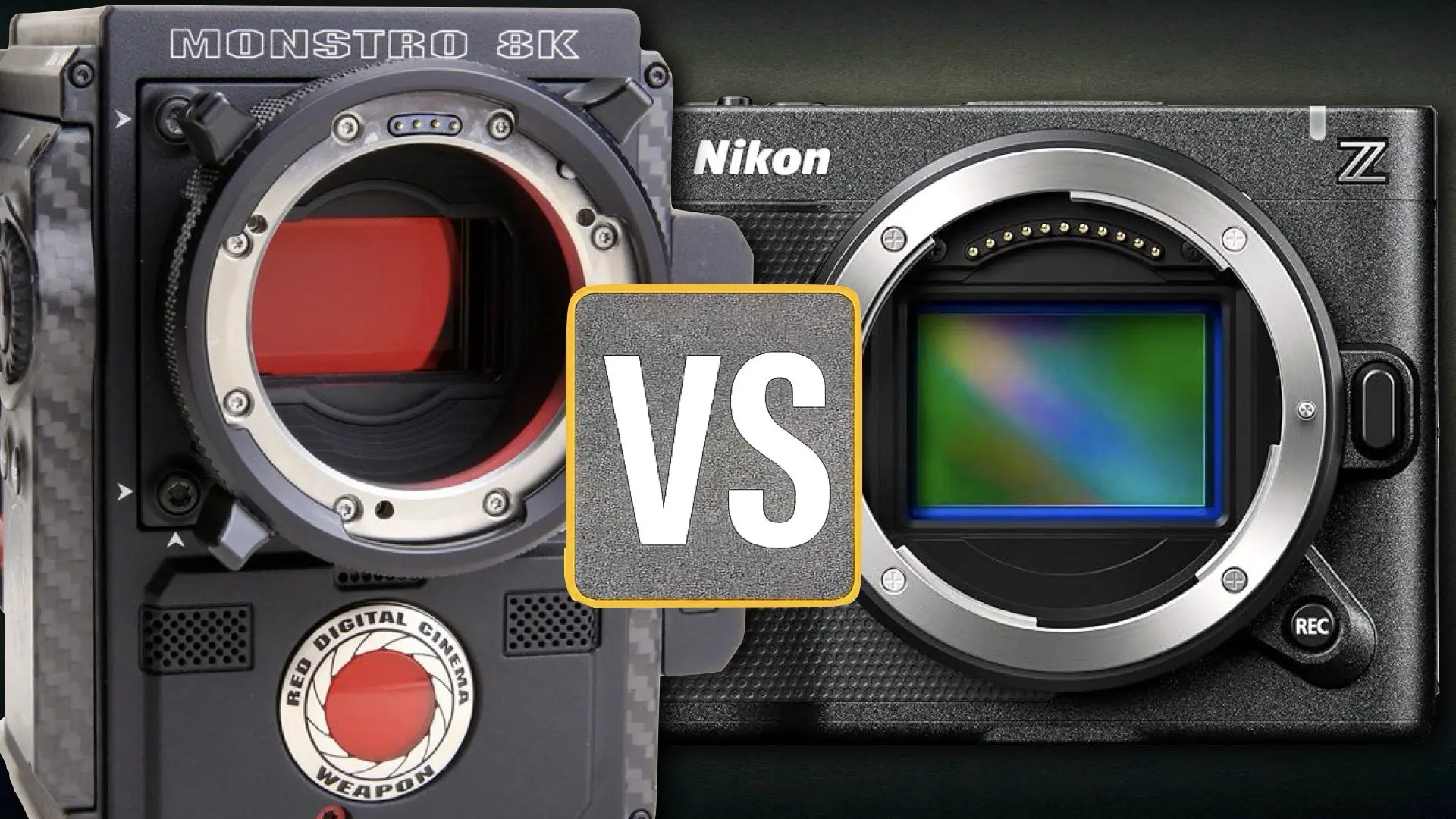
The comparison between the RED Weapon Monstro and the Nikon ZR ($2,196.95 on Amazon) has moved from theory to real testing thanks to detailed evaluations conducted by filmmaker Brandon Talbot. His work provides a neat real-world examination of how a mirrorless body behaves when placed next to a Vista Vision cinema flagship. Although these two cameras exist in different classes and price tiers, Talbot’s controlled testing shows an unexpectedly narrow performance gap in several key areas. This article aims to present an educational and practical examination of Talbot’s findings. The focus is strictly on image behavior, exposure methodology, ISO structure, workflow considerations, and the broader implications for cinematographers. BTW, if you are interested in more ‘banal’ (but effective) comparison, feel free to check out this: Nikon ZR vs Sony FX3 ($4,298 on Amazon) : What Simple Real-World Testing Really Teaches Us About These Cameras.
Image quality in controlled comparisons
In matched indoor window-lit scenes, Talbot’s footage shows that the Nikon ZR produces tonal reproduction and contrast behavior that closely resembles the RED Monstro when the same lenses, ISOs, and white balance values are applied. The Monstro’s Vista Vision sensor naturally provides a wider field of view and slightly different out-of-focus character, yet the ZR’s color and highlight roll-off track more closely than expected for a mirrorless body. These similarities do not imply equivalence between the two systems. Instead, they indicate that recent sensor and processing developments allow compact cameras to approach the look of high-end cinema tools under controlled conditions.
Understanding the ZR’s two-ISO behavior
One of Talbot’s most useful discoveries is that the ZR behaves like a dual-base-ISO camera, with true bases at 800 and 6400. ISO values between these points act more as metadata adjustments rather than changes to the underlying sensor exposure. This approach resembles how RED RAW ISO works, where the ISO value influences interpretation rather than the captured data itself. At ISO 800, Talbot shows that the ZR delivers extremely clean results with minimal noise. At ISO 6400, when properly exposed and corrected in post, the image remains surprisingly stable with a fine-grained structure. Intermediate ISO settings, however, behave inconsistently, particularly in how the waveform represents clipping. Talbot’s recommendation is clear. Operate at 800 whenever possible. If additional gain is required, move directly to 6400 rather than using intermediary values. This provides more consistency and better noise performance across scenes.
Highlight handling and recovery latitude
Talbot’s tests include scenarios with extreme contrast and intentionally overexposed frames. When the ZR’s footage is not clipped at the sensor level, significant detail remains available in highlights even when the on-camera monitor suggests otherwise. This includes subtle color transitions in bright areas such as white fur illuminated by mixed lighting. The Monstro still retains a predictable and stable highlight response thanks to its exposure tools and waveform accuracy. The ZR can approach this behavior, but the operator must be disciplined and rely on experience rather than on monitoring indicators alone. For students of cinematography, Talbot’s examples highlight how RAW metadata and sensor limits interact in practical shooting.
Why is exposure more challenging on the ZR?
Talbot’s primary critique of the ZR does not concern the sensor or codec. Instead, it focuses on exposure reliability. Waveforms shift as the ISO metadata changes, even though the sensor’s actual clipping point does not. This produces inconsistent information on the monitoring tools. Without false color or a RED-style stoplight system, predicting the clipping threshold becomes more difficult. This limitation affects workflow confidence during fast-paced production. The Monstro’s exposure tools provide immediate clarity, allowing operators to make split-second decisions. The ZR can match a portion of the Monstro’s image quality, but only when exposure is dialed in precisely. Talbot’s observations emphasize the gap between sensor performance and operator usability.
High frame rate behavior
Talbot also compared 8K60 Vista Vision footage from the Monstro with 6K60 and 4K120 material from the ZR. While the Monstro retains a resolution and compression advantage, the ZR maintains coherent detail, stable motion representation, and accurate color. The difference is visible, yet the ZR’s performance is technically strong enough for professional slow-motion applications, especially considering its size and price. This supports the broader finding that mirrorless bodies are now capable of meeting many production needs historically reserved for larger cinema systems.

Practical reliability and workflow considerations
Talbot clarifies that reliability concerns with the ZR have nothing to do with hardware durability. The camera boots quickly, feels structurally robust, and records high-quality audio. The concern lies in whether exposure can be executed consistently under pressure. For structured production environments, predictable monitoring is essential. The Monstro still provides this predictability. For owner-operators, independent productions, educational programs, and controlled shoots, the ZR offers strong performance and exceptional value. Talbot’s tests show that the limiting factor is workflow confidence rather than sensor quality. Also, the comparison suggests a shift in how we evaluate cinematography tools. The traditional gap between mirrorless and cinema cameras is narrowing in terms of raw image quality. Workflow, exposure aids, and monitoring accuracy now play a larger role in differentiating the systems. This also points to a development path for Nikon. If the company integrates RED’s stoplight system, false color, and waveform refinements into future firmware, the ZR platform would gain the operational clarity needed to support more demanding productions. The underlying image performance is already present. The interface and monitoring behavior must evolve to match it.

Wrapping up
Through Brandon Talbot’s careful testing, the Nikon ZR demonstrates an imaging capability that exceeds expectations for a camera of its class. When exposure is controlled at the sensor level, the ZR can produce output that aligns with the tonal and dynamic behavior of a RED Monstro. The Monstro retains clear strengths in monitoring tools, exposure reliability, and workflow coherence, which remain essential for high-pressure professional sets. For cinematographers, Talbot’s results offer an educational window into modern imaging. The technical distinctions now lie less in sensor limitations and more in how the operator interacts with the camera. Understanding ISO metadata, highlight headroom, waveform behavior, and exposure discipline has become central to achieving consistent results across formats. Check out his full video below:
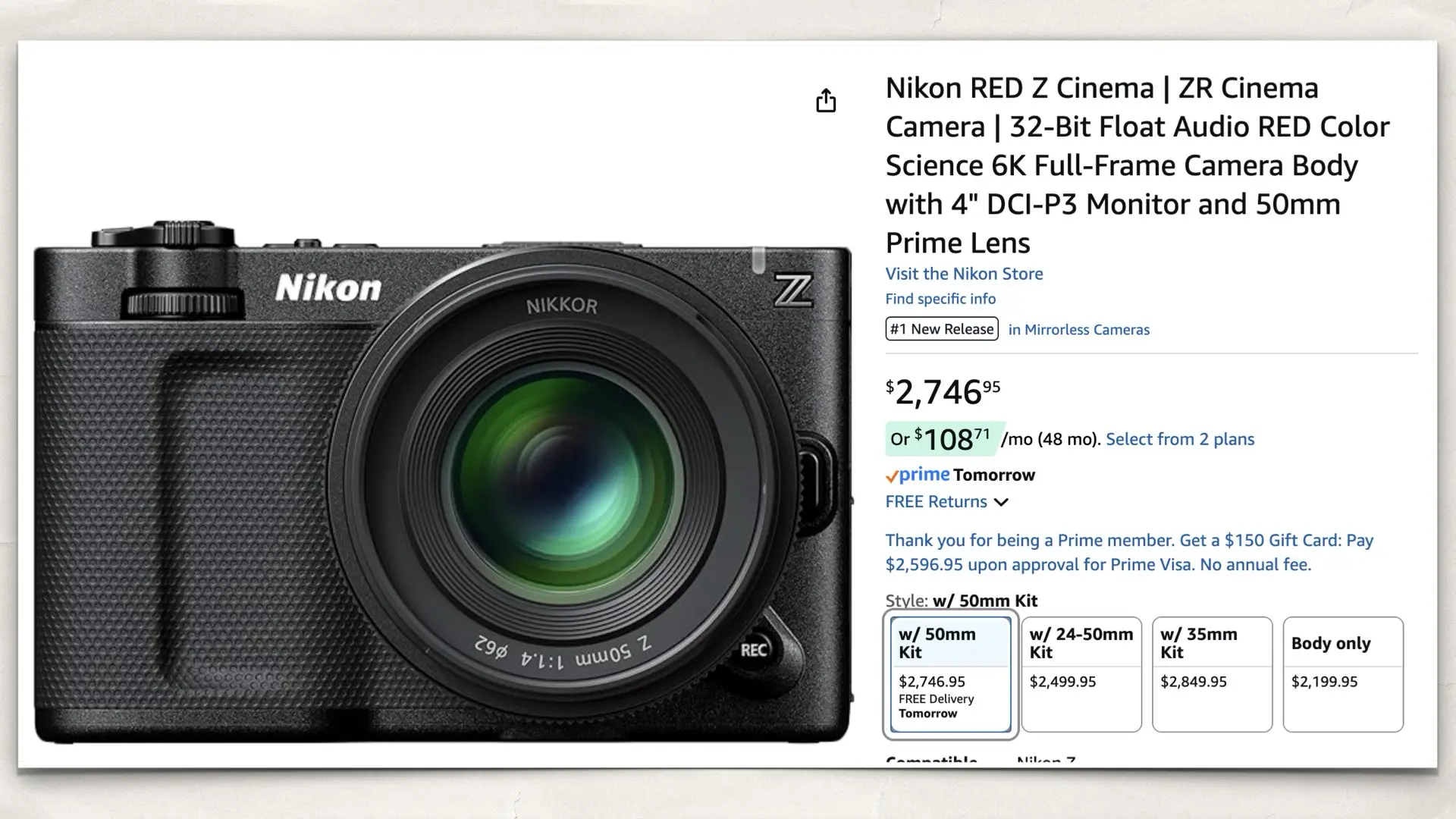
📦See the Nikon RED ZR on Amazon
As an Amazon Associate, Y.M.Cinema earns from qualifying purchases. If you purchase through the Amazon links above, Y.M.Cinema may earn a small commission at no additional cost to you. This helps support our work.

Gear mentioned in this article
Available on Amazon
Prices checked: Oct 2, 2026, 1:30 PM GMT+0000
As an Amazon Associate, Y.M.Cinema earns from qualifying purchases. If you buy through our links, we may earn a small commission at no extra cost to you.
Product prices and availability are accurate as of the date/time indicated and are subject to change. Any price and availability information displayed on Amazon.com at the time of purchase will apply to the purchase of this product.
CERTAIN CONTENT THAT APPEARS ON THIS SITE COMES FROM AMAZON. THIS CONTENT IS PROVIDED “AS IS” AND IS SUBJECT TO CHANGE OR REMOVAL AT ANY TIME.

![Nikon Is Developing Nine NIKKOR Z CINEMA T1.9 VV Lenses for RED V RAPTOR [X]](https://ymcinema.com/wp-content/uploads/2026/09/Nikon-Is-Developing-Nine-NIKKOR-Z-CINEMA-T1.9-VV-Lenses-for-RED-V-RAPTOR-X.001-480x384.webp)





It was always going to come down to compression data rates and physical differences. The rest was going to be similar. Great work Nikon.