
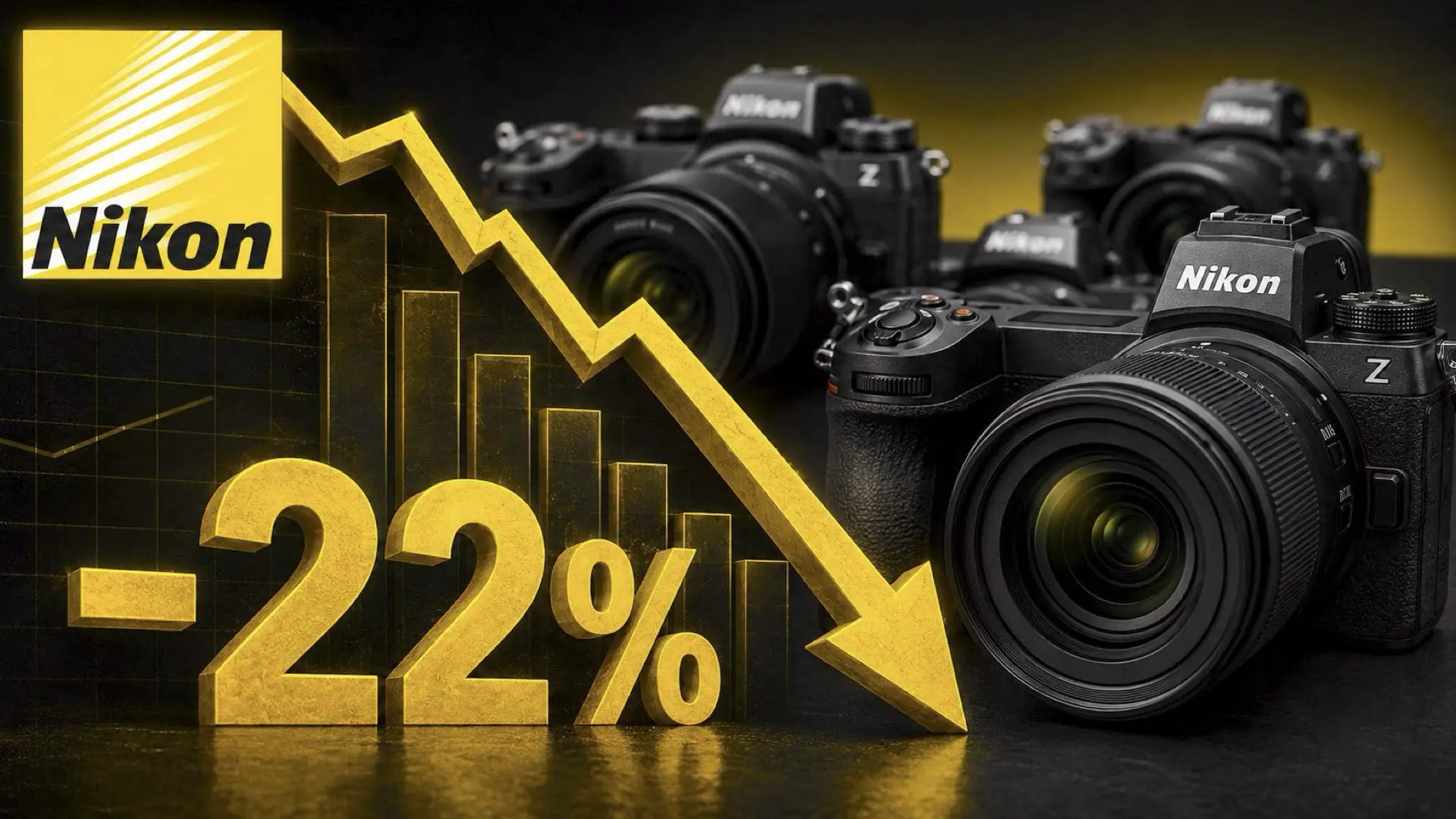
Nikon sold 210,000 interchangeable-lens cameras during the first quarter of its fiscal year ending March 2027, down from 270,000 units during the same period last year, a decline of roughly 22%. The weaker quarter has now pushed Nikon to cut both its own full-year camera sales forecast and its estimate for the broader interchangeable-lens camera market. The decline was also visible in lenses. Nikon shipped 310,000 interchangeable lenses during the quarter, compared with 370,000 a year earlier. Imaging Products revenue fell from ¥80.0 billion to ¥72.9 billion, down 8.8%, while operating profit dropped from ¥11.1 billion to ¥8.1 billion, a 27.5% decline. Nikon attributes the weaker camera and lens volumes primarily to contracting demand in China. Foreign-exchange effects helped revenue, but they were not enough to compensate for the reduced sales volume. Higher memory prices also weighed on profitability, despite favorable currency effects and refunds related to US tariffs.

Nikon cuts its camera forecast to 850,000 units
The more consequential part of Nikon’s update is what the company now expects for the rest of the year. Nikon previously projected sales of 900,000 interchangeable-lens camera bodies for the fiscal year. That forecast has now been reduced to 850,000 units. Its lens forecast has also been cut from 1.30 million to 1.25 million units. The company is not treating the weakness as a Nikon-only issue. Nikon reduced its estimate for the overall interchangeable-lens digital camera market from 7.0 million to 6.7 million units, a reduction of 300,000 cameras in only three months. Nikon says near-term demand is softening, particularly in China because of the economic slowdown, although it still expects the market to remain solid over the medium to long term. For perspective, Nikon sold 910,000 interchangeable-lens cameras during the previous fiscal year. The revised 850,000-unit forecast therefore implies lower annual unit volume as well as a reduction from the company’s original expectations. The estimated total market was approximately 7.04 million units in the previous year.

Camera volume is down, the company’s own annual target has been cut, and Nikon now expects the entire interchangeable-lens camera market to be smaller
Imaging profit takes a larger hit than revenue
The change is also affecting Nikon’s financial expectations for Imaging Products. The company has reduced its full-year Imaging Products revenue forecast from ¥303 billion to ¥290 billion, a ¥13 billion cut. Expected operating profit has been reduced from ¥16 billion to ¥13 billion. Nikon says the effect of the lower sales plan will outweigh the benefit received from US tariff refunds. Compared with the previous fiscal year, Nikon expects Imaging revenue to remain nearly flat at ¥290 billion, helped by foreign exchange. Profit is another matter. Imaging operating profit is now expected to fall from ¥17.2 billion to ¥13 billion, with Nikon pointing to reduced camera volumes and higher memory prices as pressures on the business. Nikon is not simply reporting fewer cameras sold during one quarter. It has changed its assumptions about how many cameras it expects the market, and Nikon itself, to absorb during the entire fiscal year.

A different picture from Sony’s latest imaging results
The numbers also provide an interesting counterpoint to Sony’s recently published results. Sony reported approximately 6.6% year-over-year growth in its broader camera-related Imaging category during the same April-to-June period, with external sales reaching ¥199.7 billion. Sony, however, does not publish comparable camera shipment numbers, so the two companies’ figures cannot be treated as a direct market-share comparison. Nikon gives considerably more visibility into actual hardware volume. Its quarterly figures show 60,000 fewer interchangeable-lens cameras and 60,000 fewer lenses sold year over year, while its revised forecast explicitly connects the reduction to weaker market conditions.
Including cinema cameras (RED)?
There is another qualification relevant to our readers. Nikon defines Imaging Products broadly enough to include digital cameras, digital cinema cameras, and interchangeable lenses, but it does not disclose separate unit or revenue figures for its cinema-camera operation. The reported 210,000-unit figure is specifically Nikon’s Digital Camera-Interchangeable Lens Type category. The financial documents therefore do not establish how much of the decline came from individual Nikon camera families or from its cinema products. What Nikon does disclose is unusually clear: camera volume is down, the company’s own annual target has been cut, and Nikon now expects the entire interchangeable-lens camera market to be smaller than it anticipated in May. The next question is whether the weakness remains concentrated around China and the current economic environment, or whether Nikon’s revised 6.7-million-unit estimate begins to look like the industry’s new baseline.













Let’s see, I saw a $17AU video camera the other day. I think it was a nice brand for $17. That camera can easily be made to record uncompressed raw, maybe a software change. A c-mount lens mount can be easily added or any other cheap mount, even a format converter adaptor. A good sensor with 17 stops 14 bits may cost an extra $1US onto the retail (well there were those people who thought they couldn’t see above 720p, even dvd resolution) even close to 24fps. The main restriction is manufacturers putting in restrictions, denying easy cheap features. We didn’t see the $200 8k cinema camera because of this. That is the sort of price range we may have gotten down to with better competition.