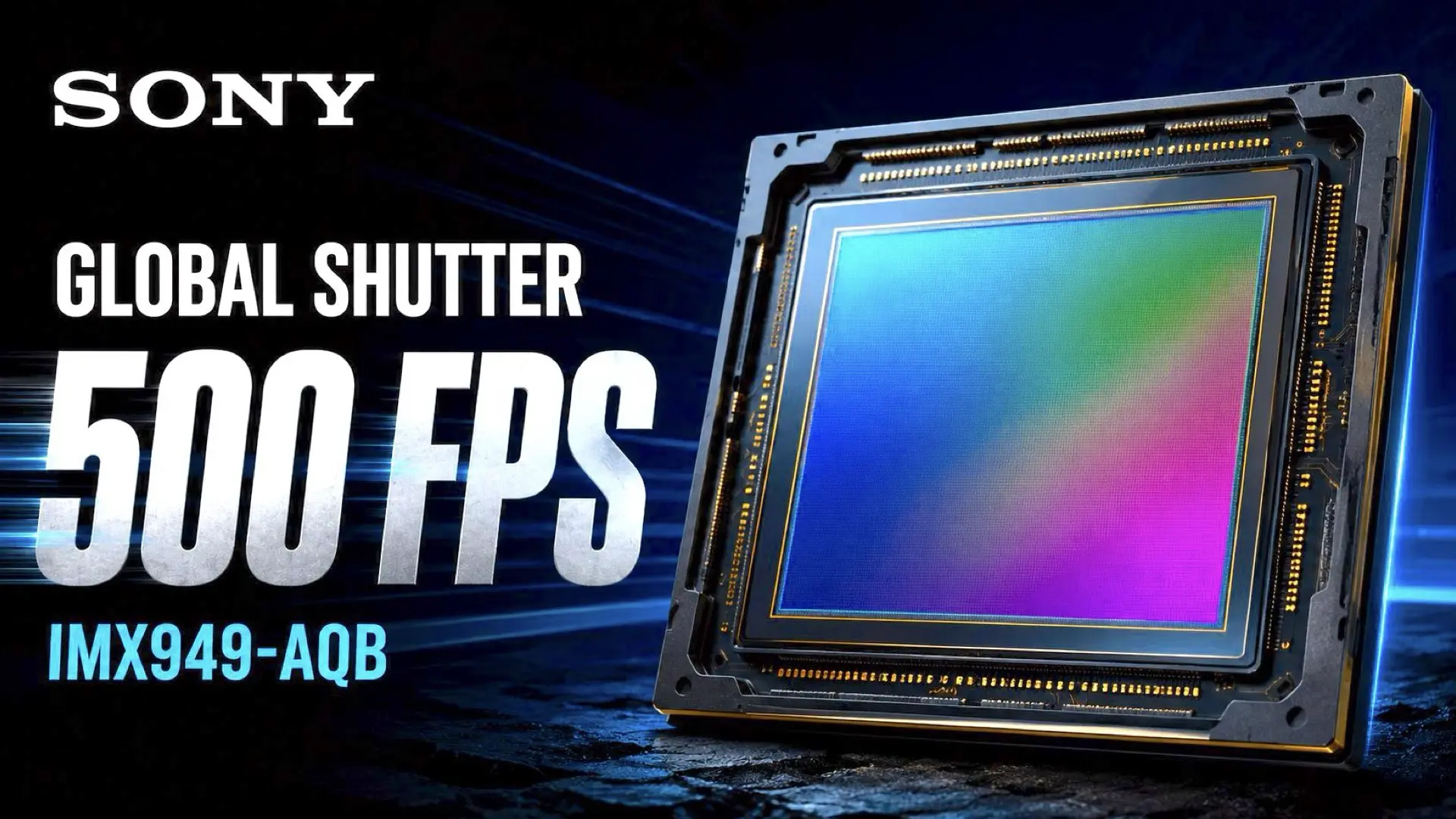
Sony has added a new sensor flyer that deserves attention far beyond the machine vision world. The IMX949-AQB is a Type 1.8 CMOS image sensor with a 28.1 mm diagonal, approximately 12.69 effective megapixels, Pregius S global shutter technology, and an all-pixel readout speed of up to 502.3 frames per second in 12-bit. In plain English, Sony is showing a 4K class global shutter sensor that can capture extremely fast motion with a resolution of 4096 x 3072 and serious bit depth. This is not a Sony VENICE sensor. It is not being presented as an FX, Alpha, or cinema camera component. Sony lists the applications as FA cameras and 3D vision cameras, which means factory automation, machine vision, robotic vision, industrial inspection, measurement, tracking, and depth-related imaging. However, some of the most interesting imaging signals now come from the edges of cinema: industrial sensors, broadcast systems, virtual production, machine vision, scientific imaging, and computational capture, so it’s worth checking out.

What is the Sony IMX949?
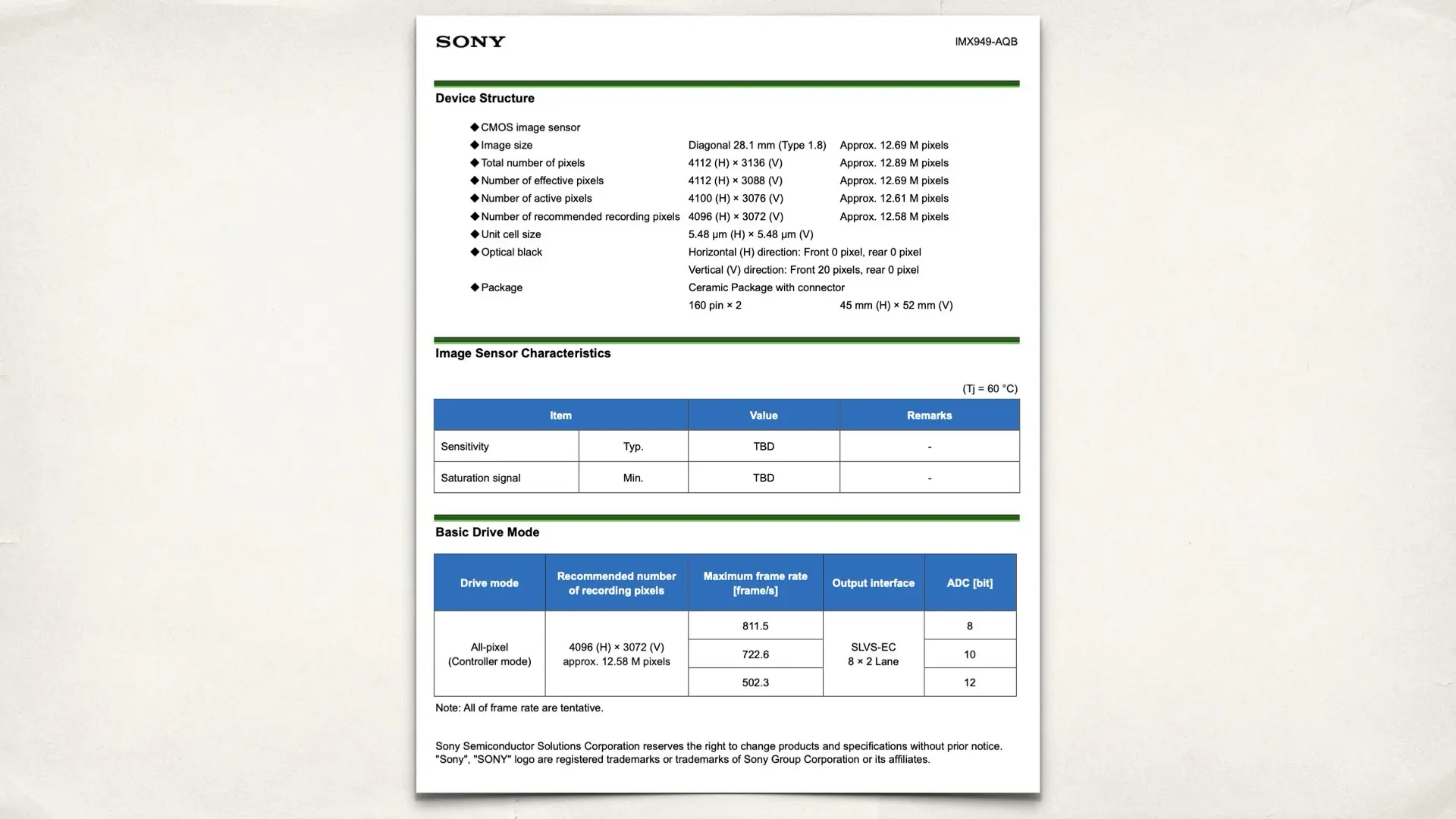
The Sony IMX949-AQB is a CMOS active pixel image sensor from Sony Semiconductor Solutions. According to the tentative flyer, it is a Type 1.8 sensor with a 28.1 mm diagonal and a recommended recording resolution of 4096 x 3072, which equals approximately 12.58 million pixels. The effective pixel count is listed at approximately 12.69 megapixels. The unit cell size is 5.48 micrometers by 5.48 micrometers. That is worth noting because Sony is not chasing ultra-high resolution here. The design points toward speed, sensitivity, and clean readout. The sensor uses Sony’s Pregius S global shutter technology, which is built around stacked back-illuminated CMOS architecture. Sony positions Pregius S as a way to combine high picture quality and global shutter performance, with a smaller chip size and high sensitivity. The flyer lists full pixel scan frame rates of 811.5 fps at 8 bit, 722.6 fps at 10 bit, and 502.3 fps at 12 bit. The output interface is SLVS-EC, with configurations up to 8 lanes x 2 and a maximum listed baud rate of 12.474 Gbps per lane. The package is a ceramic package with a connector, measuring 45 mm by 52 mm. Those are not typical cinema camera packaging details. They are industrial sensor details. Still, the central specification is hard to ignore: full resolution, global shutter, 12-bit, more than 500 fps.
What 502 fps in 12-bit means in plain English
A global shutter sensor captures the entire frame at once. That is different from a rolling shutter sensor, which scans the image line by line. Rolling shutter can create skew, wobble, bending verticals, and motion distortion when shooting fast movement, quick camera pans, vehicle work, drones, action, sports, handheld shots, flashes, strobes, or LED-heavy environments. Global shutter removes that motion skew because the frame is exposed at the same time. For industrial cameras, this is essential. A machine vision camera inspecting parts on a fast production line cannot tolerate distorted geometry. A robotic system needs accurate motion data. A 3D vision system needs precision. A tracking camera needs repeatability. For cinematographers, global shutter has a different emotional and practical meaning. It allows fast motion to look mechanically precise. It makes camera movement cleaner. It can make handheld or action footage feel more controlled. It also removes one of the long-standing compromises of CMOS cinema sensors. The frame rate is the second part of the story. 502 fps at 12 bit and 4096 x 3072 is far beyond normal production frame rates. If adapted into a camera system with the right recording architecture, processing, cooling, color pipeline, and lens coverage, a sensor like this could create a fascinating high speed camera platform. That is a big “if.” A sensor specification does not equal a finished camera. The camera body, thermal design, image processing, memory pipeline, recording media, color science, dynamic range behavior, noise profile, debayer quality, and compression options all determine whether the output becomes useful for filmmakers.
Why are these specs unusual?
Most cinema camera discussions still revolve around resolution, dynamic range, sensor size, and codec. Those are important, but the IMX949-AQB points to a different axis of competition: how fast can a sensor read a complete, distortion-free image while preserving meaningful bit depth? That question is central to the next phase of high end imaging. Global shutter usually involves tradeoffs. In many sensor designs, a global shutter can reduce dynamic range or sensitivity compared with rolling shutter sensors. High frame rates also create massive data and heat problems. The higher the resolution and bit depth, the harder the engineering becomes. A 12.69 MP Type 1.8 Pregius S sensor with 5.48 micrometer pixels and 12-bit readout at 502.3 fps suggests a serious combination of sensor architecture and throughput. It is exactly the kind of specification that belongs in machine vision, but it is also the kind of specification cinema camera engineers will watch.
Our take
The Sony IMX949-AQB is not a cinema sensor announcement, and it should not be framed as one. Sony is clear about its intended applications: factory automation and 3D vision cameras. The package, interface, and flyer language all point to the industrial imaging market. Still, cinema people should pay attention. The most interesting part of this sensor is the balance. It is not a tiny high-speed sensor. It is a 28.1 mm diagonal chip with 5.48 micrometer pixels, global shutter, 4096 x 3072 recommended recording pixels, and 12 bit readout at 502.3 fps. That combination says more about the future of imaging than another incremental megapixel increase. Global shutter sensors are now getting stronger, faster, and more flexible. The industrial market may move first because it needs precision more urgently than cinema does. A future cinema camera based directly on this sensor is not confirmed. There is no evidence that the IMX949-AQB is bound for an FX, Alpha, VENICE, or high speed cinema product. But the sensor is a serious reminder that the next leap in camera technology may come from outside the traditional cinema camera aisle.