
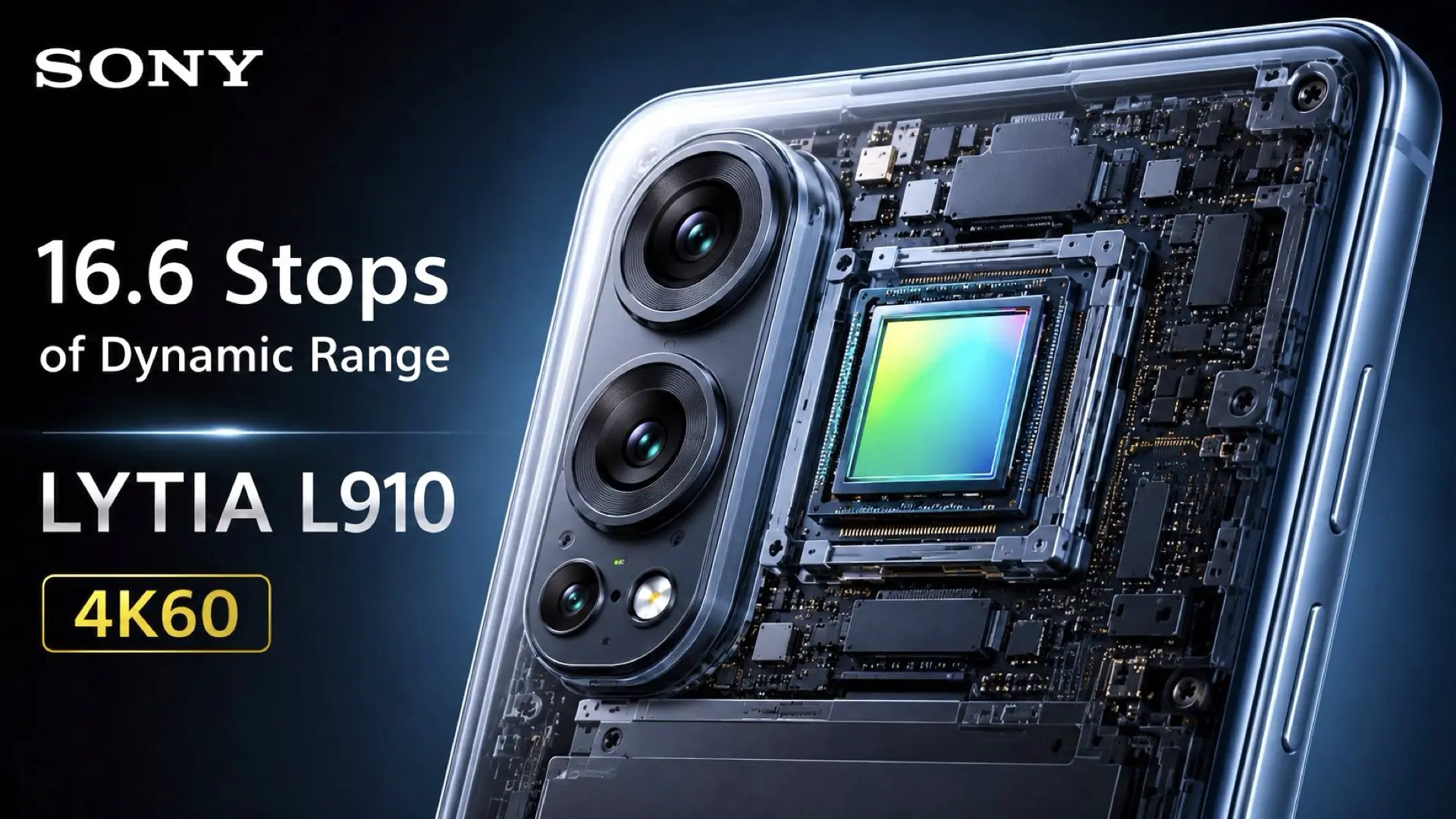
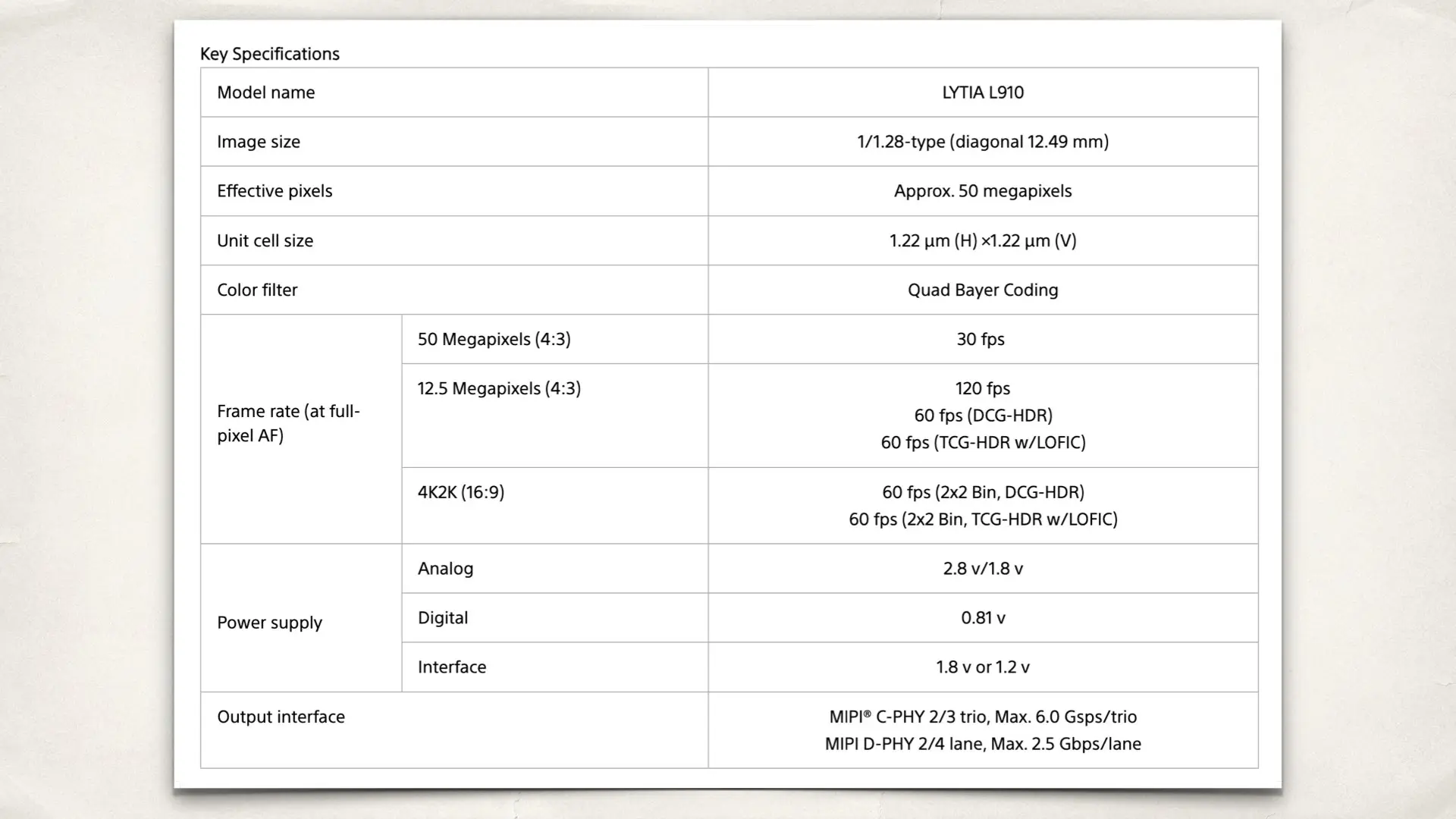
Sony has announced the LYTIA L910, a new high-end smartphone image sensor that brings LOFIC technology and 100 dB dynamic range to flagship mobile cameras. Translated into cinema language, that equals roughly 16.6 stops. For filmmakers, camera geeks, and creators, that number is the hook. For Sony, the deeper story is the direction of smartphone imaging: fewer tricks, fewer HDR artifacts, and more sensor-level latitude in scenes with brutal contrast. This is a mobile sensor, not a cinema camera sensor. Still, the technology target is familiar to every cinematographer. Protect the highlights. Keep the shadows clean. Avoid motion artifacts. Avoid flicker. Keep the image usable when the scene includes bright LEDs, reflective surfaces, neon signs, car headlights, dark streets, and moving subjects. That is the real signal behind the LYTIA L910. Sony says the LYTIA L910 is an approximately 50 effective megapixel stacked CMOS image sensor for mobile applications. It uses a 1/1.28 type format with a 12.49 mm diagonal, 1.22 µm unit pixels, Quad Bayer Coding, and support for 4K2K 16:9 video at 60 fps with TCG HDR and LOFIC. Mass production shipment is planned for summer 2026.
What is Sony LYTIA L910?
The LYTIA L910 is Sony Semiconductor Solutions’ new 50MP class image sensor designed for mobile cameras, specifically the kind of high-end smartphone camera systems used in flagship devices. The important part is not the megapixel count. Smartphone makers have been selling 48MP, 50MP, 108MP, and 200MP sensors for years. The more interesting part is the combination of LOFIC and single exposure HDR. LOFIC stands for Lateral Overflow Integration Capacitor. In simple terms, it gives the pixel somewhere to store overflow charge when the photodiode receives more light than it can normally hold. That expands saturation capacity. In image terms, it helps preserve bright information that would otherwise clip into white.
What 16.6 stops means
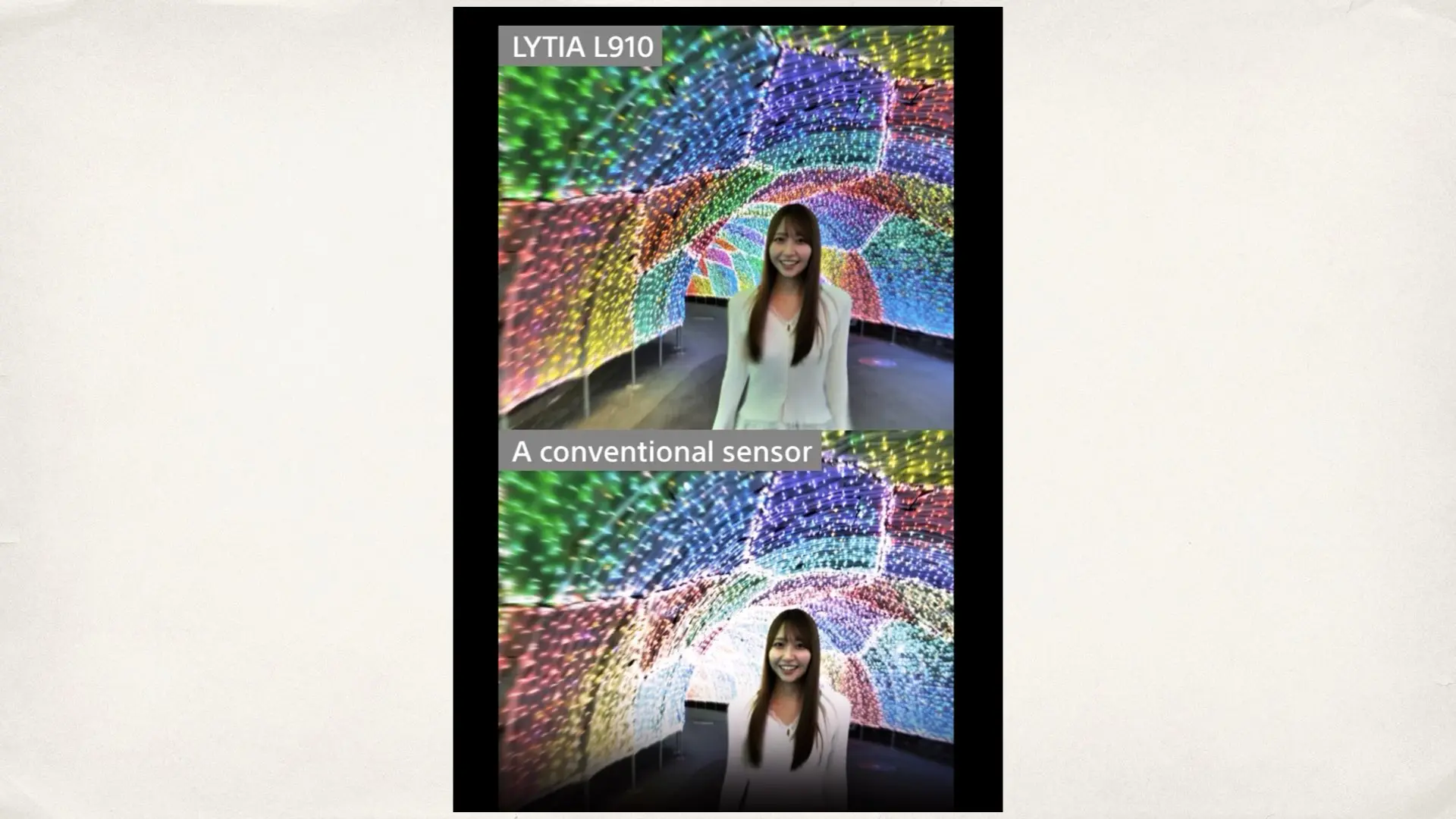
Sony combines that LOFIC structure with TCG HDR, or Triple Conversion Gain HDR. The sensor reads information from a single exposure at 3 different conversion gains. That allows the sensor to handle bright areas, mid-tones, and darker image regions with a wider usable range. Sony also mentions UHCG circuits, or Ultra High Conversion Gain circuits, designed to improve charge to voltage conversion efficiency and reduce random noise in darker image areas. The result is the headline specification: 100 dB dynamic range in a single exposure. Using the common conversion of 6.02 dB per stop, 100 dB works out to about 16.6 stops. That is why this announcement deserves attention beyond smartphone circles.
Sony LYTIA L910 vs OmniVision TheiaCel and the LOFIC race
It is important to be precise. Sony is not introducing LOFIC to mobile imaging for the first time in the industry. OmniVision has already promoted TheiaCel technology, which uses LOFIC for high dynamic range mobile sensors. OmniVision’s OV50K40 and OV50X announcements positioned TheiaCel as a major HDR technology for high-end smartphones, with the OV50X aimed at flagship phones requiring high dynamic range video and preview with single exposure. The question for flagship smartphones is no longer only who has the largest sensor or the most megapixels. It is who can deliver the most stable HDR video, the best highlight retention, and the cleanest low-light image within the limits of a phone body. Sony’s advantage is ecosystem credibility. The company is a dominant supplier of image sensors across consumer, mobile, and professional imaging categories. The LYTIA brand was created to give Sony’s mobile sensors a more visible identity, and the L910 now brings LOFIC into that lineup. The exact smartphone models that will use this sensor are not confirmed in the announcement, and it would be premature to connect it to any specific device. But mass production in summer 2026 suggests Sony is targeting the next wave of premium mobile camera systems.

The caution
There are limits. Dynamic range numbers do not tell the whole story. We do not yet know how the LYTIA L910 will behave inside a finished smartphone, with a specific lens module, thermal envelope, ISP, codec, stabilization system, and manufacturer color pipeline. A sensor can be excellent while the final phone image is still overprocessed. It can preserve highlight data while the phone’s tone mapping makes the image look artificial. It can offer an impressive HDR preview, while recording formats and app limitations reduce the real production value. Also, 16.6 stops is derived from Sony’s 100 dB figure. It is a useful translation into cinema language, but it should not be treated as a direct apples-to-apples comparison with the lab-measured dynamic range of a cinema camera in a professional recording format. Sensor-level HDR, finished video dynamic range, and usable production latitude are related, but they are not identical.
YMCinema’s two cents
The LYTIA L910 is worth covering because it shows a meaningful shift in the smartphone camera conversation. Megapixels are no longer the strongest story. AI image processing is already everywhere. The next valuable battlefield is the sensor itself: saturation capacity, noise behavior, single exposure HDR, flicker suppression, and power-efficient 4K60 recording. If the LYTIA L910 performs as Sony claims inside actual smartphones, flagship phone video could become more stable in night scenes, concerts, city environments, interiors with windows, and LED-heavy locations. That is exactly where phone footage often breaks.










Is this LOFIC tech scalable to larger and larger sensorS? Is the wafer yield high enough to make it viable for full frame chips? Could we see 6 micron photosites and capacitors produce 20 stops of DR.