
Adobe stock is falling hard, and that would normally sound like a Wall Street story. But for filmmakers, editors, cinematographers, camera reviewers, colorists, and content creators, this one goes deeper. Adobe is not a random software company. It is the company behind Premiere Pro, After Effects, Photoshop, Lightroom, Illustrator, Frame.io, Firefly, and the Creative Cloud subscription model that shaped modern digital creation. The strange part is that Adobe is not collapsing financially. The company reported record Q2 FY2026 revenue of $6.62 billion, up 13% year over year, raised its full-year outlook, and says AI-first recurring revenue has passed $500 million. On paper, that is a strong business. On the market, however, investors are treating Adobe like a company under pressure. That tension is the story. Adobe is still a revenue machine. But the stock’s free fall suggests that Wall Street is no longer valuing Adobe as an untouchable creative infrastructure company. And then there is the mighty Blackmagic’s DaVinci Resolve.
The leadership issue adds pressure. CFO Dan Durn is leaving, with Steve Day stepping in as interim CFO. CEO Shantanu Narayen has also announced plans to step down once a successor is selected.
The core facts behind Adobe’s stock free fall
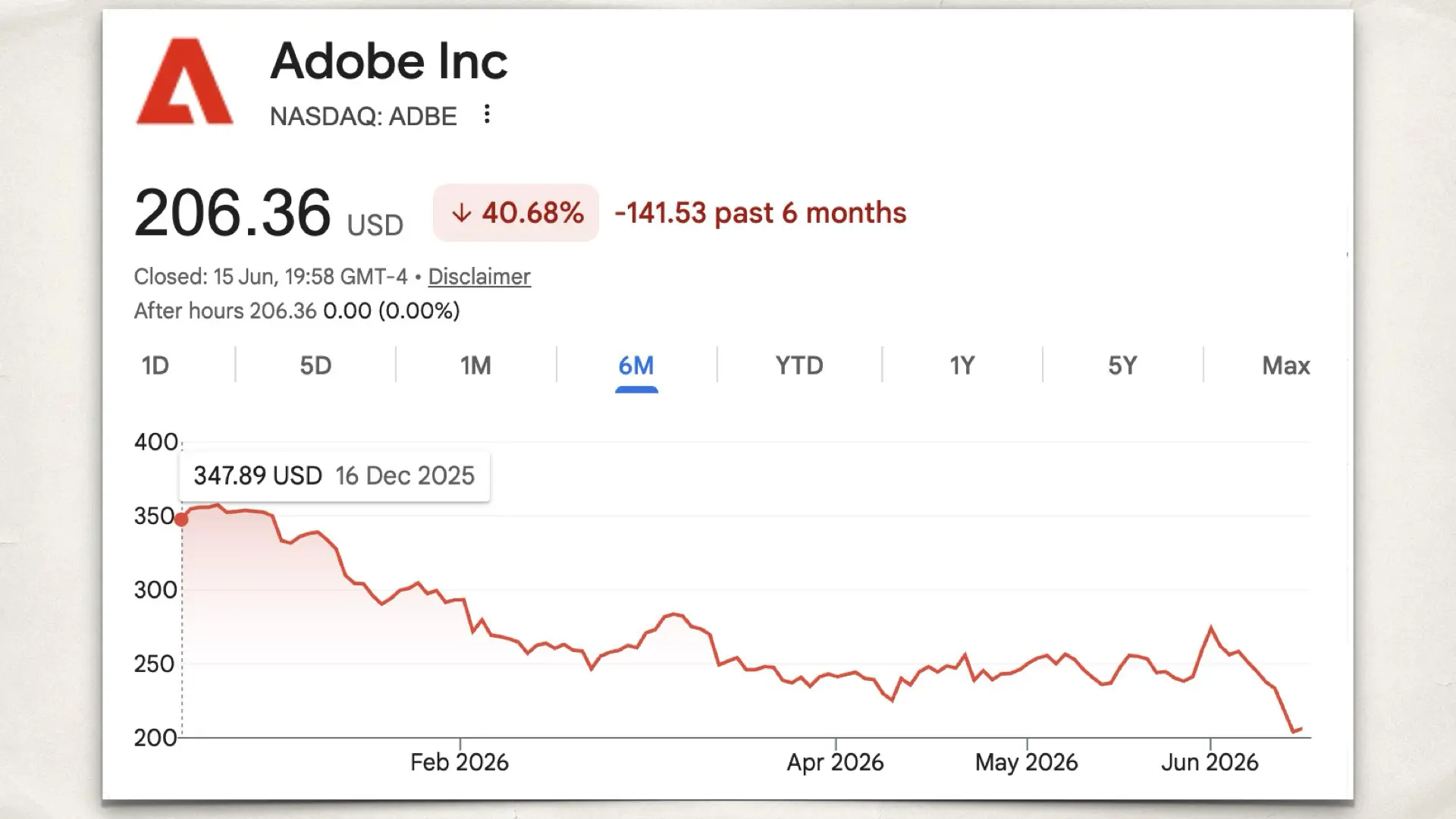
Adobe’s latest financial results were strong by most conventional measures. Revenue reached $6.62 billion in Q2 FY2026. The company reported non-GAAP earnings per share of $5.96. Annualized recurring revenue exited the quarter at $27.10 billion, including the contribution from Semrush. Adobe also raised its full-year revenue forecast to a range of $26.50 billion to $26.60 billion. That is not what a broken company looks like. Adobe still has scale, enterprise reach, subscription power, and one of the deepest professional creative software ecosystems in the world. Premiere Pro and After Effects remain major post-production tools. Photoshop is still a verb. Lightroom is central to photo workflows. Frame.io is deeply relevant for cloud-based review and collaboration. Firefly is Adobe’s answer to generative AI across image, design, video, and marketing content. Yet Adobe stock has been punished. Reports describe the shares reaching their lowest level in several years, with the stock down roughly 37% to 40% in 2026, depending on the time of measurement. The decline followed a mix of investor concerns: AI competition, a shift toward freemium AI user growth, a pause in some short-term monetization levers, and an executive transition. The leadership issue adds pressure. CFO Dan Durn is leaving, with Steve Day stepping in as interim CFO. CEO Shantanu Narayen has also announced plans to step down once a successor is selected. None of this means Adobe is unstable. But markets dislike uncertainty, especially when the company is already fighting a major platform shift.
What this means in plain English
The market is not saying Adobe is out of money. The market is asking whether Adobe’s moat is still as deep as it used to be. For years, Adobe’s strength was obvious. If you wanted serious creative work, you probably needed Adobe. A photographer needed Lightroom or Photoshop. A motion designer needed After Effects. Many editors needed Premiere Pro. Designers used Illustrator and InDesign. Agencies, brands, marketing departments, freelancers, and studios built entire pipelines around Creative Cloud. That ecosystem created gravity. Once a creator learned the tools, stored projects in the system, used Adobe file formats, collaborated with Adobe-based teams, and paid the subscription, leaving was painful. AI changes the calculation. Prompt-based image tools, AI video generators, browser-based design tools, automated editing platforms, template systems, and collaborative creative apps are attacking the workflow layer that Adobe once controlled. They are not all replacing Photoshop or Premiere Pro today. Many are immature. Some produce inconsistent results. Professional cinema work still demands control, reliability, codecs, color management, conforming, delivery standards, and human judgment. But the threat is not that AI tools instantly replace every Adobe application. The threat is that the starting point of creation moves away from Adobe. A new creator may not begin with Photoshop. They may begin with a prompt. A small business may not open Illustrator. It may open Canva. A social video producer may not begin inside Premiere Pro. They may use an AI-assisted browser editor. A marketing team may not hire a motion designer for every asset. It may generate 50 versions automatically. A filmmaker may still finish in a serious NLE, but ideation, previz, rough cut assembly, mood boards, storyboards, and versioning may shift into AI native tools before Adobe even enters the process. That is the danger. Adobe’s empire was built on being the default creative workspace. AI threatens the default.
The DaVinci Resolve factor: Blackmagic attacks the subscription model
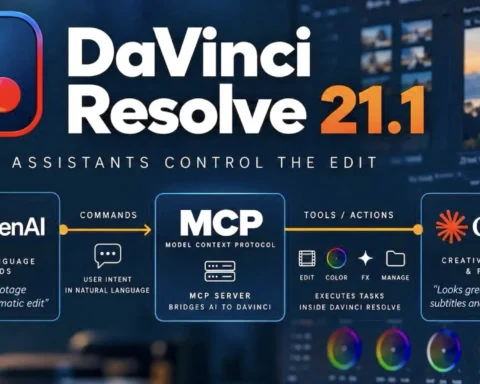
However, for filmmakers and post-production users, the most direct pressure on Adobe does not come from Canva or Figma. It comes from Blackmagic Design’s DaVinci Resolve. Resolve has become one of the most important software stories in modern filmmaking because it attacks Adobe at the exact point where many creators feel the most friction: the subscription. Adobe’s creative tools are powerful, mature, and deeply integrated, but they are also locked inside a monthly payment structure. Creative Cloud Pro is listed by Adobe at $69.99 per month after the introductory period for new subscribers. For a solo filmmaker, a YouTuber, a student, a small production company, or a creator building a lean post workflow, that cost adds up quickly. Blackmagic’s offer is radically different. DaVinci Resolve is available as a free download, and the free version is not a toy. Blackmagic includes professional editing, color correction, visual effects, motion graphics, and audio post-production in a single application. The free version can edit and finish projects up to 60 fps at Ultra HD 3840 x 2160, with extensive color grading tools, HDR tools, keyers, audio retiming, and more. The paid DaVinci Resolve Studio version is a one-time $295 purchase and adds advanced features for heavy pro users. The key is not only price. Resolve is not simply “free editing software.” It is a full post-production environment built around editing, grading, Fusion visual effects, Fairlight audio, media management, and delivery. For camera-focused users, Resolve also has a strong psychological advantage: it feels close to the image. It grew from elite color grading, became the default language of many colorists, and then expanded into editing, sound, VFX, cloud collaboration, and now broader creator tools. Blackmagic is not trying to win by copying Adobe app by app. It is trying to compress the post-production pipeline into one powerful platform. The rise of Resolve also changes the way young filmmakers learn. A new editor can download Resolve, cut a project, grade it with serious tools, mix audio, add effects, export deliverables, and never enter the Adobe ecosystem. That is dangerous for Adobe because creative software dominance is built early. The tool a creator learns first often becomes the tool they defend later.
Final thought
Adobe’s stock free fall should not be framed as the end of Adobe. That is too easy, and the numbers do not support it. Adobe remains one of the strongest software companies in the creative industry. It has massive recurring revenue, dominant brands, enterprise relationships, professional workflows, and a serious AI strategy. But the fall is still important. It may mark the end of Adobe’s unquestioned creative software dominance. Adobe is facing a Kodak-style question, although not a Kodak-style collapse. Kodak had the technology but struggled with the business model shift. Adobe has the AI technology and the customer base. The challenge is whether its subscription empire can absorb AI without losing the pricing power that made Creative Cloud such a powerful machine. That is why the stock drop is worth watching. It is not simply a financial chart. It is a vote of confidence, or lack of confidence, in the old creative software model.



Classic biased Y.M.Cinema Magazine slop that’s poorly researched. Shows painfully by the mere fact that Apple’s Creator Studio for example is not mentioned once, but CANVA? 😂 Clearly you don’t grasp how big of a role ACS plays. Wow. Even if Resolve is certainly a greater threat to Premiere since they share the same antiquated, inferior track-based paradigm that people are too ignorant to let go of.