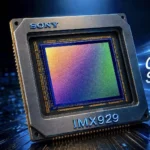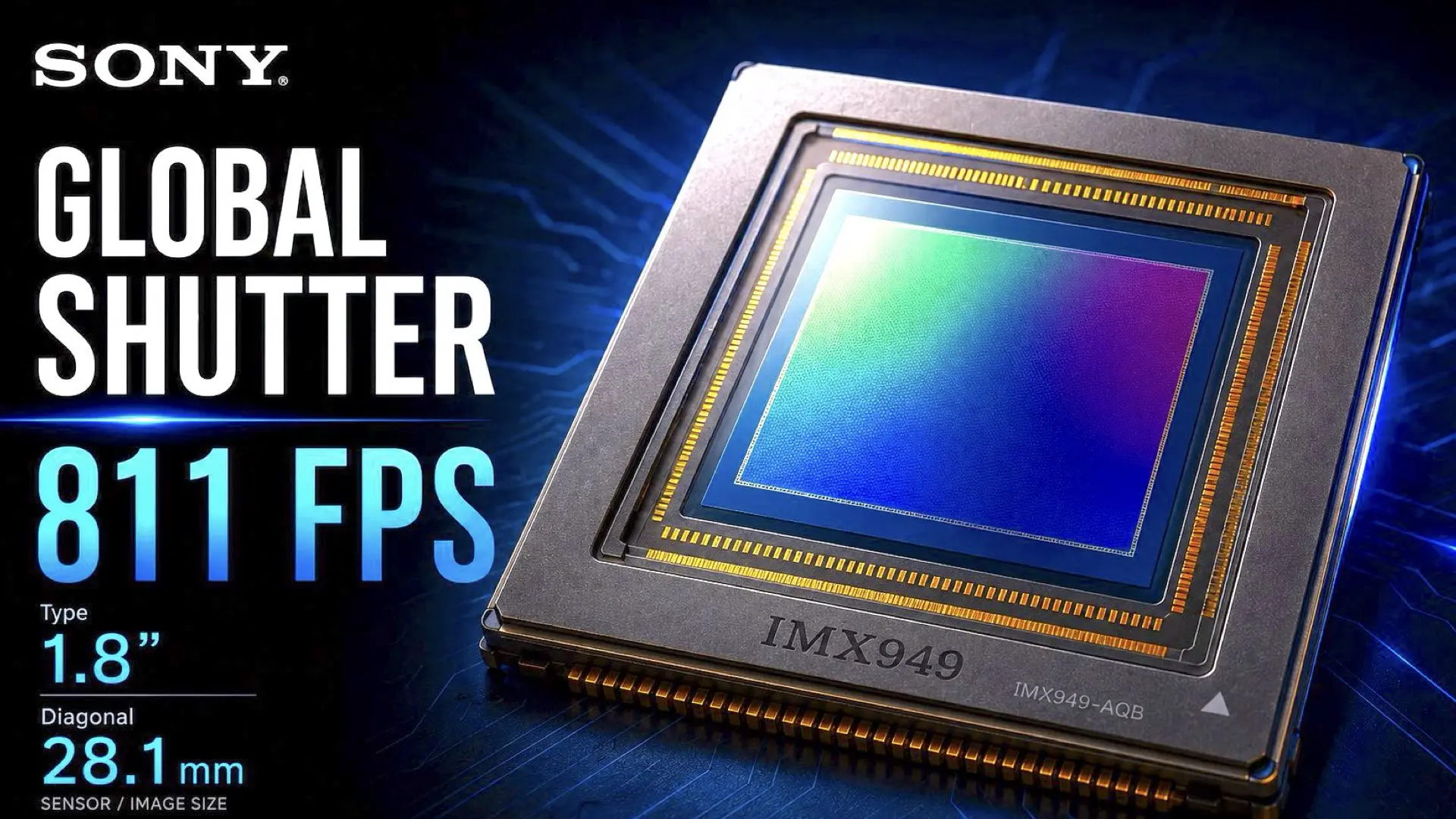
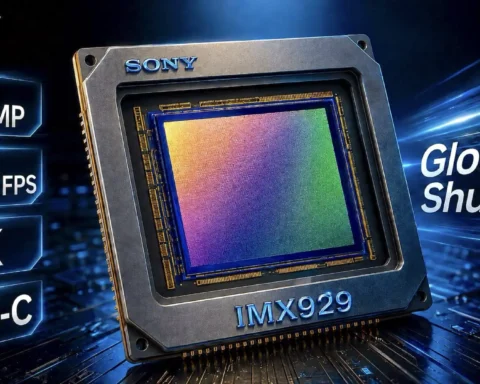
Sony Semiconductor Solutions has started communicating the sample release of its new IMX949 global shutter image sensor. According to Sony’s tentative product flyer, the IMX949-AQB is a Type 1.8, 12.69MP, Pregius S CMOS sensor with a 28.1mm diagonal, 5.48 μm pixels, and a maximum listed frame rate of 811.5 frames per second. That makes the IMX949 more than a 500 FPS sensor. Depending on bit depth, it becomes an 800 FPS-class global shutter sensor.
Sample shipment: June 2026
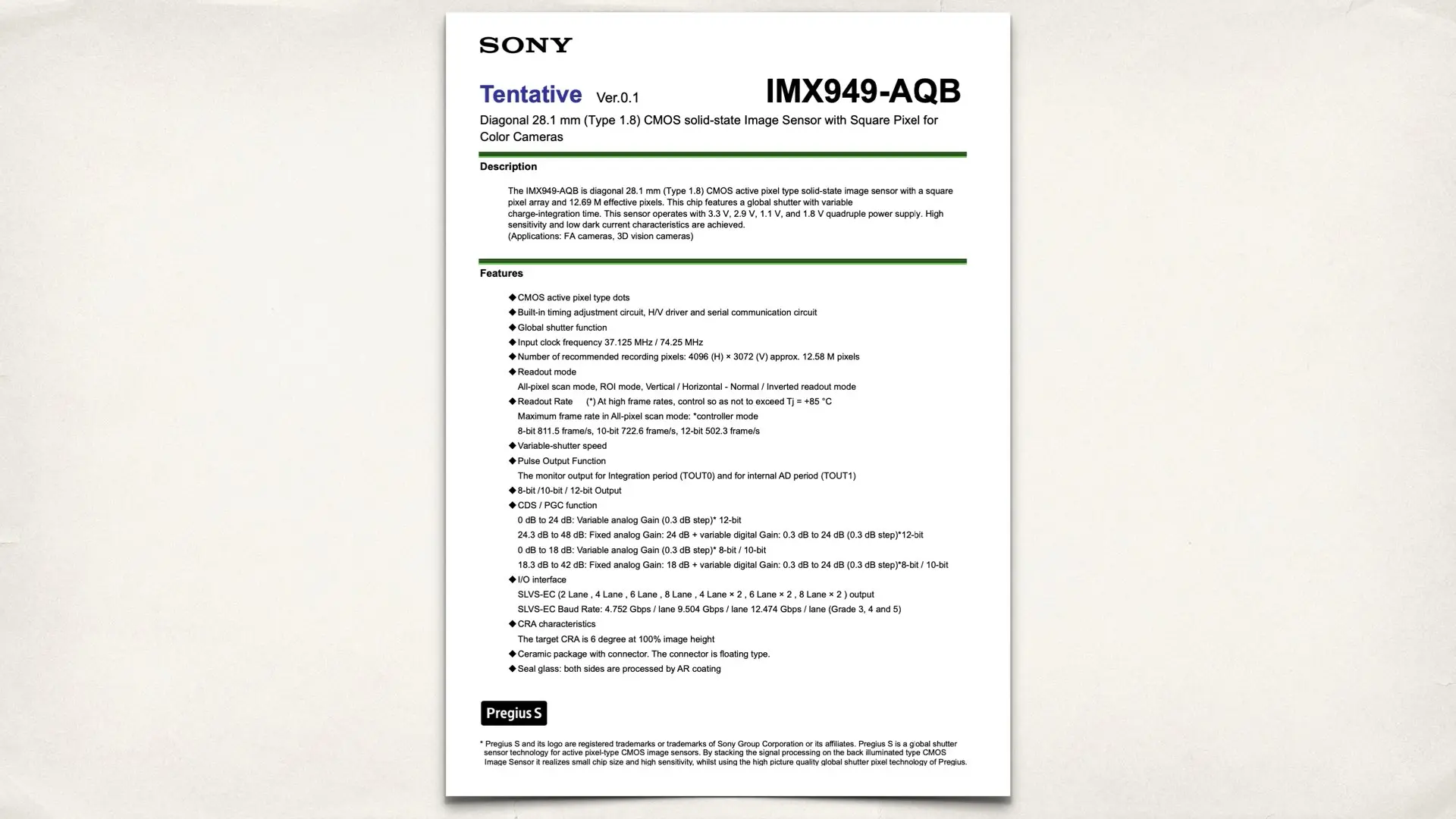
The main news here is not only the specification sheet. It is the sample release. Sony’s flyer lists the sample shipment date as June 2026, while the document itself is marked as a tentative Ver. 0.1. That means the sensor is not necessarily in mass production yet, and Sony also notes that specifications may change without prior notice. However, sample shipment is a meaningful step forward. It means the sensor is moving from pure specification into the hands of selected camera manufacturers, integrators, and developers. Back in June, we reported on the IMX949 as a very fast global shutter sensor capable of 502 FPS at 12-bit. The new product flyer expands that story significantly. The IMX949 is now listed with three frame-rate tiers in all-pixel scan/controller mode:
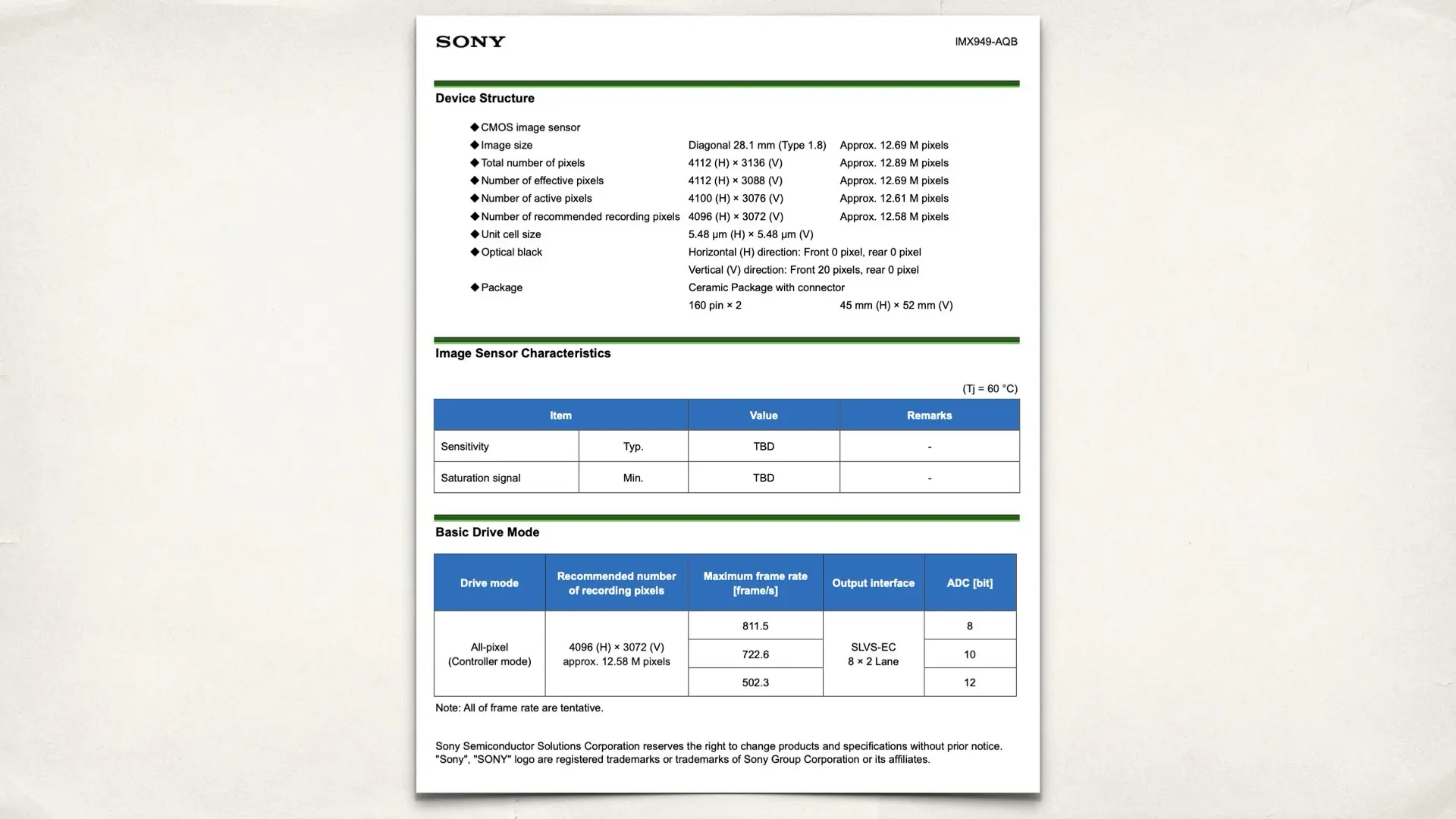
- 8-bit: 811.5 FPS
- 10-bit: 722.6 FPS
- 12-bit: 502.3 FPS
All frame rates are still tentative, but the numbers are impressive. Especially for a sensor of this size.
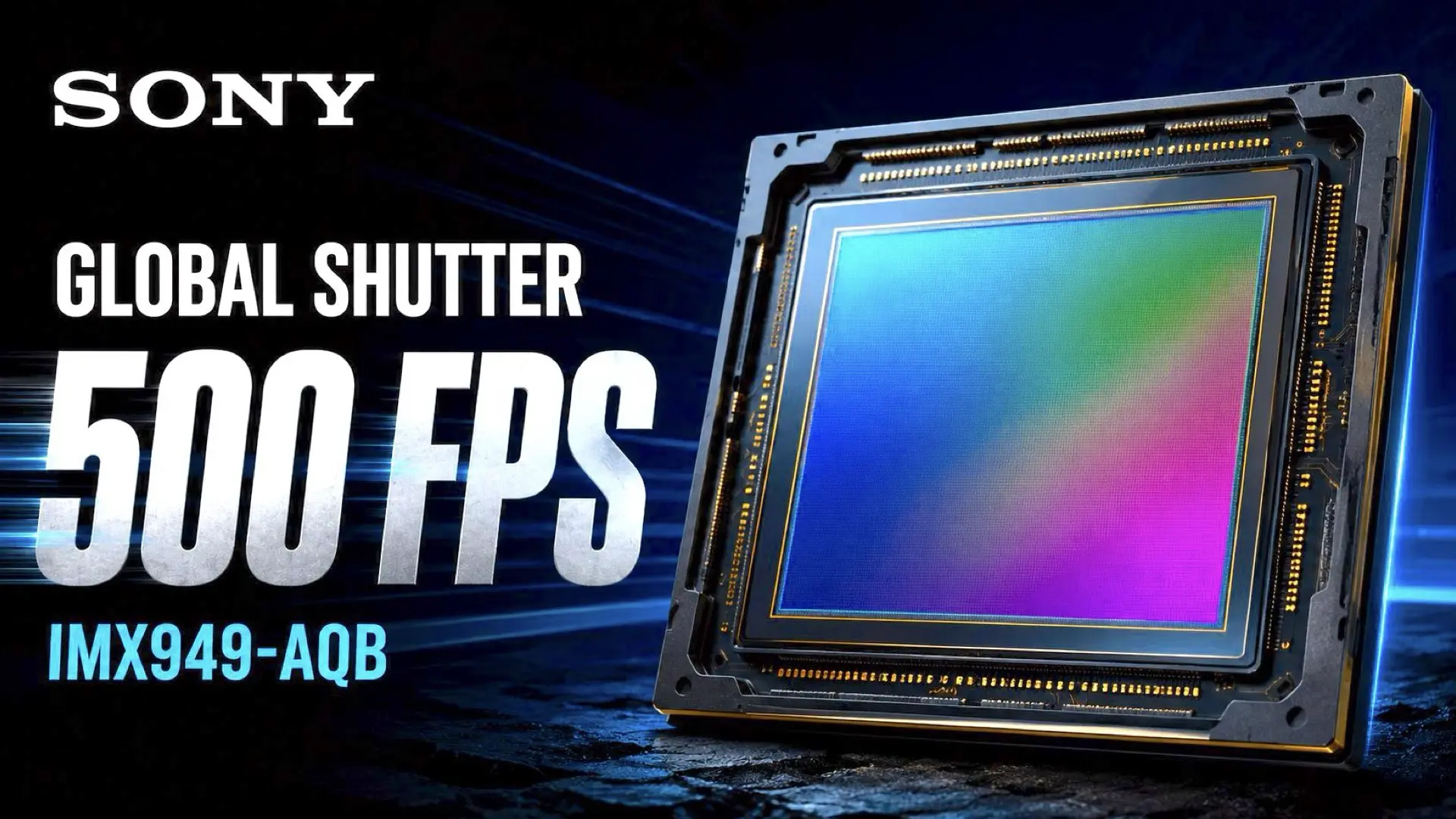
A Type 1.8 global shutter sensor
The IMX949-AQB is described by Sony as a diagonal 28.1 mm Type 1.8 CMOS active pixel type solid-state image sensor. It offers 4112 × 3088 effective pixels, approximately 12.69 megapixels, while the recommended recording pixel count is 4096 × 3072, approximately 12.58 megapixels. The pixel size is 5.48 μm × 5.48 μm. In cinema language, this places the IMX949 in the Super 35-class territory, but not as a conventional Super 35 motion picture sensor. Sony does not call it Super 35, and it is not presented as a cinema camera sensor. However, its 28.1mm diagonal, 4:3 aspect ratio, and 4096 × 3072 recommended recording area make it unusually relevant to high-speed imaging discussions. This is not a tiny machine-vision chip. It is a large-format industrial sensor with a format that cinematographers can immediately understand.
Global shutter and Pregius S
The IMX949 uses Sony’s Pregius S global shutter technology. Sony describes Pregius S as a global shutter sensor technology for active pixel-type CMOS image sensors, using a stacked back-illuminated structure to achieve small chip size, high sensitivity, and high-picture-quality global shutter pixels. For cinema, global shutter is always interesting. It eliminates rolling shutter distortion, skew, flash banding, and motion wobble. Those artifacts are especially visible in fast motion, handheld work, stunts, sports, explosions, VFX plates, flashing lights, propellers, and vehicle shots. That does not mean this sensor is heading into a Sony VENICE, BURANO, or FX camera. Sony lists the applications as FA cameras and 3D vision cameras, not cinema cameras. But the technology is highly relevant to the broader cinema imaging ecosystem.
Why cinema should care
The IMX949 is not a cinema sensor by definition. It is an industrial sensor. But its specifications touch several areas that valid deeply to filmmakers and high-speed cinematographers. First, the sensor is large. The 28.1mm diagonal puts it close to the world of Super 35-class imaging. Second, the sensor is 4:3, which is useful for anamorphic capture, reframing, motion analysis, VFX plates, and specialty rigs. Third, it is global shutter. Fourth, the frame rates are extreme: 811 FPS at 8-bit, 722 FPS at 10-bit, and 502 FPS at 12-bit. The IMX949 is not built for traditional narrative cinema cameras. It is much more relevant to high-speed cinematography, scientific cinematography, sports imaging, stunts, crash testing, robotics, VFX reference, 3D vision, and specialty camera systems. In other words, this is the kind of sensor that may not appear in a mainstream cinema camera, but could influence the tools used around cinema production.
4K-ish 4:3 at extreme speed
The recommended recording format of the IMX949 is 4096 × 3072. That is not DCI 4K in the traditional 17:9 cinema sense, but it is a highly useful 4K-class 4:3 canvas. For high-speed work, this is significant. Many ultra-high-speed cameras trade resolution for speed. Here, Sony is listing a 12.58MP recommended recording mode with frame rates that reach more than 800 FPS, depending on bit depth. That combination is what makes the IMX949 stand out. The 12-bit number remains the most cinema-friendly from an image-quality perspective: 502.3 FPS at 12-bit. But the 10-bit mode, at 722.6 FPS, may be very interesting for applications that need more speed while preserving more tonal information than 8-bit. The 8-bit mode reaches the headline number: 811.5 FPS.
Not a VENICE sensor. Still important.
Sony does not position the IMX949 as a cinema camera sensor. The flyer specifically lists FA cameras and 3D vision cameras as the intended applications. That distinction matters. However, cinema technology does not develop only inside cinema cameras. Many imaging breakthroughs first appear in industrial, scientific, broadcast, or machine-vision environments before influencing motion picture tools. Global shutter, stacked CMOS designs, high-speed readout, and advanced sensor interfaces all have a direct relationship with the future of cinema imaging. The IMX949 is a good example. It is an industrial sensor, but its combination of size, resolution, global shutter, and speed makes it a sensor that high-speed cinema professionals should watch closely.



![Nikon Is Developing Nine NIKKOR Z CINEMA T1.9 VV Lenses for RED V RAPTOR [X]](https://ymcinema.com/wp-content/uploads/2026/09/Nikon-Is-Developing-Nine-NIKKOR-Z-CINEMA-T1.9-VV-Lenses-for-RED-V-RAPTOR-X.001-480x384.webp)