
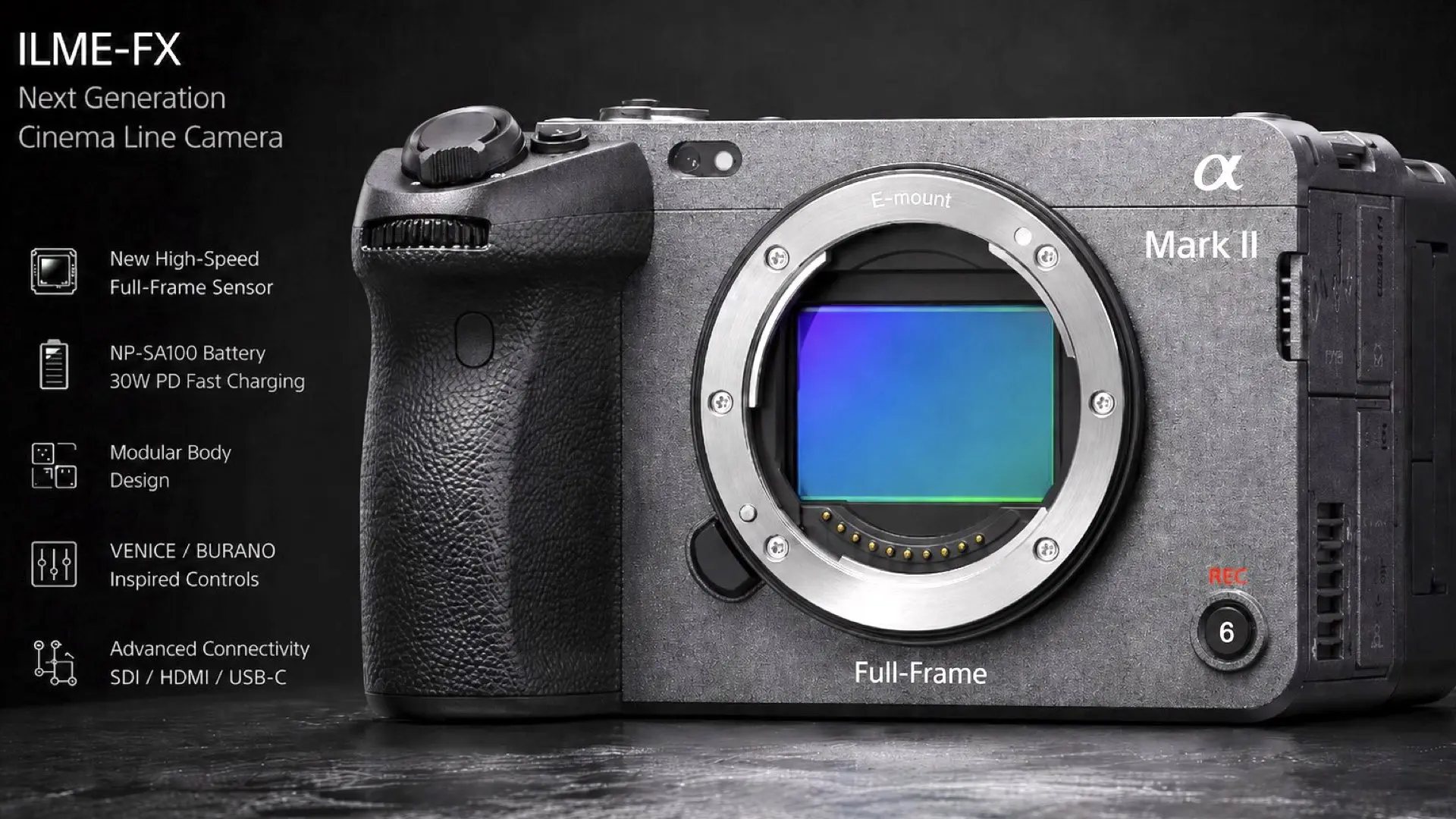
Sony’s next Cinema Line camera may not be a simple FX3 ($3,998 on Amazon) replacement. New registration information and leak data point to a new ILME-FX model that appears to belong firmly inside Sony’s Cinema Line, with multiple registration numbers, a new battery platform, 30W USB-C PD charging, and a body concept that may move beyond the compact Alpha-derived design language of the original FX3. Until now, the FX3 Mark II discussion has been mostly about the sensor. In our previous analysis, we focused on the central technical question: Should the next FX3 prioritize resolution, or should Sony keep the FX3 concept focused on sensor speed, readout performance, low-light capability, thermal reliability, and high-frame-rate video? The newest registration details add another layer to that discussion. They suggest that Sony may not only be working on a new sensor pipeline, but also on a more serious Cinema Line body architecture. Read on.
The Registration data: ILME-FX, not Alpha
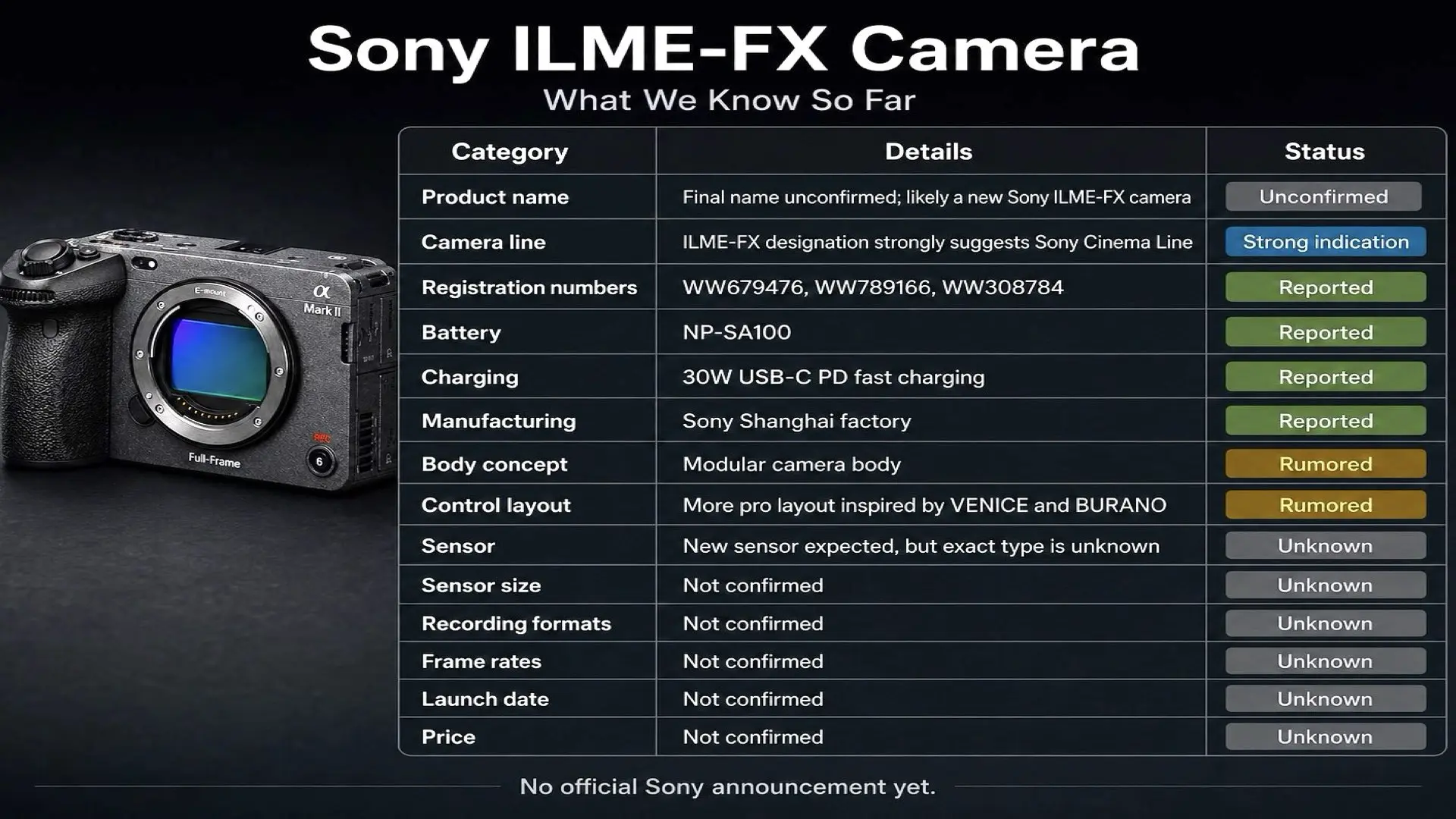
The most important detail is the naming format: ILME-FX. Sony’s current FX cameras use the ILME-FX model designation. The FX3 is ILME-FX3. The FX30 ($2,098 on Amazon) is ILME-FX30. The FX6 ($8,876 on Amazon) and FX9 also sit inside the same broader professional Cinema Line logic, even if their body design, operating concept, and production role are very different. That makes the ILME-FX registration important. It does not point to a regular Alpha mirrorless stills camera. It points to a Cinema Line product. According to the latest registration information circulating from Chinese certification sources, the new Sony FX camera is connected to the following registration numbers: WW679476, WW789166, and WW308784 The same information claims that all three numbers belong to the same new ILME-FX camera, rather than three separate FX models. That is an important distinction. Multiple registration numbers can be associated with regional wireless variants, radio modules, or product certification pathways, and they do not automatically mean Sony has three different Cinema Line bodies ready for launch. In other words, the registration trail suggests one new FX camera, not necessarily three new FX cameras.
NP-SA100 battery and 30W PD charging
Another key technical detail is the battery. The new ILME-FX model is said to use the NP-SA100 battery, not the older NP-FZ100 used by cameras such as the FX3 and FX30. That would be a significant shift. Battery selection is not a cosmetic specification. It affects internal body design, power delivery, thermal behavior, runtime, accessory compatibility, and rigging decisions. If Sony is moving this next ILME-FX body to the NP-SA100 battery, it could suggest that the camera has higher power requirements than the current FX3. That may be due to a faster sensor, a more powerful processor, more demanding recording modes, new monitoring options, advanced I/O modules, or simply a redesigned internal power architecture. The reported support for 30W USB-C PD fast charging is also relevant. The current generation of compact Sony Cinema Line and Alpha bodies already supports USB power delivery in various forms, but a 30W PD figure attached to a new ILME-FX registration would suggest that Sony is planning for more robust continuous power and charging behavior. Stronger USB-C PD support can be just as important as sensor specs, because it affects how the camera survives long production days.
Shanghai Manufacturing and the “Pure Cinema Line” direction
The registration information also points to manufacturing in Shanghai, reportedly through Sony’s Shanghai facility. The leaked description frames the camera as a pure Cinema Line product with what has been described as a “Shanghai bloodline.” It sounds like leak-source language, not Sony’s official marketing language. However, the manufacturing point itself is technically relevant. If accurate, it indicates that this ILME-FX model is not just another Alpha-derived camera receiving a Cinema Line badge. It may be part of a more specific production and design pipeline. The phrase “pure Cinema Line” is also important, but it needs context. Sony’s FX3 was a Cinema Line camera, but physically it remained very close to the Alpha ecosystem. It used an Alpha-style body concept, an Alpha-style operating layout, and a compact hybrid camera foundation, adapted for video and professional use. The new leak suggests something different: an FX-style camera with a body and control layout moving further away from traditional Alpha language.
Modular Body: The most interesting part
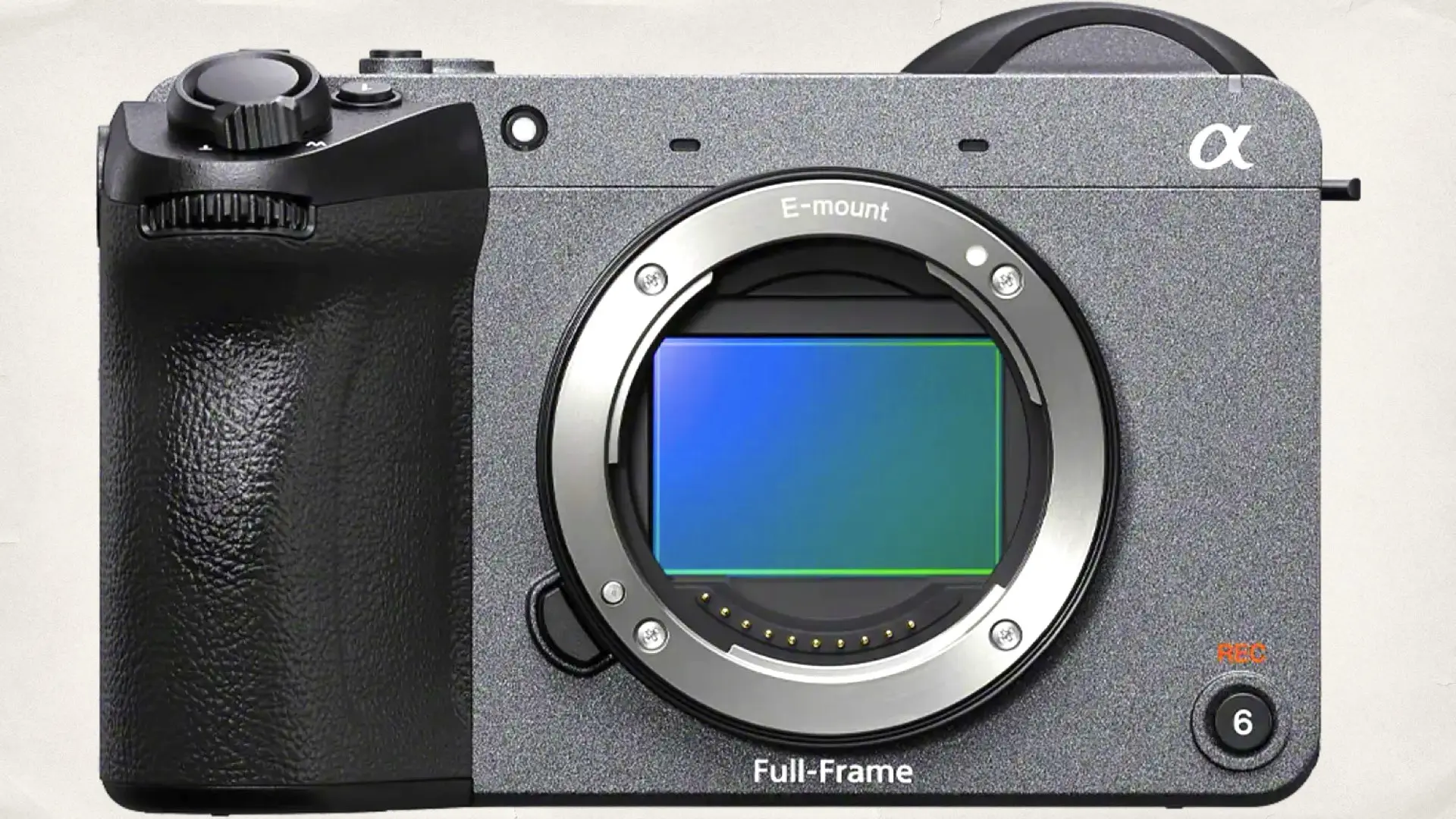
The most interesting part of the registration leak is the claim that this new ILME-FX body is modular. That detail is not confirmed by Sony. It should not be treated as official. But it is technically the most important claim in the entire leak, because it would change the meaning of the camera. A simple FX3 Mark II would be easy to imagine: same general body, new sensor, new processor, better autofocus, better heat management, maybe improved screen behavior, maybe internal RAW or better codecs, and perhaps some high-frame-rate upgrades. A modular ILME-FX body suggests something more ambitious. The leak claims the body layout and button configuration are more professional, with design inspiration from Sony’s larger cinema cameras such as VENICE and BURANO. It also suggests that the camera may support accessories such as an XLR handle, an external EVF, and possibly an SDI expansion module. If true, the next ILME-FX camera may be less of an “FX3 Mark II” and more of a new compact cinema platform.
Different screw-hole layout
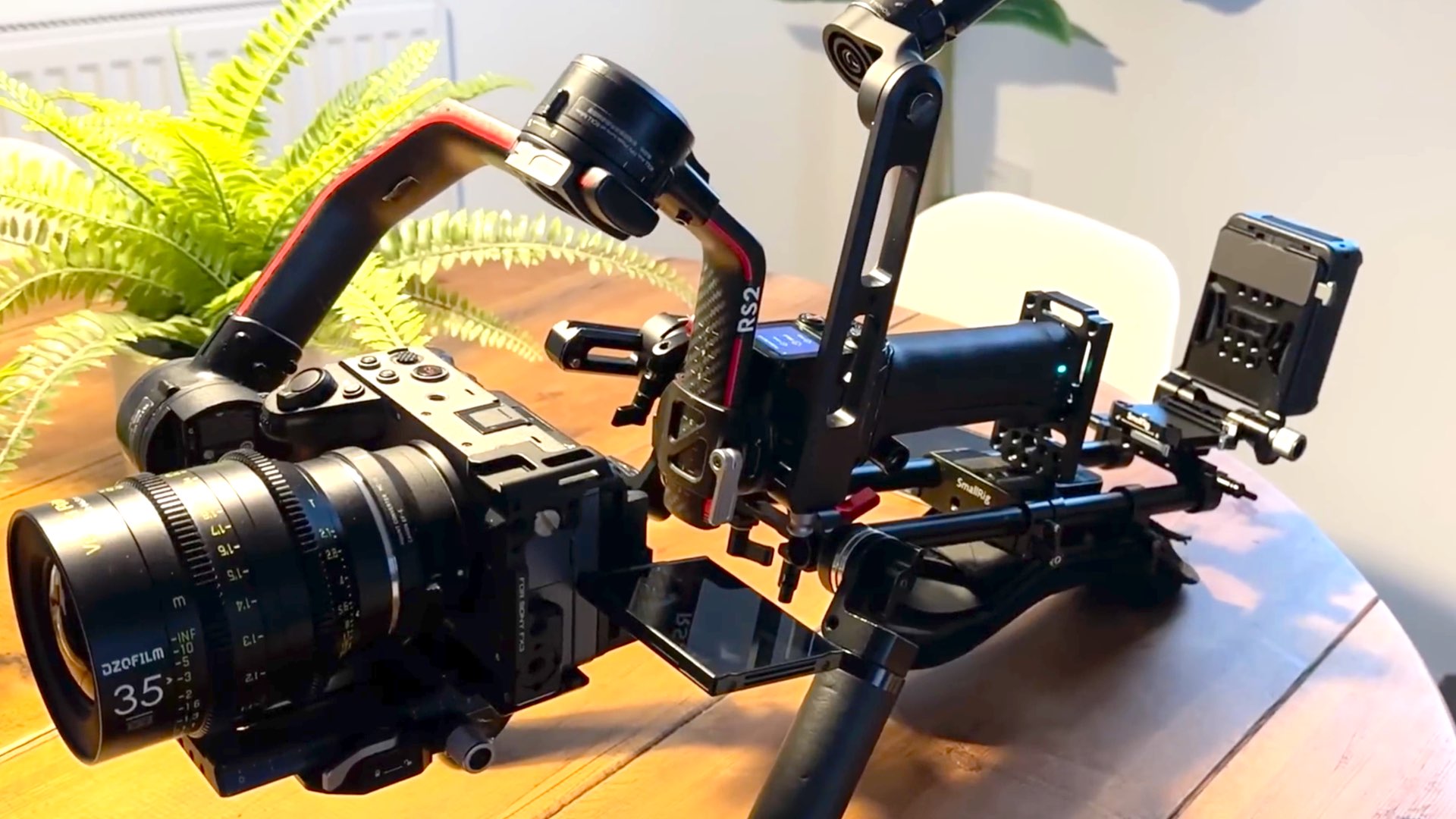
One detail in the leak says the screw-hole positions are different from the FX3. That sounds minor, but it is actually meaningful. The FX3 has become a very rig-friendly camera, and an entire accessory ecosystem has been built around its physical dimensions and mounting points. If the new ILME-FX body changes the mounting layout, then existing FX3 cages and accessories may not be compatible. Camera makers do not usually change mounting geometry unless the internal structure, heat path, accessory concept, or physical handling philosophy has changed. A new screw-hole layout could indicate a body built around modular accessories from the beginning, rather than a stills-camera shell adapted for cinema work.
What the registration does not confirm
This is where caution is required. The registration information does not confirm the final product name. It does not officially confirm FX3 Mark II. It does not confirm FX3 II. It does not confirm FX4. It only points to a new ILME-FX model. It also does not confirm:
Sensor resolution
- Sensor architecture
- Global shutter
- Partially stacked sensor design
- 6K recording
- 5K recording
- 4K 120p or 4K 240p
- Internal RAW
- Internal ND
- SDI output
- Cooling design
- Launch date
- Price
- Final body shape
- Final accessory system
FX2, FX3, FX6: The lineup problem
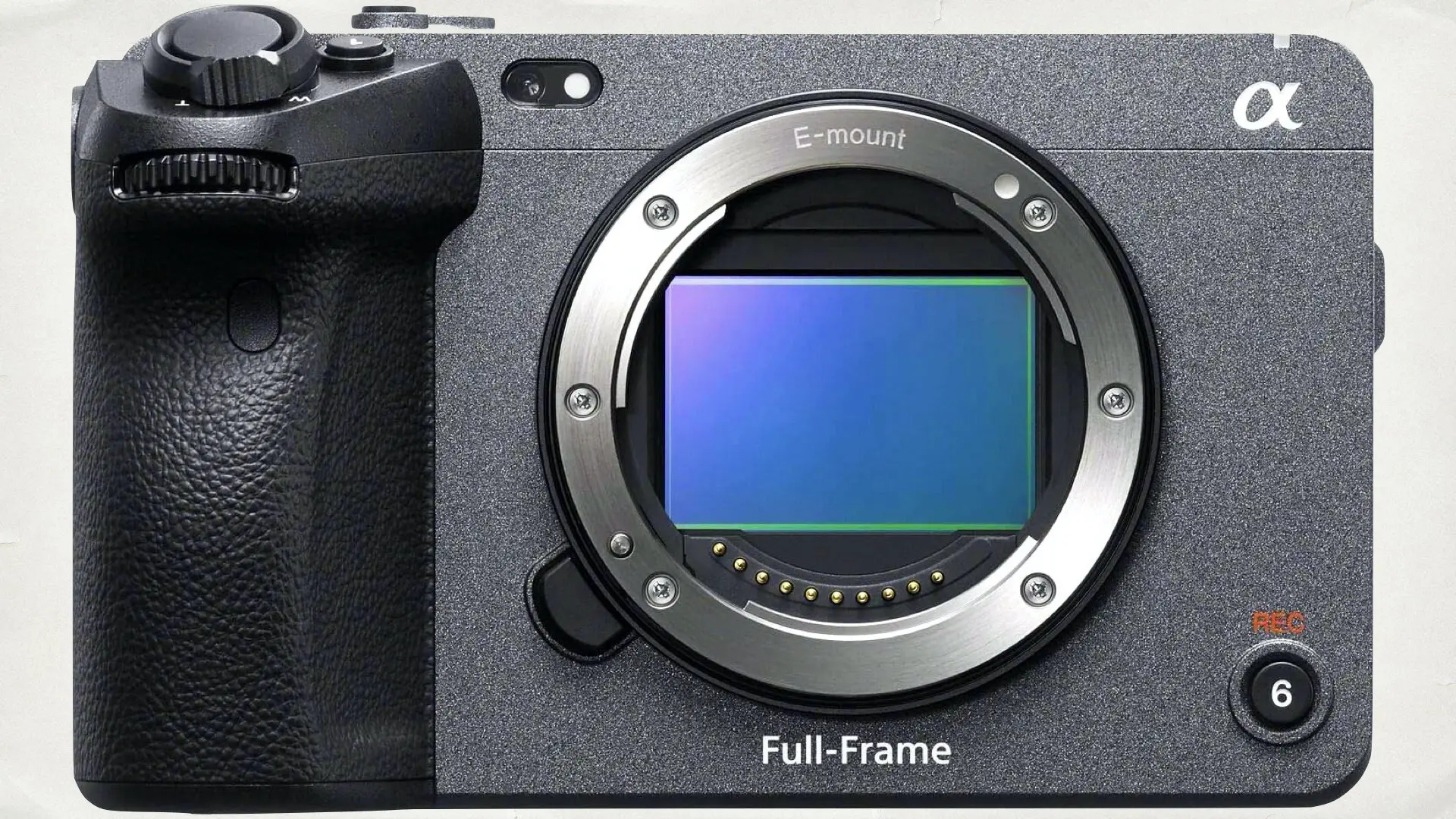
Sony now has an interesting Cinema Line structure problem. The FX2 ($2,498 on Amazon) gives creators a compact full-frame body with a stronger hybrid flavor. The FX3 remains one of the most popular compact cinema cameras on the market, but it is aging. The FX6 is still a proper production camera with built-in electronic variable ND, a more video-native body, better I/O, and a professional documentary/production footprint. So where does the next ILME-FX fit? If it is too similar to the FX2, it becomes redundant. If it is too similar to the FX6, it risks overlapping with a higher-end camera. If it is merely an FX3 with a new processor, it may not be enough. A modular compact cinema body solves part of that problem. It gives Sony a way to create a camera that sits between FX3 and FX6 in concept, without necessarily replacing either one directly. It could stay compact, but become more expandable. It could remain gimbal-friendly, but become more production-friendly. It could keep the FX3 spirit, but move away from the Alpha-derived design limitations. That would make the next ILME-FX camera much more interesting than a basic Mark II refresh.

Gear mentioned in this article
Available on Amazon
| Product | New | Renewed | Used |
|---|---|---|---|
| Sony FX3 | $3,998 | — | — |
| Sony FX30 | $2,098 | — | From $1,567.33 |
| Sony FX6 | $8,876 | — | — |
| Sony FX2 | $2,498 | — | From $2,050.89 |
Prices checked: Oct 7, 2026, 1:31 PM GMT+0000
As an Amazon Associate, Y.M.Cinema earns from qualifying purchases. If you buy through our links, we may earn a small commission at no extra cost to you.
Product prices and availability are accurate as of the date/time indicated and are subject to change. Any price and availability information displayed on Amazon.com at the time of purchase will apply to the purchase of this product.
CERTAIN CONTENT THAT APPEARS ON THIS SITE COMES FROM AMAZON. THIS CONTENT IS PROVIDED “AS IS” AND IS SUBJECT TO CHANGE OR REMOVAL AT ANY TIME.






I wish one company would just fucking bring it already; kitchen sink it. I understand that making the “ultimate camera” could lead to stagnation in sales of future products but I’m so sick of incremental upgrades.
People used to laugh at me when I said cinema cameras should have autofocus and internal nd filters. “That stuff’s for amateurs, it’ll never get better than glass filters and pulling focus”.
With how much technology has advanced, I don’t see why one of these companies can’t put out a small, modular body with internal nd, internal raw recording, autofocus, decent wireless video, wireless timecode, fast sensor readout, etc.
Sony got close with the Burano but the rolling shutter on that thing borders on egregious. Also it’s chunkier than I’d prefer. Now that Nikon owns Red, it seems like they have everything needed to create the ultimate do-all camera. Weirdly Kinefinity is putting out some of my favorite body designs, but I doubt they’re on the path to making the ultimate camera
Issue is goal posts keep getting pushed and product development cycles take an insanely long time to react to those goal posts. Think about the FX3. It came out Feb 2021 and it took Canon almost 5 years to copy that design and come out with their own version C50. Even with Nikon owning RED they still don’t have open gate on a single Nikon camera and you won’t see anything serious from the in cinema for a while(ZR was clearly a creator cam already in development before the RED purchase and will take a long time for true ground up design with RED tech) Its been 7 years and Lumix who has no high end cinema line to protect still doesn’t have a S1HII and they have been just putting in video features into existing photo camera designs(just been reusing the S5 design for years now renaming it as the S1II, S1RII).
I don’t think the goal posts have moved in a long time. In my opinion, we effectively hit the ceiling for digital image quality around 2013; Maybe the Alexa35 being the exception from a technical perspective.
Not much has changes in camera tech for quite a while. Little quality of life improvements here and there, but we’ve had internal NDs, solid autofocus and everything else I mentioned for a long time. I don’t think it’s beyond any of the major camera manufacturers to mash them all together
do you have a different source for this “leak” other than sonyalpharumours or are you just rehashing what Pizzini says but disingenuously trying to hide his name? If it’s the letter, I will swear off ever reading your blog… I am not referring to the first part about registration info but what you keep referring to as “leak” for new body design etc, which he has been talking about for several days now… Have some decency you people…
??? …..Who is Pizzini?
andrea_pizzini is an Italian Youtuber who leaks Sony products. Most of the rumors are coming from his sources.