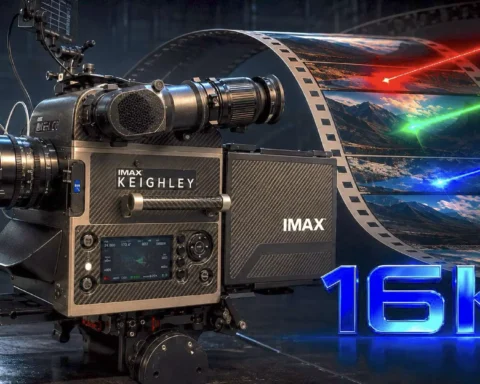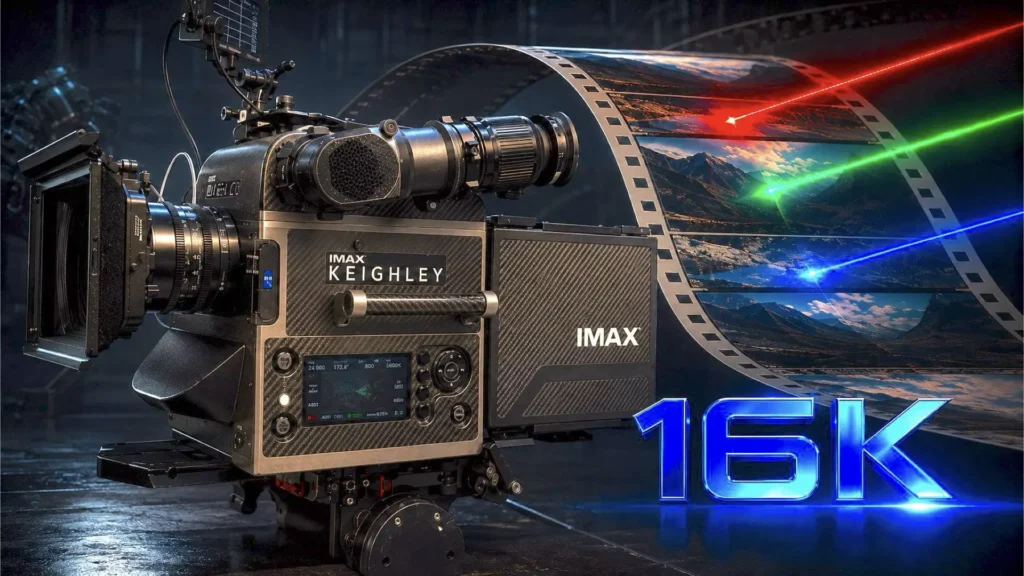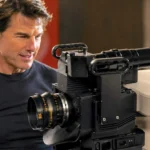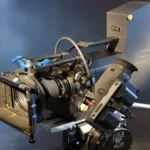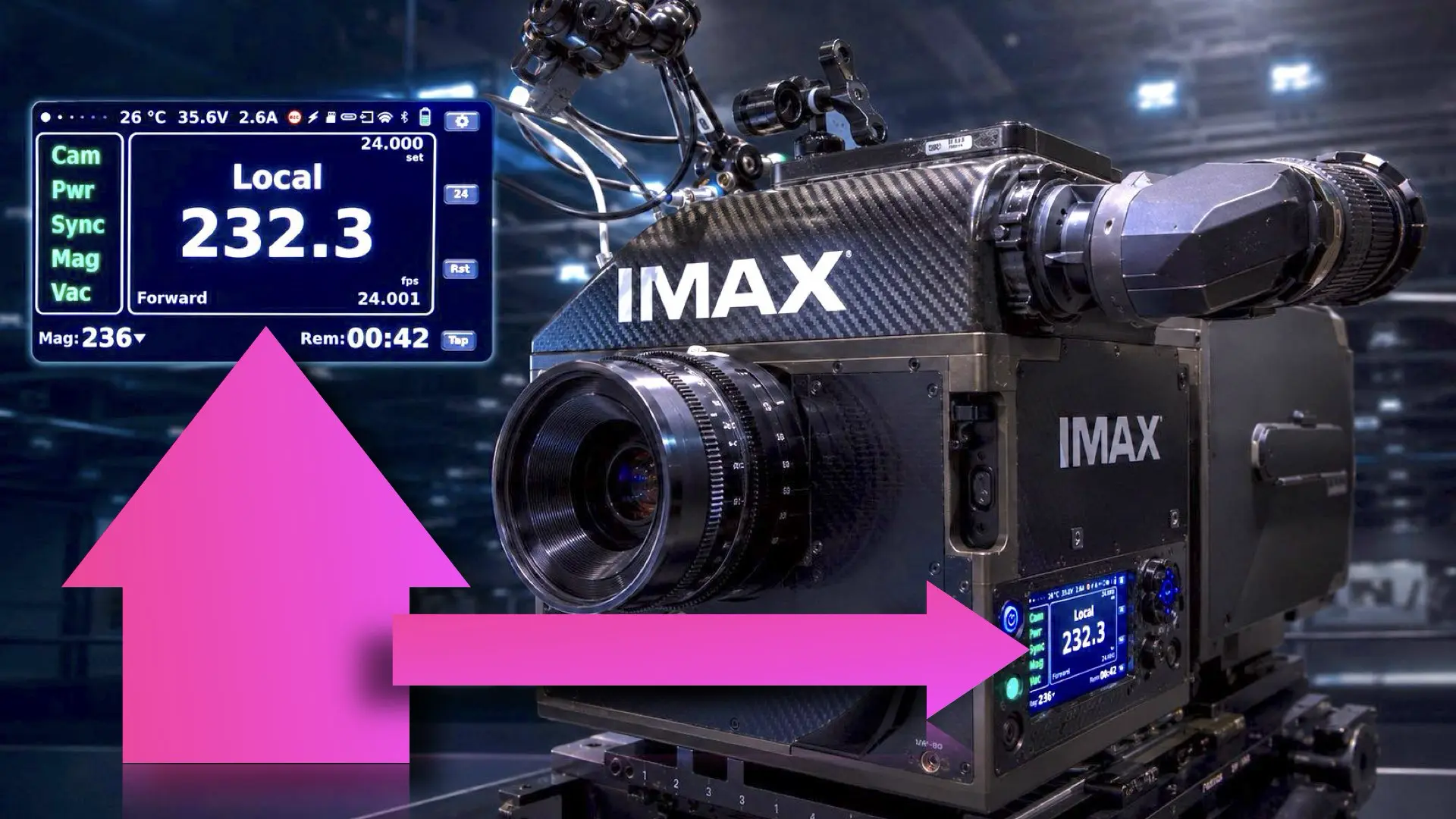
The new IMAX Keighley film camera is not just about a quieter body, a refined mechanical design, or a new generation of 15/70 filmmaking hardware. A close look at the recently released IMAX clip reveals something equally fascinating: the camera has a surprisingly modern user interface. This is still a pure large-format film camera. It is still moving massive 15/70 film through the gate at a terrifying speed. It is still the opposite of a compact digital cinema camera. But the screen mounted on the camera tells a very different story. Keighley appears to wrap one of the most demanding analog film transports ever built with a clean layer of digital telemetry.

A film camera with digital telemetry
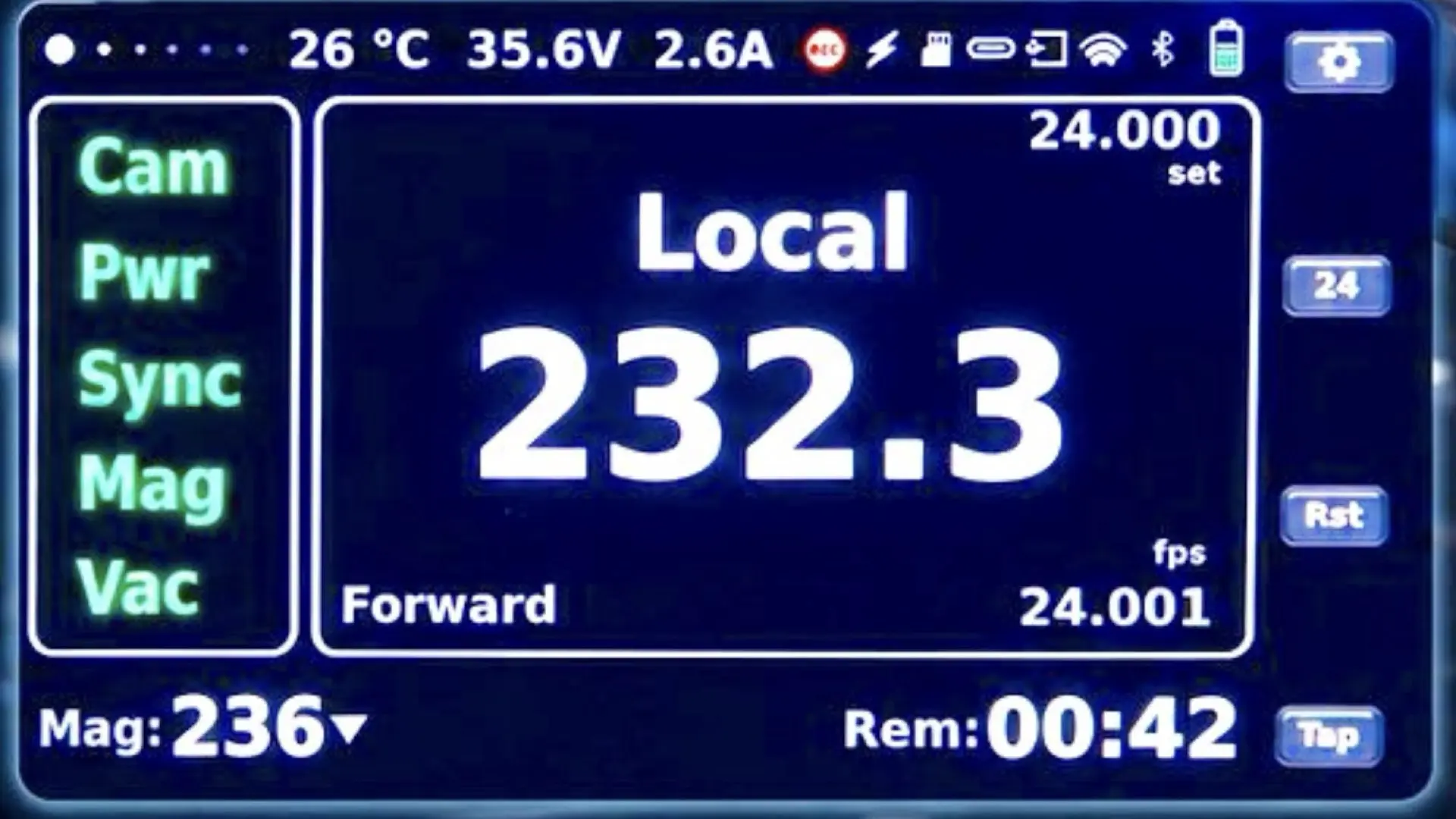
In the clip, the camera screen shows several live parameters. Some of them are expected. Some of them are more revealing. The UI displays a frame rate setting of 24.000 fps, while the actual running speed appears as 24.001 fps. That tiny deviation is not a problem. Quite the opposite. It suggests that the camera is not only set to 24 fps, but also continuously monitoring and reporting its actual transport speed with high precision. For a 15/70 IMAX camera, that is important. This is not a small 16mm or 35mm camera gently pulling film through the gate. IMAX 15/70 uses 15 perforations per frame. At 24 frames per second, that equals 360 perforations per second. Since 70mm film runs at roughly 64 perforations per foot, the camera is moving film at about 5.6 feet per second. That is a huge amount of film moving very quickly. So when the screen shows exact speed feedback, it is not just cosmetic. It is a live window into one of the most demanding film movements in cinema.
The mysterious “Local” counter
One of the most interesting elements on the screen is the value marked “Local.” At first glance, this looks like a standard footage counter. And to be clear, footage counters are not new. Professional film cameras have tracked film in feet, meters, or remaining runtime for decades. But what is interesting here is the context. The “Local” value appears inside a broader digital UI, next to transport direction, reset and tap controls, speed data, power telemetry, and remaining runtime. In the clip, the number also appears to advance at a rate that roughly matches real 15/70 film travel at 24 fps. In other words, the point is not that Keighley counts film. Every serious film camera does that. The point is that Keighley appears to expose live film transport information as part of a modern telemetry interface. This is analog film movement, but digitally monitored.
42 seconds remaining
Another revealing item is the remaining runtime display. In the close-up, the UI shows approximately 00:42 remaining. That number is very IMAX. When shooting 15/70 at 24 fps, film disappears fast. A runtime readout like this gives the operator and camera team a clean, immediate understanding of how much shooting time is left in the magazine. Again, the concept is not new. But the presentation is modern. Rather than relying only on a mechanical counter or assistant-side calculation, Keighley appears to translate the brutal reality of 15/70 film consumption into a simple digital countdown.
Voltage, current, and temperature
The UI also shows electrical telemetry, including voltage, current draw, and temperature. In the still frame, the camera displays around 35.6V and 2.6A, which equals roughly 93 watts. In the clip, the current appears to rise significantly during operation, reaching around 5A to 6A. At roughly 35 to 36 volts, that suggests a live draw in the area of 175 to 215 watts. That is a notable detail. It suggests the UI is not only showing cinematography data, but also the real electrical state of the camera system. For a camera built around a powerful mechanical film movement, this can be extremely useful. It gives the camera team immediate feedback on power behavior, system load, and possibly transport state. Temperature is also visible, around 26°C in the inspected frame. That adds to the impression that Keighley has a modern embedded monitoring system, closer in spirit to digital cinema telemetry than to a traditional purely mechanical film camera display.
Analog capture, modern control
The most accurate way to describe the Keighley UI is this: 15/70 analog film transport wrapped in a digital telemetry layer. That may be the real innovation visible in the clip. Not a digital sensor. Not electronic capture. Not a hybrid camera. But a mechanical IMAX film camera whose operating state is presented through a modern, clean, data-rich interface. This makes Keighley feel like a very different kind of film camera. It respects the analog mechanics of IMAX capture, while giving the camera team the kind of real-time system visibility expected from contemporary cinema technology. Is it the most advanced UI ever built into a film camera? That is hard to claim without full technical documentation. But based on the clip, it is fair to say this may be one of the most advanced interfaces ever seen on an IMAX film camera. And here’s the clip below: