
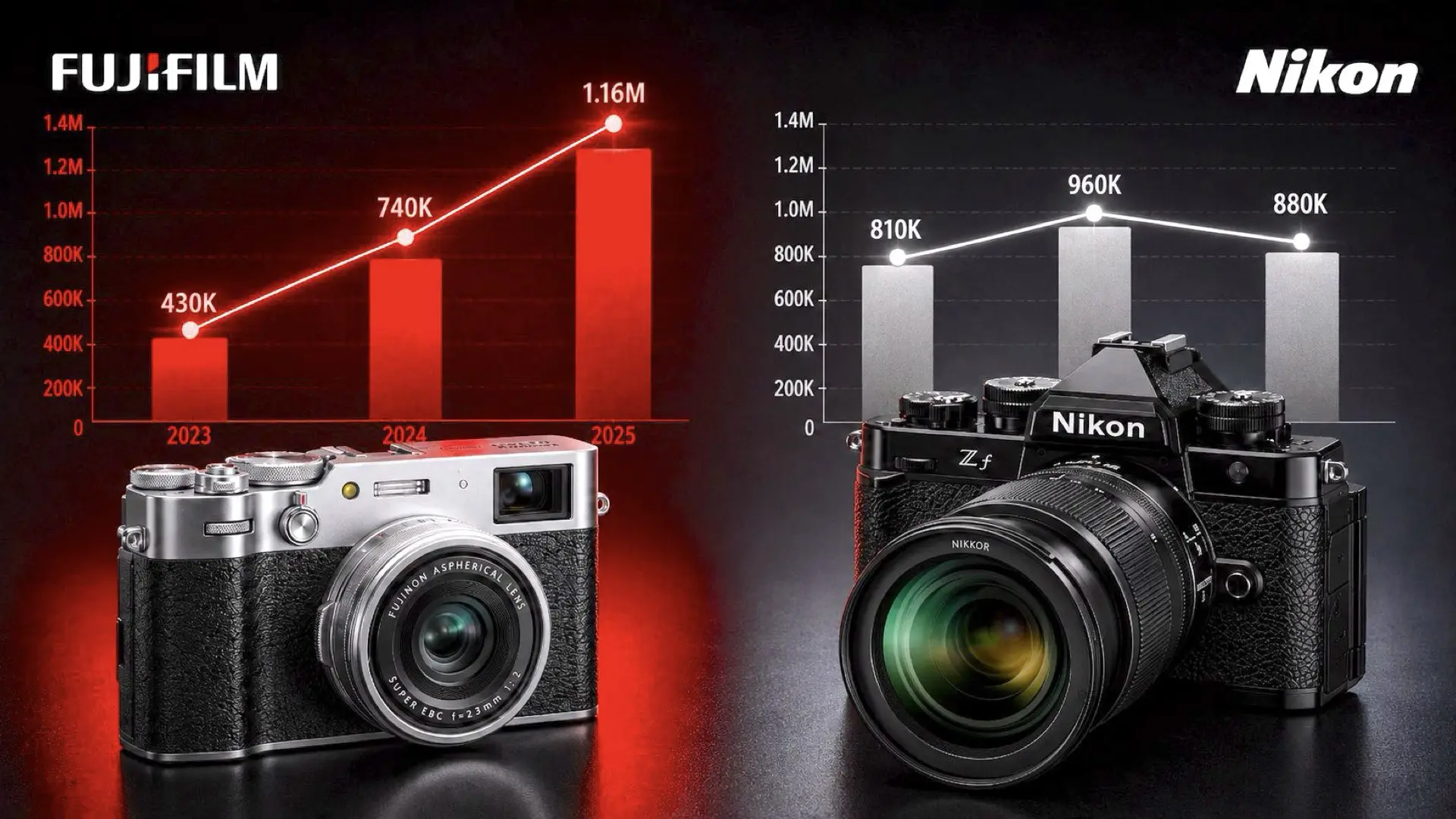
The global digital camera market has a new number-three manufacturer. Fujifilm shipped approximately 1.16 million digital cameras in 2025, overtaking Nikon and pushing the latter into fourth place, according to data published in Nikkei’s Industry Map 2027. But the ranking tells a broader story about what kinds of cameras are currently generating volume, where Canon’s enormous scale comes from, and why Nikon’s strategy may increasingly extend beyond the conventional still-camera race.
Fujifilm’s growth
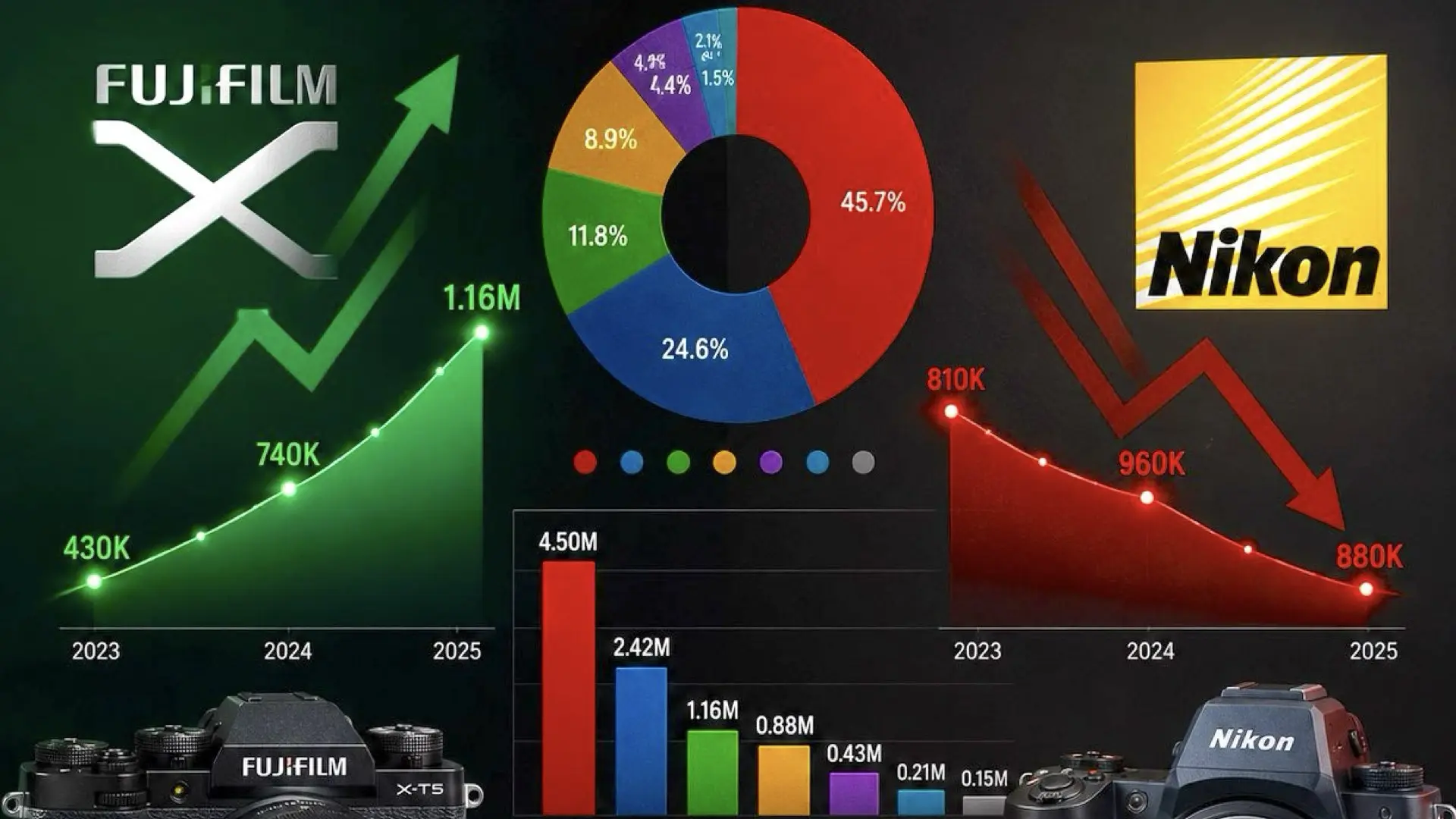
Fujifilm’s growth is particularly noteworthy. The company shipped approximately 430,000 cameras in 2023, 740,000 in 2024, and 1.16 million in 2025. That represents an increase of roughly 170% in only two years. Nikon moved in the opposite direction during the latest period. Its shipments increased from around 810,000 units in 2023 to 960,000 in 2024, before declining to approximately 880,000 cameras in 2025. As a result, Fujifilm captured an estimated 11.8% of the market tracked by Nikkei, compared with 8.9% for Nikon. It is important to emphasize what these numbers measure. They represent camera shipments by unit, not revenue, profit, or the value of the cameras being sold. A manufacturer selling large numbers of $1,000 to $2,000 cameras can therefore rank ahead of a company concentrating more heavily on expensive full-frame or professional products without necessarily generating more imaging revenue.
Fujifilm found a very strong camera market
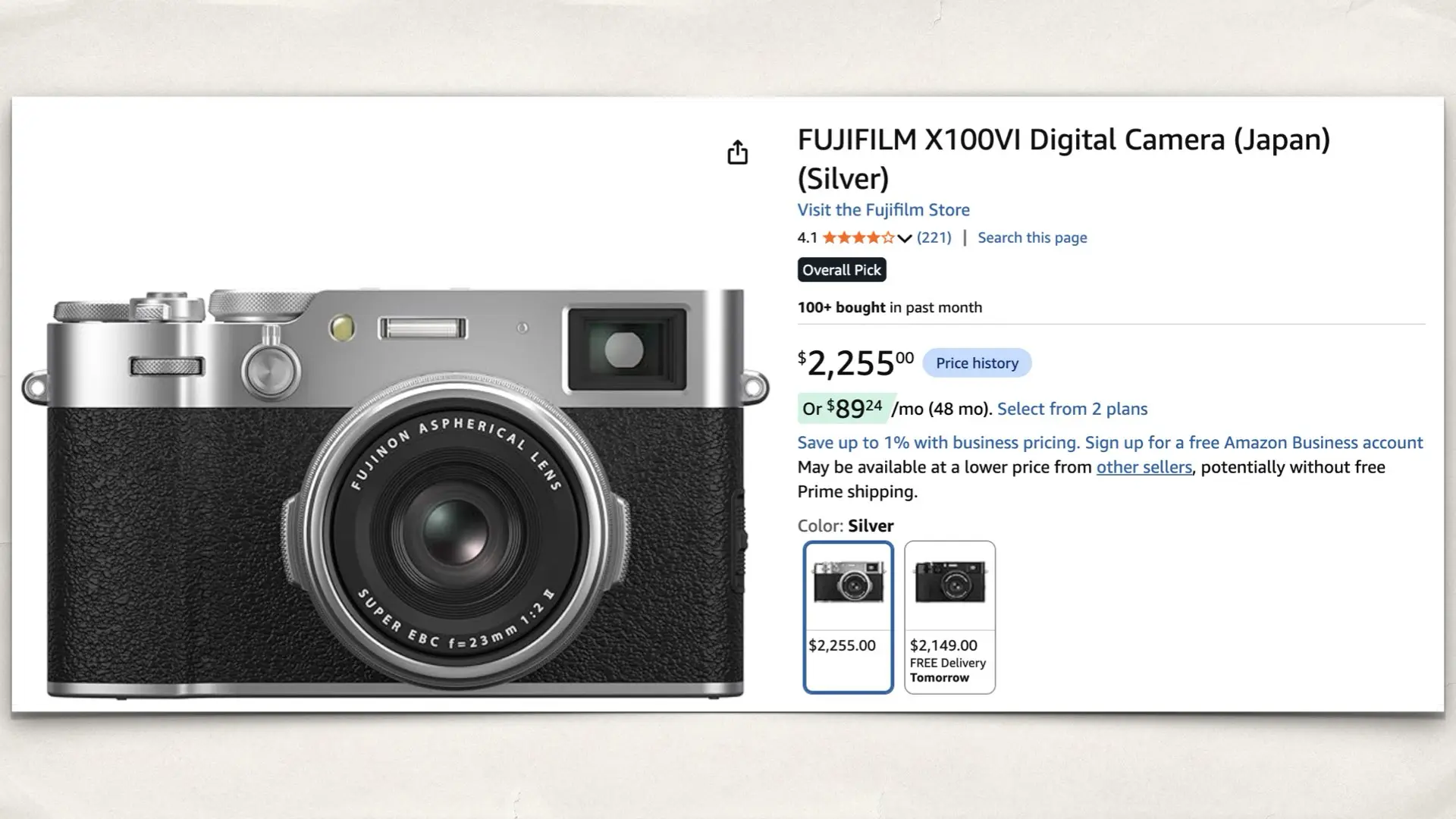
Fujifilm’s rise did not happen because of a single exotic professional camera. Much of the momentum appears to come from the company’s increasingly popular X Series ecosystem and, particularly, compact and retro-inspired cameras. Fujifilm itself has identified strong digital-camera sales around four models introduced in 2024: the X100VI ($2,098 on Amazon), X-T5 ($1,999 on Amazon)0 ($1,699 on Amazon), X-M5, and GFX100S II ($5,699 on Amazon). Of those, three illustrate an especially interesting part of Fujifilm’s strategy. The X100VI combines an APS-C sensor, fixed 23mm F2 lens, traditional camera controls, Fujifilm’s Film Simulations, and a compact rangefinder-style body. Demand became so strong that availability remained constrained long after launch. The X-T50 brought Fujifilm’s 40.2-megapixel APS-C sensor and Film Simulations into a relatively compact interchangeable-lens camera, while the X-M5 addressed an even more accessible segment with a small APS-C body designed around both photography and content creation. The GFX100S II sits at the opposite end of the spectrum. It demonstrates that Fujifilm is simultaneously maintaining a medium-format professional ecosystem. However, Nikkei’s figures do not provide a model-by-model shipment breakdown, so it would be incorrect to claim that a specific number of Fujifilm’s 1.16 million units were X100VI, X-M5, or X-T50 cameras. What we can say is that Fujifilm’s own reporting identifies those products as important contributors to strong digital-camera sales, while the extraordinary demand surrounding cameras such as the X100VI demonstrates how effectively the company has expanded beyond the traditional enthusiast-camera audience.
APS-C became an advantage rather than a limitation
For years, much of the interchangeable-lens camera industry’s technological competition has centered on full-frame sensors. Fujifilm took a different route. Instead of attempting to build another large full-frame ecosystem alongside Canon, Sony and Nikon, the company concentrated much of its mainstream business around APS-C, while using the much larger GFX sensor format for its premium professional offering. That left Fujifilm with a particularly interesting product ladder. A photographer can enter the system through a small X Series body, move into more sophisticated APS-C cameras such as the X-T5 or X-H2 ($2,799 on Amazon) series, or step all the way up to GFX medium format. The strategy also happens to align well with one of the strongest areas of the current camera market: relatively compact, purpose-built cameras that provide an experience substantially different from shooting with a smartphone. The success of the X100 series is perhaps the clearest expression of that trend. Rather than competing purely through sensor size, autofocus specifications or maximum video resolution, Fujifilm has turned camera design, physical controls, color profiles and the act of photography itself into selling points. That appears to be translating into units.
The best-selling Fujifilm cameras are:
- Fujifilm X100VI
The clearest individual product behind Fujifilm’s momentum. Demand remained exceptionally strong, and multiple reports specifically connect Fujifilm’s rise to the popularity of the X100VI.
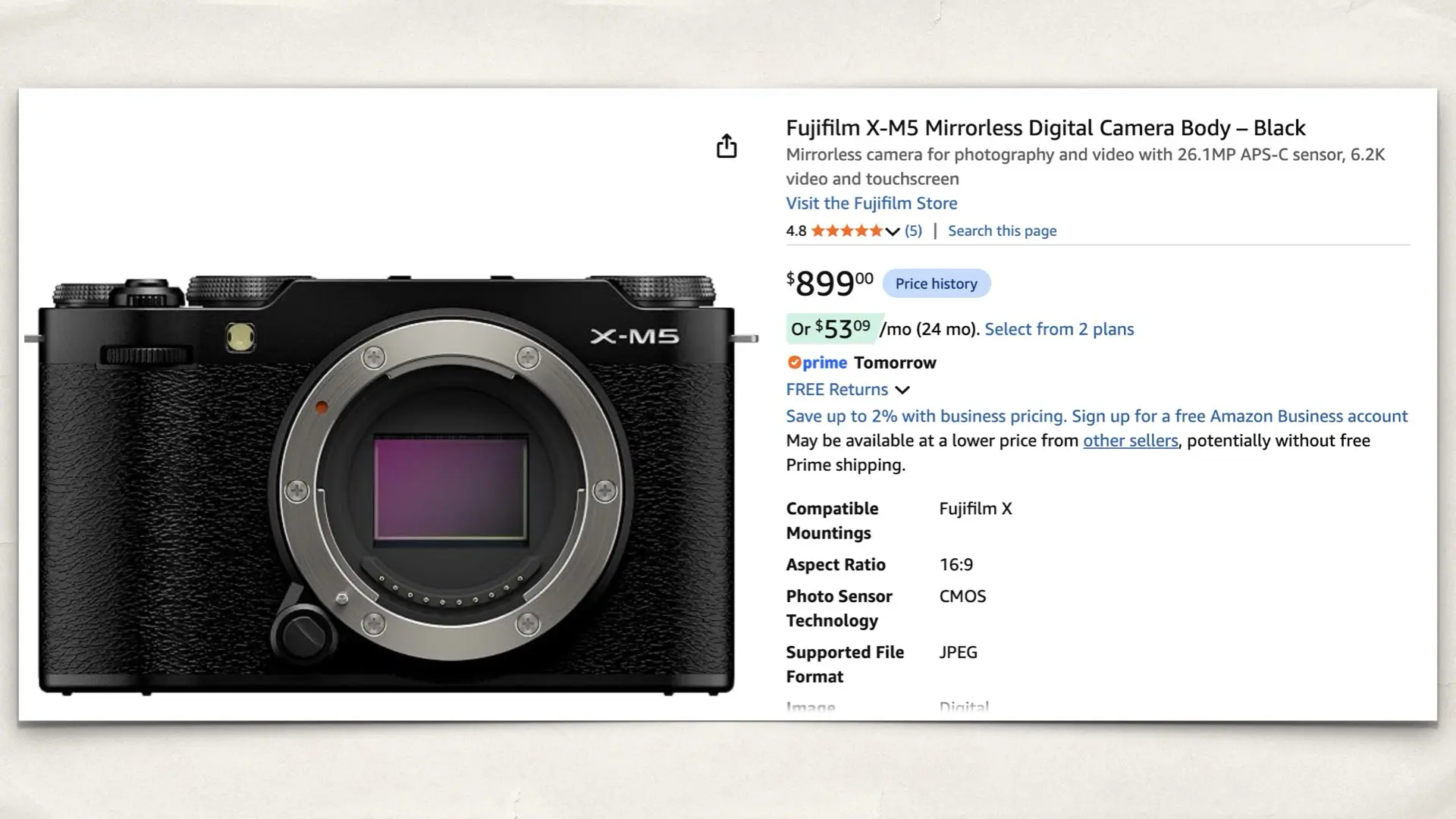
- Fujifilm X-M5
A compact APS-C interchangeable-lens camera aimed at photographers and creators. Fujifilm specifically cited the X-M5 among the models driving strong digital-camera sales.
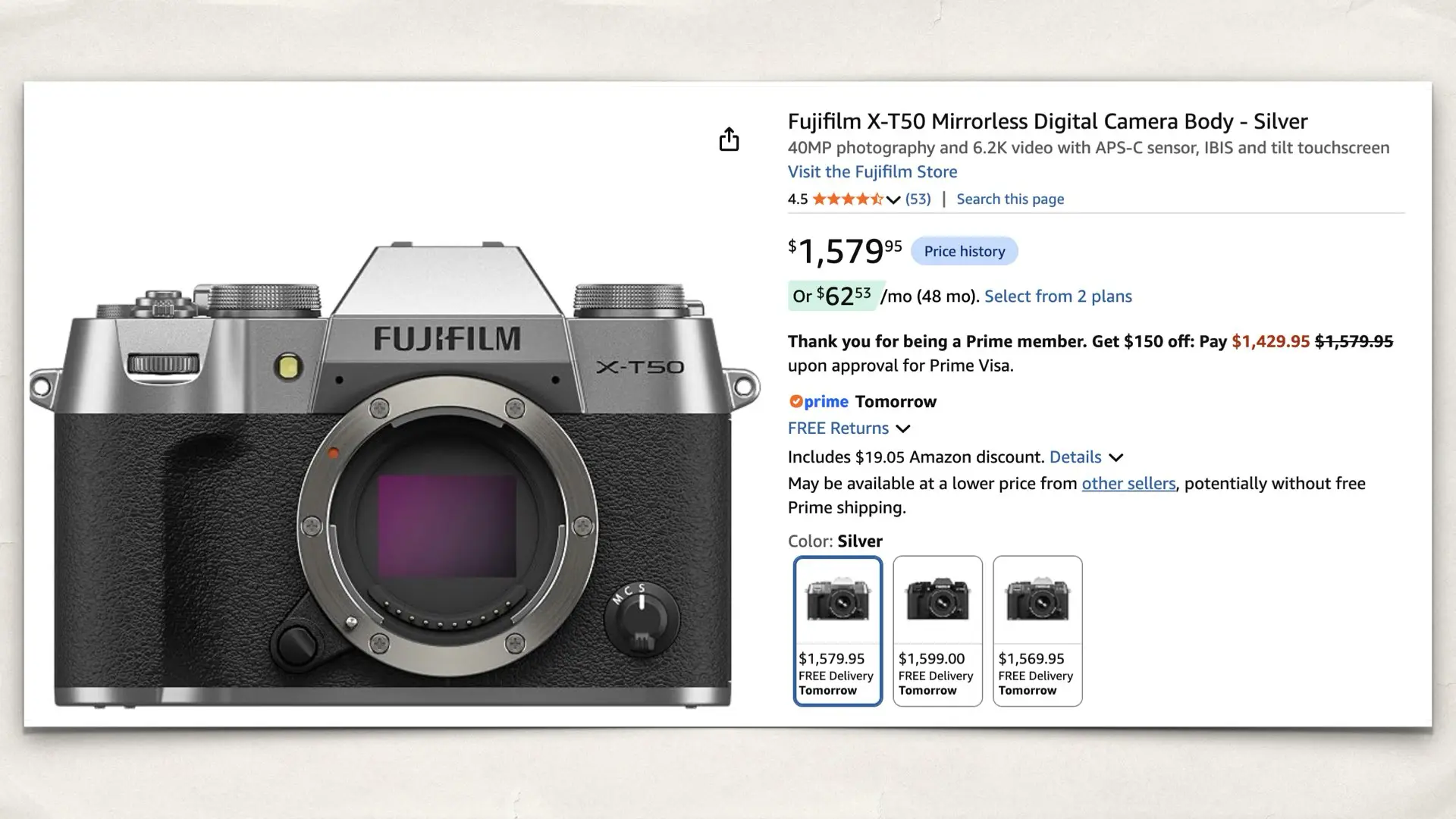
- Fujifilm X-T50
Another important APS-C model in Fujifilm’s 2024 generation. Fujifilm reported robust sales of the X-T50 alongside the X100VI and X-M5.
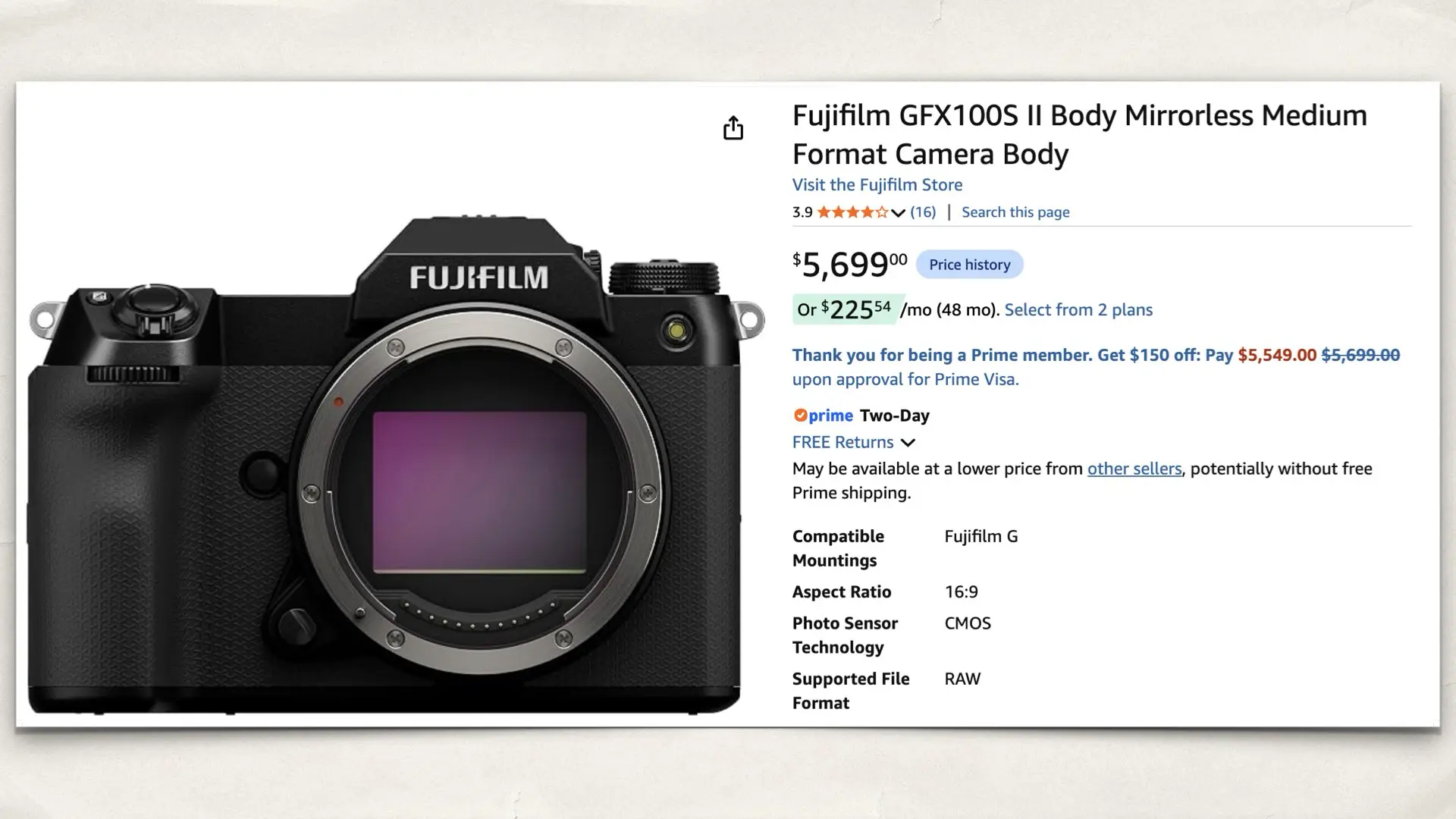
- Fujifilm GFX100S II
Much lower-volume than Fujifilm’s APS-C products, but important at the high end. Fujifilm also identified it as one of the four 2024 models contributing to strong digital-camera sales.
Canon is still playing in another league
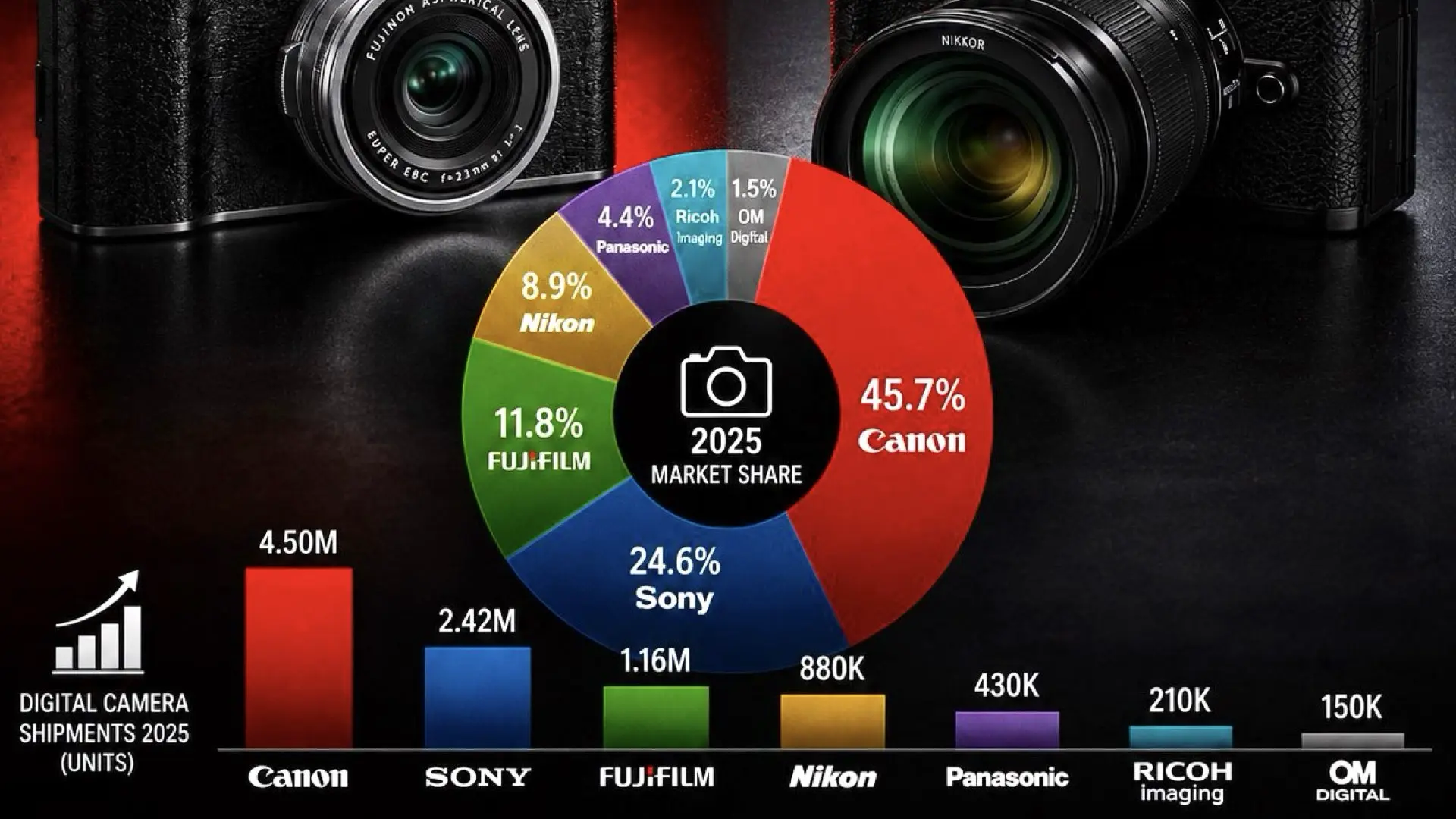
Fujifilm overtaking Nikon is the biggest change in the ranking, but Canon remains by far the largest camera manufacturer by shipment volume. According to the Nikkei figures, Canon shipped approximately 4.5 million cameras in 2025, representing 45.7% of the market covered by the report. Sony remained second with approximately 2.42 million units and 24.6%. The difference is substantial. Canon shipped nearly twice as many cameras as Sony and almost four times as many as Fujifilm. More importantly, Canon itself grew dramatically. Its shipments increased from approximately 3.34 million units in 2023 to 3.53 million in 2024 and 4.5 million in 2025. That means Canon added almost one million annual camera shipments in just one year. The ranking for 2025 is therefore:
- Canon: 4.50 million — 45.7%
- Sony: 2.42 million — 24.6%
- Fujifilm: 1.16 million — 11.8%
- Nikon: 880,000 — 8.9%
- Panasonic: 430,000 — 4.4%
- Ricoh Imaging: 210,000 — 2.1%
- OM Digital: 150,000 — 1.5%
Canon’s position illustrates the value of covering an exceptionally broad range of customers. Its EOS R ecosystem now stretches from accessible APS-C cameras through mainstream full-frame models and into high-end professional bodies. Thus, Fujifilm’s rise should not obscure the other major takeaway from these numbers: Canon has strengthened an already commanding position.
Nikon is becoming more than a still-camera company
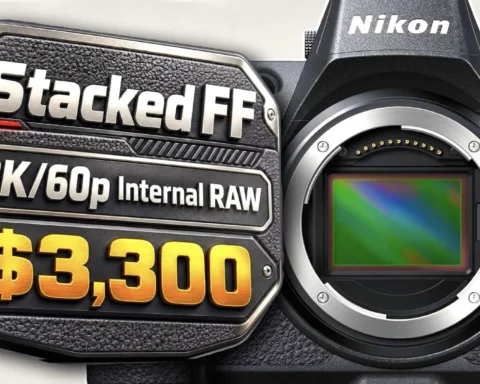
Nikon dropping from third to fourth might initially look like an uncomplicated loss of market position. There is another dimension to consider. Nikon completed its acquisition of RED Digital Cinema in 2024, bringing one of the cinema industry’s best-known camera manufacturers into Nikon Corporation. The first particularly visible product expression of that relationship arrived in September 2025 with the Nikon ZR, the first camera in Nikon’s Z Cinema series developed around technologies from Nikon and RED. The ZR is a compact full-frame cinema camera capable of recording up to 6K/60p, and importantly, it introduced R3D NE, a new RAW recording format based on RED’s R3D technology. Nikon says the format incorporates RED color science and exposure standards to facilitate integration with RED camera workflows. That connection valid when interpreting Nikon’s position in the shipment ranking. The Nikon that competes with Fujifilm in consumer camera unit shipments is now also the company that owns RED and is actively developing products intended for cinema production and professional video. However, selling one high-value cinema camera does not contribute the same unit volume as selling large quantities of compact APS-C cameras, and shipment rankings alone cannot reveal the profitability or strategic value of those products. The ZR therefore provides useful context. Nikon may have fallen behind Fujifilm in overall digital-camera units, but at the same time it is attempting to expand the definition of what the Nikon imaging business can address.

The ZR connects two previously separate camera worlds
The ZR is particularly relevant because it demonstrates that Nikon did not acquire RED simply to operate it as an isolated cinema-camera subsidiary. Technology is already moving between the companies. Nikon contributes its Z mount, autofocus system, stabilization, lens ecosystem and mass-market camera manufacturing expertise. RED contributes its cinema heritage, color science and RAW workflow. The result is a camera carrying the Nikon name but explicitly positioned within a cinema ecosystem influenced by RED. This could ultimately make shipment rankings increasingly difficult to interpret in isolation. Fujifilm, Nikon, Canon and Sony are not necessarily chasing exactly the same customer with exactly the same type of product. Canon has extraordinary scale across consumer and professional imaging. Fujifilm has found significant momentum with APS-C cameras and premium fixed-lens products while maintaining GFX medium format. Sony combines Alpha cameras with a much broader semiconductor and professional-cinema presence. And Nikon is now connecting its Z system to RED Digital Cinema.

Unit shipments tell only part of the story
The most interesting aspect of the 2025 ranking is therefore not simply which manufacturer finished third. It is what the ranking reveals about the changing camera market. Fujifilm increased shipments from 430,000 to 1.16 million units in two years, an increase of approximately 170%. That is an exceptional expansion in a mature hardware category and suggests substantial demand for cameras that do not necessarily follow the industry’s traditional full-frame-first formula. Canon, meanwhile, remains dominant, approaching half of the market represented by the Nikkei numbers. And Nikon, despite slipping to fourth place in unit shipments, is simultaneously moving into an entirely different strategic territory through RED and the Z Cinema platform. The 2025 numbers consequently describe more than a podium change. They show an imaging industry increasingly divided between scale, specialization, experience and professional workflow. Fujifilm’s rise demonstrates that APS-C and compact cameras can still generate significant growth. Canon demonstrates what enormous ecosystem scale looks like. Nikon’s RED strategy suggests that the next competition may not be measured purely by how many conventional cameras each manufacturer ships. And that may ultimately be the more important story behind the numbers.
As an Amazon Associate, Y.M.Cinema earns from qualifying purchases. If you purchase through the Amazon links above, Y.M.Cinema may earn a small commission at no additional cost to you. This helps support our work.
Gear mentioned in this article
Available on Amazon
| Product | New | Renewed | Used |
|---|---|---|---|
| Fujifilm X100VI | $2,098 | — | From $2,070 |
| Fujifilm X-T50 | $1,699 | — | From $1,438.38 |
| Fujifilm X-T5 | $1,999 | — | From $1,539.99 |
| Fujifilm GFX100S II | $5,699 | — | From $5,665.54 |
| Fujifilm X-H2 | $2,799 | — | From $2,300 |
Prices checked: Oct 25, 2026, 1:35 AM GMT+0000
As an Amazon Associate, Y.M.Cinema earns from qualifying purchases. If you buy through our links, we may earn a small commission at no extra cost to you.
Product prices and availability are accurate as of the date/time indicated and are subject to change. Any price and availability information displayed on Amazon.com at the time of purchase will apply to the purchase of this product.
CERTAIN CONTENT THAT APPEARS ON THIS SITE COMES FROM AMAZON. THIS CONTENT IS PROVIDED “AS IS” AND IS SUBJECT TO CHANGE OR REMOVAL AT ANY TIME.








Fuji color science and picture profiles have received a lot of praise over the last few years, so I’m not surprised.
Fujifilm’s Film Simulations and color rendering have become a major part of the brand’s identity, and they clearly help differentiate the X Series in a crowded market.