

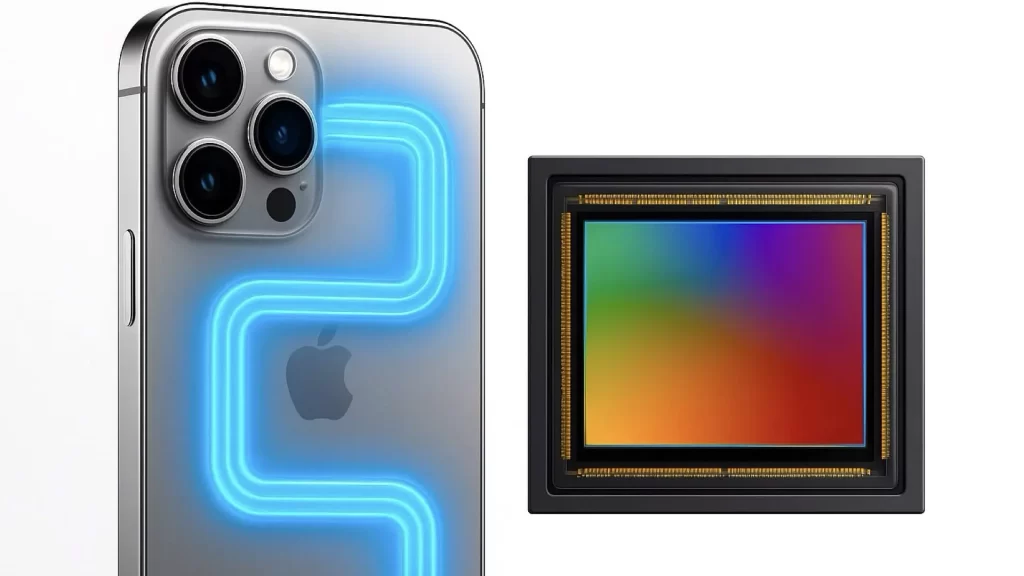
Apple might be quietly preparing one of the biggest advancements in image sensor design — and it could change everything from iPhones to professional cinema tools. Y.M.Cinema Magazine is the first to uncover a newly published Apple patent titled “Image Sensor With Stacked Pixels Having High Dynamic Range And Low Noise”. This revelation points to a breakthrough that could reshape both mobile and professional imaging. With claims of a staggering 20 stops of dynamic range packed into a stacked sensor architecture, Apple might be gearing up to rival — or even surpass — the giants of cinema camera technology.

A Sensor That Could Outperform the Best
A newly published Apple patent titled “Image Sensor With Stacked Pixels Having High Dynamic Range And Low Noise” reveals a major step forward in imaging tech. While Apple is known for its custom chips and camera software, this patent hints at something far more ambitious: a fully in-house image sensor design with the potential to rival or even surpass leading cinema cameras in dynamic range. And we’re not just talking theory — this sensor architecture claims a dynamic range of 120 dB, which translates to nearly 20 stops of range. That’s more than current industry titans like the ARRI ALEXA 35.

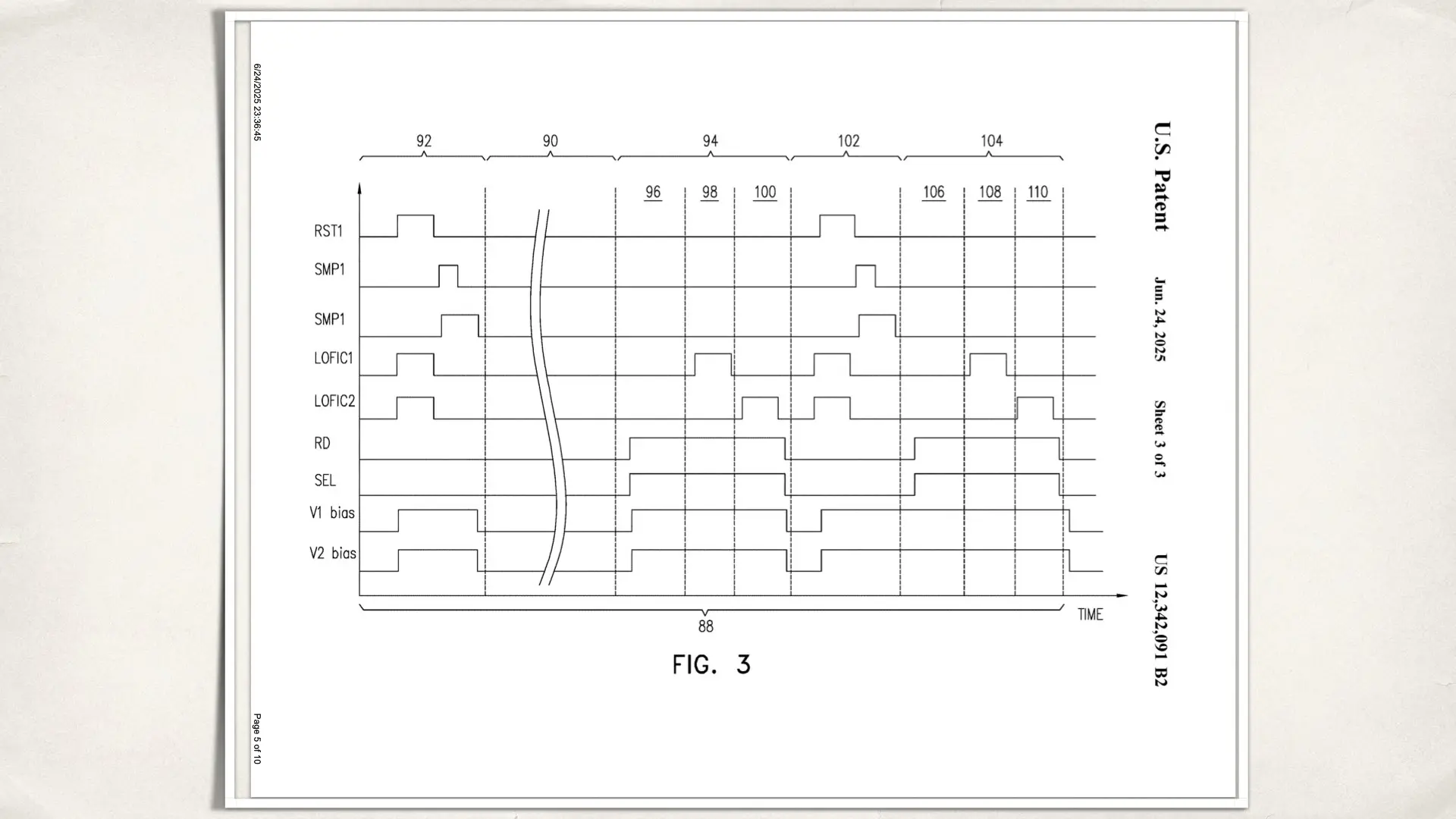
Embodiments of the present invention that are described herein provide image sensors comprising 3T pixels of a novel design that achieves high dynamic range with low noise and without the artifacts that can occur in conventional 4T pixel arrays. The image sensor comprises a sensor die stacked on a logic die. Each 3T pixel comprises a sensing circuit on the sensor die, including a photodiode and a lateral overflow integration capacitor (LOFIC) circuit to enable sensing over a wide range of lighting conditions, from indoors to bright sunlight, without automatic exposure control. In addition, each pixel comprises a pixel circuit on the logic die, which includes a current memory circuit. The current memory circuit is used in sensing the level of noise in the detector element. Signals output by the current memory circuit enable suppression of thermal (kTC) noise using CDS.
-Apple’s new “Image Sensor With Stacked Pixels Having High Dynamic Range And Low Noise” patent
What’s Inside Apple’s Patent?
The patent outlines a stacked sensor composed of two layers:
-
A sensor die (with the photodiodes and analog circuitry)
-
A logic die (handling readout, noise cancellation, and control)
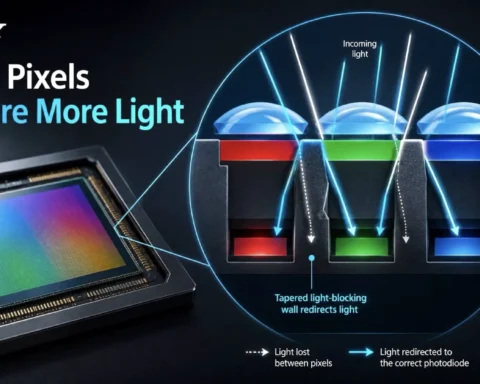
This stacked approach, similar to what Sony has done, allows Apple to pack advanced circuitry into a thinner sensor module — perfect for smartphones and AR/VR gear like Vision Pro. But the real innovation is in the on-pixel architecture, featuring:
LOFIC (Lateral Overflow Integration Capacitor)
This mechanism lets the sensor handle light overflow across three charge storage levels, automatically adapting to extreme brightness or darkness — all in one shot. It’s what allows that 20-stop dynamic range.
Built-in Noise Sensing Circuitry
A current memory circuit within each pixel detects and subtracts thermal noise in real-time, meaning the final image is far cleaner, even in low-light conditions — without requiring post-processing or AI tricks.
3T Pixel Design (Not 4T)
Surprisingly, Apple is using a 3-transistor design, often considered simpler but noisier. However, thanks to the innovations above, this design achieves lower noise than standard 4T sensors, offering performance with fewer components and greater efficiency.

LOFIC circuit 44 in the present example comprises two charge storage capacitors 50, 52 and two LOFIC transistors (LOFIC1 and LOFIC2) 54, 56 coupled in series to floating diffusion node 42. The first LOFIC transistor (LOFIC1) 54 connects the floating diffusion node to the charge input terminal of the first charge storage capacitor 50, which has a small capacitance, for example about 20 fF. The second LOFIC transistor 56 connects the charge input terminal of this first charge storage capacitor 50 to the charge input terminal of the second charge storage capacitor 52, which has a larger capacitance, for example about 500 fF. In this configuration, floating diffusion node 42 itself will be used to store and read out photocharge in low-light conditions; charge storage capacitor 50 will be used to store and read out photocharge in intermediate conditions; and charge storage capacitor 52 will be used to store and read out photocharge in conditions of bright light. This LOFIC configuration enables detector element 26 to sense light over a dynamic range of about 120 dB. Alternatively, other LOFIC configurations may be used, with smaller or larger numbers of capacitors and transistors.
-Apple’s new “Image Sensor With Stacked Pixels Having High Dynamic Range And Low Noise” patent
What This Means for iPhone, Vision Pro, and Beyond
If this tech is implemented — perhaps in a future iPhone 17 Pro ($1,179 on Amazon) or Apple Vision Pro 2 — it could lead to:
-
Cinematic HDR on mobile devices
-
Real-time noise-free video capture
-
Professional-quality imaging in ultra-thin form factors with a very high DR (20-stops of Dynamic Range)
Apple could be preparing to step away from reliance on Sony for high-end camera sensors and enter the image sensor market as a competitor, not just a customer. It also suggests that Apple’s next leap in computational photography may be rooted in image-sensors-first innovation, rather than software or AI.

Why This Is a Big Deal for Filmmakers and Technologists
Dynamic range and noise are the two main limiting factors in digital imaging. A mobile or compact sensor offering 20 stops of dynamic range and advanced on-chip noise suppression is not just an improvement — it’s disruptive.
This could impact:
-
Mobile cinematography
-
HDR streaming content
-
AR/VR visual fidelity
-
Even professional filmmaking kits where compactness and quality must coexist
And since this is Apple, it’s not hard to imagine the company integrating this sensor deeply with Neural Engine processing, making it even more capable under extreme conditions.
Final Takeaway
This patent may fly under the radar for now, but the implications are huge. Apple isn’t just iterating on camera software — it’s redefining the image sensor from the silicon up. And if this tech goes into production, we could be looking at a new gold standard in digital imaging — not just for smartphones, but for cinema itself.
Update (3/7/2025): Apple’s Sensor Patent Adds More Evidence to Cinematic Ambitions
Following the recent revelation by Y.M.Cinema of Apple’s newly patented image sensor capable of capturing 20 stops of dynamic range, it’s becoming increasingly clear that Apple is laying the groundwork for a new era in mobile cinematography. Combined with the active cooling system covered in this report and the soft iris membrane technology discussed here, Apple appears to be strategically assembling core components of a professional-grade mobile imaging system. These developments, when viewed together, suggest that Apple is no longer content with computational photography alone, but is moving toward hardware-first imaging pipelines capable of rivaling cinema-grade cameras in compact form. The convergence of sensor innovation, thermal management, and aperture control could culminate in a future iPhone that genuinely meets the demands of filmmakers and professionals.

Gear mentioned in this article
Available on Amazon
| Product | New | Renewed | Used |
|---|---|---|---|
| iPhone 17 Pro | $1,179 | — | — |
Prices checked: Oct 2, 2026, 1:30 PM GMT+0000
As an Amazon Associate, Y.M.Cinema earns from qualifying purchases. If you buy through our links, we may earn a small commission at no extra cost to you.
Product prices and availability are accurate as of the date/time indicated and are subject to change. Any price and availability information displayed on Amazon.com at the time of purchase will apply to the purchase of this product.
CERTAIN CONTENT THAT APPEARS ON THIS SITE COMES FROM AMAZON. THIS CONTENT IS PROVIDED “AS IS” AND IS SUBJECT TO CHANGE OR REMOVAL AT ANY TIME.









A patent protects the author’s idea. It doesn’t need to be economical, practical, nor is a working prototype required to obtain a patent. Apple may decide this sensor can’t be reliably manufactured. So let’s see what happens with this idea.
You’re absolutely right. A patent doesn’t guarantee a product, and many patents never see commercial light. They’re often strategic: for future use, licensing leverage, or simply to secure IP before anyone else does.
However, what makes this Apple patent particularly noteworthy is its level of technical maturity. It details:
A stacked sensor design
On-pixel noise memory
A proven architecture similar to LOFIC, which Sony already uses in commercial sensors
This suggests Apple is building on existing, manufacturable methods, but with their own hardware control stack. It’s not far-fetched to assume this could land in next-gen iPhones or Vision Pro iterations, especially as Apple continues pulling sensor design in-house.
So yes — it may never reach production… but it’s more than theoretical fluff, and that’s why it deserves attention.
..maybe i’ve overlooked details. anything said about sensor diameter? size is to me the only, but most important fact that could bring significant change finally to the professional market.
The patent does not specify the sensor’s physical size or diameter. That’s pretty typical for early-stage patents, especially from Apple, where form factor is often kept flexible to apply across multiple devices (iPhone, Vision Pro, etc.).
However, based on the stacked architecture and LOFIC-based HDR design, the structure is consistent with mobile-format sensors, not large cinema formats like full-frame or Super 35. The emphasis here is on high dynamic range (20 stops) and on-pixel noise cancellation, which could simulate larger sensor performance — even if the sensor itself remains compact.
That said, if Apple ever does scale this design up to a larger sensor size, that would indeed mark a significant shift toward true professional or even cinema-grade imaging.
At above absolute zero -459.67 °F thermal noise is always there. Excess noise can be reduced but even a plain wire has thermal noise. Op amps are now available with a 120 dB noise floor. But the only to eliminate (Stationary Stochastic — Thermal) Noise is Digital Signal Processing, specifically Homomorphic Deconvolution.
So, I don’t really understand what Apple is doing.
I have to say that I don’t understand. Johnson Noise (thermal noise) is inherent in all electronics and while TI and AD are now offering op amps with 120 dB noise floors, the only way to remove (stationary stochastic) noise from a digital signal remains Digital Signal Processing (Homomorphic Deconvolution). There just isn’t an analog way to eliminate noise. Even a plain wire has Thermal Noise if it is above absolute zero (-459.67 °F).