
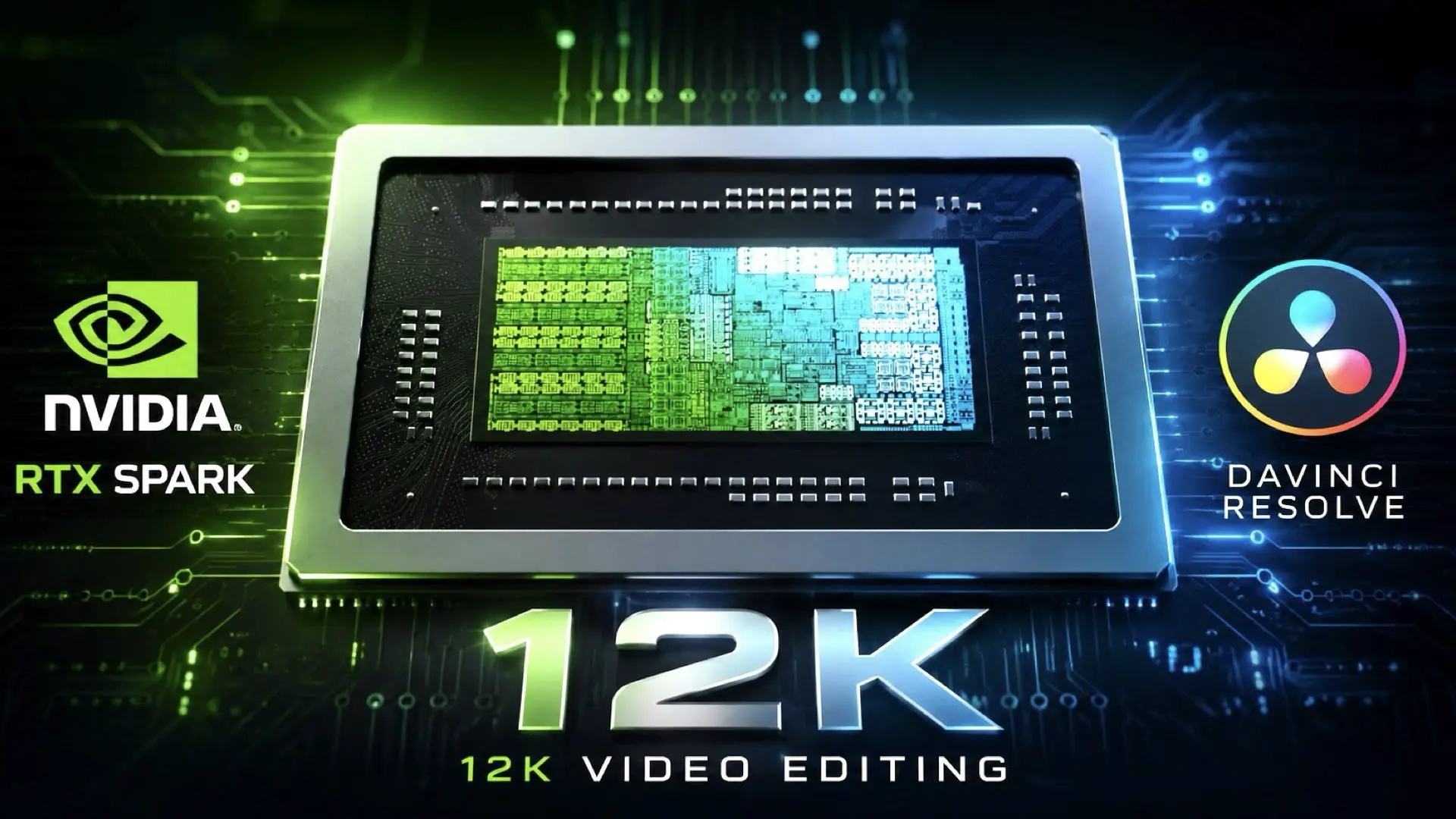
NVIDIA has introduced RTX Spark, a new superchip platform for thin Windows laptops and compact desktops, and the claim aimed at creators is unusually direct: 12K 4:2:2 video editing on a portable machine. For DaVinci Resolve users and Blackmagic camera owners, that line deserves attention. This is not a typical GPU announcement for another generation of gaming laptops. RTX Spark is NVIDIA’s attempt to bring Blackwell RTX graphics, unified memory, local AI, and professional creative workloads into a new class of Windows PCs. The Blackmagic angle is what turns this from a silicon story into a cinema technology story. NVIDIA lists Blackmagic Design among the software companies embracing RTX Spark, and Grant Petty, CEO of Blackmagic Design, is quoted in the announcement saying that Blackmagic Design and NVIDIA have accelerated video production for many years, and that portable RTX Spark laptops could help Blackmagic customers take the next leap in on-the-go production. That does not mean Blackmagic has announced a dedicated DaVinci Resolve optimization for RTX Spark. It does mean Resolve users should watch this platform closely.
What NVIDIA actually announced
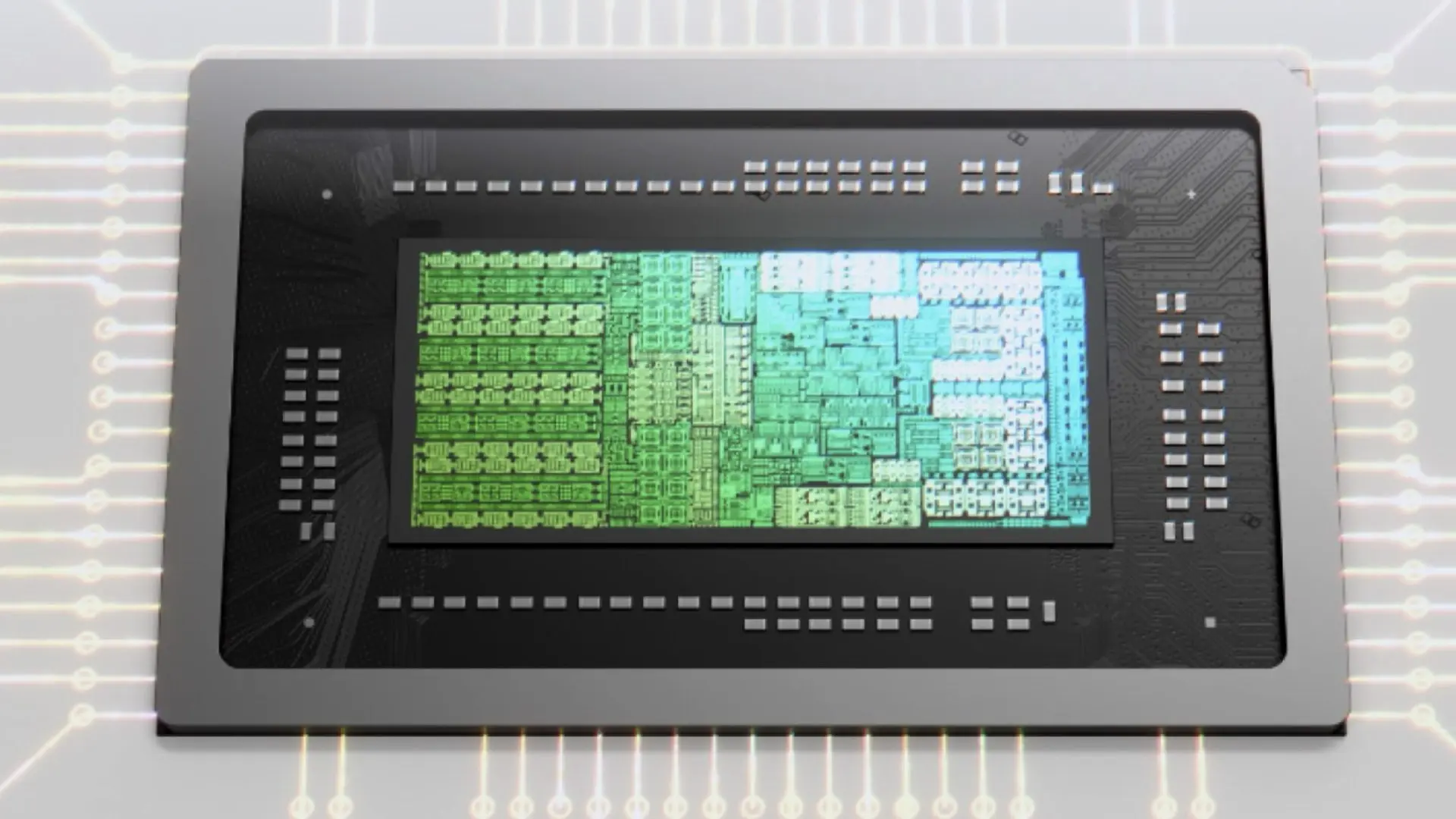
RTX Spark is a new Arm-based Windows PC platform built around a superchip that combines a Blackwell RTX GPU with a 20-core NVIDIA Grace CPU. NVIDIA says the chip includes up to 6,144 CUDA cores, 5th generation Tensor Cores with FP4 precision, up to 1 petaflop of AI compute, and up to 128GB of unified memory. In plain English, NVIDIA is putting CPU, GPU, AI acceleration, and a large shared memory pool into a single platform designed for laptops and small desktop systems. The creative claim is the headline for our readers. NVIDIA says RTX Spark can render very large 90GB plus 3D scenes, edit 12K 4:2:2 video with the NVIDIA Blackwell decoder, generate 4K AI video, run 120 billion parameter local language models with up to 1 million tokens of context, and play AAA games at 1440p with ray tracing. The gaming line will attract mainstream attention, but the 12K video line is the one that speaks directly to professional imaging. These machines are expected to appear as slim Windows laptops and compact desktop PCs. NVIDIA says RTX Spark-powered systems will be available from ASUS, Dell, HP, Lenovo, Microsoft Surface, and MSI, with Acer and GIGABYTE to follow. Microsoft also says RTX Spark will power Windows laptops and small form factor desktop PCs beginning this fall.
Why Blackmagic is part of the story
Blackmagic did not announce RTX Spark. Blackmagic did not say that a specific future version of DaVinci Resolve has been optimized for RTX Spark. NVIDIA’s announcement says that more than 100 Windows software providers, including Blackmagic Design, are embracing the new RTX Spark platform. It also includes Grant Petty’s statement about portable RTX Spark laptops and Blackmagic customers. That is enough to make the connection editorially meaningful, especially because DaVinci Resolve is already one of the most GPU-dependent post-production applications in the industry. Resolve is no longer a simple editing tool. It is a full post-production environment for editing, color grading, Fusion compositing, Fairlight audio, finishing, delivery, and AI-assisted workflows. Many of its most demanding features rely heavily on GPU performance, memory bandwidth, codec support, and system stability. Microsoft adds another important detail: DaVinci Resolve already runs natively on Arm today. In its RTX Spark Windows announcement, Microsoft names DaVinci Resolve among creative tools that run natively on Arm, alongside apps such as Blender, Maxon Cinema4D, Redshift, Topaz Photo, CapCut, Cubase, Bitwig Studio, and Affinity by Canva. That does not confirm RTX Spark-specific Resolve optimization, but it removes a major compatibility question from the discussion.
The 12K claim hits Blackmagic territory
The reason this story feels especially relevant to Blackmagic users is resolution. Blackmagic has spent years pushing high-resolution acquisition into price points that were once unthinkable. URSA Mini Pro 12K started that. URSA Cine 12K LF and URSA Cine 17K 65 pushed it further into large format and ultra high resolution territory. PYXIS 12K brought 12K capture into a compact box-style camera body. Those cameras create a practical problem. Capture is only half of the workflow. Once filmmakers record very high-resolution footage, they need to offload it, review it, create proxies, grade it, conform it, and finish it. That process often depends on desktop-class hardware, fast storage, GPU memory, codec acceleration, and optimized software. If RTX Spark can bring credible 12K timeline performance into thin laptops, it could change expectations for DITs, editors, colorists, and small production teams working away from a dedicated post facility. The important caveat is that NVIDIA’s 12K 4:2:2 claim does not automatically mean every BRAW, REDCODE, ProRes, OpenEXR, Fusion, noise reduction, and multi-node grade workflow will run smoothly. Real-world performance depends on the codec, bit depth, debayer settings, timeline resolution, effects stack, storage speed, thermals, driver maturity, and Resolve implementation. A demo-friendly 12K playback claim is one thing. A full Resolve project with camera originals, temporal noise reduction, Fusion effects, OFX plugins, external monitors, and color management is another.

Why unified memory could be important for post-production
The most interesting part of RTX Spark may be the unified memory design. Traditional Windows workstations often separate system memory from GPU memory. That works well in many setups, but very large projects can become constrained by how much VRAM the GPU has available. RTX Spark’s unified memory design gives the CPU and GPU access to a large shared memory pool, up to 128GB according to NVIDIA and Microsoft. Microsoft says it has improved how Windows supports unified memory systems, including a higher and smarter limit on total system memory accessible by the GPU. The company says this can help load larger local AI models or render more complex projects. For editors, this is relevant because modern post-production is becoming memory-hungry in multiple directions at once: higher resolution video, larger RAW workflows, AI tools, heavier color pipelines, 3D scenes, neural processing, and background analysis. This is where RTX Spark starts to resemble a broader shift rather than a single product launch. Apple has already trained many editors to understand the value of unified memory in portable computers. NVIDIA is now trying to bring a version of that logic into the Windows ecosystem, with CUDA, RTX, TensorRT, OptiX, and Blackwell decode capabilities attached. For Resolve users, that combination could be very attractive, provided Blackmagic and NVIDIA deliver reliable support in shipping hardware.

Local AI is becoming part of the editing machine
NVIDIA’s larger RTX Spark pitch is built around personal AI agents running locally. That part may sound distant from cinema production, but it connects directly to where editing software is going. Resolve already includes AI-assisted tools such as Magic Mask, object isolation, transcription, facial recognition, smart reframing, voice isolation, Super Scale, speed processing, relighting tools, and other GPU-assisted features depending on version and configuration. As these tools become more ambitious, the editing machine becomes an inference machine as much as a playback machine. A future Resolve workstation will need to decode high-resolution camera footage, manage color pipelines, process effects, and run local AI models at the same time. RTX Spark is designed for that convergence. The promise is a laptop that can handle media creation and AI workloads locally, reducing dependence on cloud processing and making on-location work more practical. That does not mean the editor disappears. It means the computer becomes more capable of handling background analysis, search, masking, enhancement, transcription, cleanup, and generative assistance without sending every task away from the machine. For documentary editors, commercial teams, YouTubers, DITs, and independent filmmakers, local AI performance could become as important as export speed.
The compatibility question for DaVinci Resolve
This is the part that needs careful wording. DaVinci Resolve already runs natively on Arm, according to Microsoft. Blackmagic Design is named by NVIDIA as one of the companies embracing RTX Spark. Grant Petty is quoted in NVIDIA’s announcement. Those facts make it reasonable to expect that Blackmagic is paying attention to RTX Spark compatibility. However, there is no public confirmation yet of a dedicated RTX Spark-optimized Resolve update. The smarter way to read the announcement is this: RTX Spark gives Blackmagic a new Windows on Arm hardware platform that appears designed for exactly the kind of high resolution and AI-assisted workflows Resolve serves. If the platform gains traction among creator laptops, Blackmagic will likely need to treat it as a serious Resolve target. The first serious tests should focus on BRAW 12K, BRAW 17K proxies, multi-stream editing, temporal noise reduction, Fusion, color grading with complex node trees, external monitoring, and sustained performance after 30 minutes of load.
Initial thoughts
NVIDIA is entering a space that has become increasingly important for filmmakers: powerful portable post-production. The announcement combines 3 ideas that are shaping the next phase of cinema technology. Higher resolution acquisition, AI-assisted editing, and mobile workstations with large unified memory. For our readers, the Blackmagic connection gives the story its weight. Blackmagic has made high-resolution acquisition more accessible, and DaVinci Resolve has become one of the most complete post-production platforms available. If RTX Spark laptops can genuinely handle 12K class workflows in a thin Windows machine, Resolve users may have a new category of hardware to consider. Will it succeed? We will be able to confirm that only in a real post-production environment!










Hi mate. It needs to be a lot more. I’ve got a reputation of being years ahead towards where the industry is headed in quality technology. Manufacturers have a reputation for getting it wrong on the meantime.
I am recommending 1 Terabyte+ sized models and machine configurations with 1TB+ AI primary highspeed DRAM, just so the machines have enough contextual knowledge of the intricacies of the real world to spot mistakes and present a true sound consistant quality representation of it. Extra menory over the model to track, keep and use the context are needed for consitent quality result over time of the session/sequence etc. No such consumer machines exists. Apple may have a configuration comming in the mac studio line up, but it is not the RTX based standard, and the ram crises may slow that introduction. This means that a commercial service from a server farm is needed, but also means others can potentially hack into your content to see or corrupt as you make it. For the big studios, that is not a problem, they can arrange a localised AI server rack tower and keep everything off the internet, and fund experts to use it (one or more experts and one or more artist teams). For the rest of us, there is no real localised options. There is advancement in splitting AI over GPU and slow main memory and parrallel systems, but these operate slowly and thats just on text cat. If you had to get the AI to verify quality of context of the visual sequence to do it well at the same time, I have no reference as to how slow that would go. The industry needs to pay to research and develop an opensourced system and standard for this. The studios need to continue independent supply to them of new talent and content, and should fund tĥis. Otherwise AI will continue to deliver little enhancement, or very poorly on larger work. Waferscale and Apple AI hardware may be worth exploring. But there are faster non GPU hardware developments in the works. Jim Keller has a company, but still for mickey mouse sized models, unless you massively parrallel them. My own effort to drum up interest in my old 1TB+ low energy low cost ($1000+) wafer design proposal went nowhere, and Apple is likely to have a relatively medium priced product before it could be done id started now, and the design was aimed at being medium performance on a truely large model. It could be sped up, but will raise the heat and energy required. The only other option is magnetic quantum cellular automata (MQCA) technology, which I had a internal proposal for a mechanism to get to 4Thz and is the lowest energy. A research team had a similar system they were working on to get to 4Thz a few years back, but that all went silent and I can not find a reference to it any longer. Which means it would be under national secrecy orders, and likely acquired by the military. But, the studio system could lobby for access to it. An entire server farm could be reduced to a single tower at 1 mw+ or -, when made into a 3D circuite (they were proposed at 1 millions times less energy decades ago, almost on the maximum theoretical energy efficiency for physics. How that goes at 4Thz, I don’t know. There was another researcher doing a custom magnetic processing technology, proposing 10x faster than that again (which fits my estimates from a few decades ago I was planning after doing MQCA. But they are fractional performance compared to some options.
I have made countless technology suggestions to Red, the Alexa sensor designer and BM over the decades. Some implemented to good success, some doing their own alternative version of it. What we need is 8K cameras with bayer, rgbw, or random etc colorfilter pattern cheap to do 4K (or using a 3 to 7+ colour light pickup, such as foveon is known for and developing a new sensor for. Which can deliver Alexa beating colour and image when done right, as i was hoping to eventually do). I specified on how this could be used for quality post digital zoom and reframing, with the 4K image derived from the 8k from memory, using a shift and split for dealaising. To get rid of the low pass filter. A 16k large imax format version for 4k, 8k and 16K delivery. 32K, is the next level. I have expressed desirability for colour filters like this before the BM sensor pattern. Too many clear pixels do not help in colour. When we were trying to revolutionise the industry, 1970’s negative film look of cmos sensors was meant to be a stepping stone, not the base. The best colour rendering of the late 1990’s/2000’s film stock was meant to be the base objective. Alexa reached that. Now, 16 stop+ 16-bit was my proposal, for good image and gradability, able to relight and strech and compress the highlights, shadows and in-between around, even on different curves. Real creative control to produce interesting looks. Not muck under a theoretical muddy water screen filter look we have seen on some cmos sensor films. Alexa and Red, now have some interesting looks.
Webmasters note: This edit comment form has an advertising video floating over it. I rarely come due to all the advertising videos etc, getting in the road.